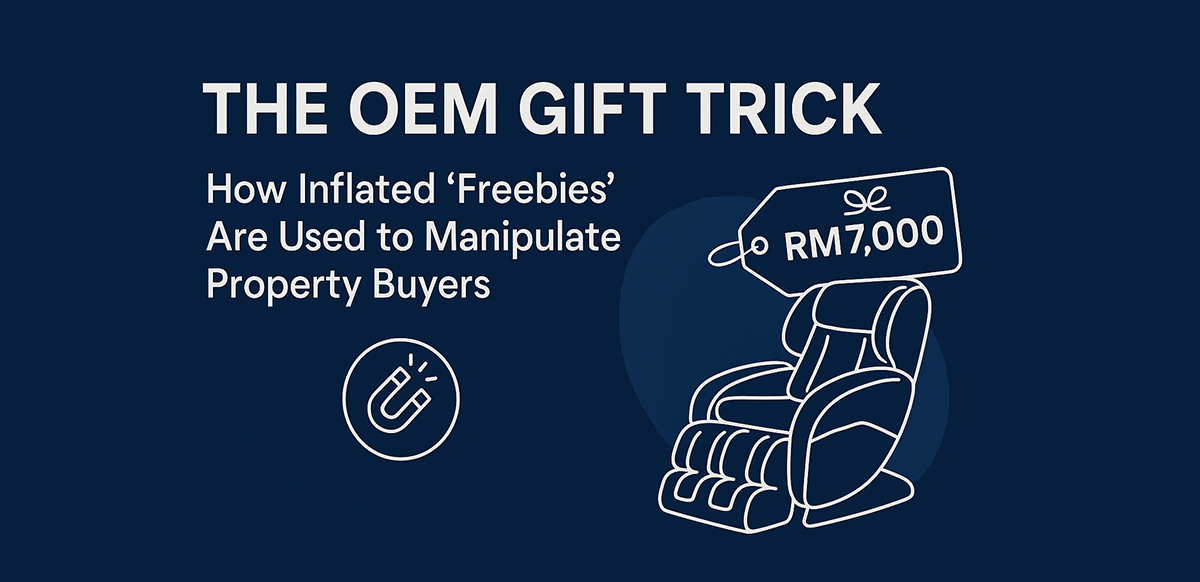
Inflated freebies can distort buyer perception and hide the real property price. Agents should help buyers separate genuine value from marketing tricks.
In the competitive world of real estate, agents are constantly looking for an edge. But a common marketing tactic—offering "free gifts"—has evolved into a form of psychological manipulation that misleads buyers and damages industry professionalism.
This is the "OEM Gift Trick," a strategy where low-cost, factory-direct products are presented with a wildly inflated "retail price" to create an illusion of massive value.
The strategy is simple but powerfully deceptive.
The Commission: An agent closes a significant deal, earning a commission (e.g., RM18,000 from a subsale or RM30,000+ from a new project).
The "Gift": Instead of offering a cash rebate—which is traceable, taxable, and often violates agency or developer policies—the agent sources an Original Equipment Manufacturer (OEM) product. This could be a massage chair, air purifier, or smart lock bought directly from a factory.
The Inflation: The agent's real, all-in cost for the item might be RM1,000. However, the product is packaged and marketed with a fake "Recommended Retail Price" (RRP) of RM7,000.
The Pitch: The gift is presented to the buyer as a high-value bonus for closing the deal through that specific agent.
The result is a profound gap in perception:
The Buyer's View: "Wow, I'm getting a RM7,000 luxury gift for free. This agent is so generous!"
The Agent's Reality: "I spent RM1,000 of my RM30,000 commission to close this deal."
This isn't generosity; it's psychological arbitrage.
This trick works by exploiting basic human psychology, not by offering real value.
This strategy is deployed at both the individual and agency level.
At the Personal Agent Level: It's the core of their pitch on social media. "Other agents just take a commission; I give back to my clients. Buy this unit through me and I'll sponsor a RM7,000 smart-home package!"
At the Agency/Showroom Level: It's used as a large-scale lead magnet. "Visit our showroom this weekend and stand to win a RM7,000 luxury massage chair!" In reality, the agency buys five units for RM5,000, not RM35,000, creating massive perceived value for a minimal marketing cost.
While it may seem like a harmless sales gimmick, this practice is deeply problematic.
| Problem Area | Description |
|---|---|
| Misleading Marketing | The core of the issue. The "RM7,000 value" is a fabricated statement designed to deceive. |
| Unfair Competition | It penalizes ethical agents. An honest agent offering a genuine RM1,500 cash discount looks "cheap" next to a dishonest agent offering a "fake" RM7,000 gift. |
| Legal & Tax Risk | Disguising rebates as gifts can be a "grey area" for tax evasion (unaccounted costs) and potential breaches of Act 242 (disguised inducements). |
| Erosion of Trust | It turns a professional financial transaction into a "pasar malam" (night market) culture. When buyers eventually discover the item's true cost, it burns their trust in the agent and the industry. |
Buyers fall for this because of a simple information gap. They don't know how easy and cheap China-direct or OEM sourcing is. They trust the "retail price" because they assume an agent wouldn't—or couldn't—fabricate it so boldly.
A professional reputation cannot be built on deception. The ethical alternative is not to stop giving back, but to do so with transparency.
This is not "value-add." It is "value-illusion." If agents want to build sustainable careers and be seen as trusted advisors, they must replace illusions of savings with concrete proof of value.

Founder of ListingMine and author of Agent for Life. Building ERP for Malaysian real estate agencies since 2008 — and writing to reshape how agencies grow.
More about Marvin Foong →More articles in this topic
This article is one of the sources behind these assessments. Take one to see what you already know and what to read next.
Educational self-assessment. Not a licensing examination or professional certification.