Weekly performance debriefs create accountability, learning, and early problem detection. Structured review prevents teams from drifting into chaos.
Most Malaysian real estate agencies operate reactively. They only pay attention when revenue drops, when agents complain, or when the branch begins to lose momentum.
By then, it is already too late.
A professional real estate office does not manage crises. It manages through rhythm.
That rhythm is created through The Performance Debrief System.
This system is the weekly operational checkpoint that keeps agents accountable, gives leaders visibility, and prevents small issues from becoming major failures. Without it, no branch—no matter how talented the agents—can maintain consistent performance.
The Performance Debrief System is not a meeting. It is a management structure. It is the backbone of predictable agency operations.
Real estate performance is volatile by nature. But volatility is not the main problem. The real problem is lack of visibility.
Most branches cannot answer:
Why did revenue drop last month?
Why did the viewing volume collapse?
Why did buyer flow disappear?
Why did the team become unproductive?
Without visibility, leaders rely on gut feeling. Agents get away with inconsistency. Branches drift without direction.
A Performance Debrief System turns invisible issues into visible metrics. It prevents surprises. It stabilises growth. It is the difference between "hoping for a good month" and "engineering a good month."
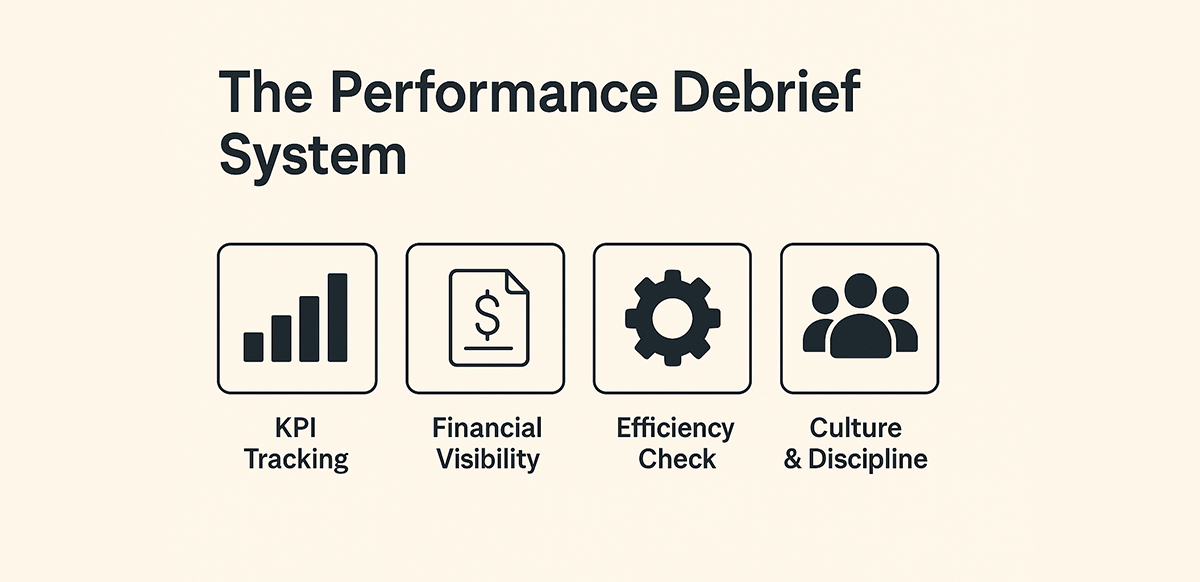
This is not a casual chat. It is a structured review covering five specific dimensions. This structure ensures that leaders do not only look at revenue but see the early indicators that predict revenue stability.
1. KPI Movement (The Early Warning System)
Revenue is a lagging indicator. KPIs are leading indicators. Every week, the branch monitors:
This is where leaders detect market cooling or agent burnout weeks before the bank account is affected.
ListingMine Role: Consolidates these KPIs automatically using real-time status trails, preventing data manipulation or guessing.
2. Financial Health (Beyond Just Sales)
The health of the branch is not defined by closings alone. Weekly financial visibility includes:
Agencies that only review finances monthly are always behind. Financial debriefing must be weekly.
ListingMine Role: Centralises expenses, advertising spend, and deal projections—giving branch managers operational awareness instead of surprises.
3. Focus Work Progress (Strategy to Execution)
Every branch has priority tasks that determine growth: building launches, agent onboarding, marketing cycles, and neighbourhood dominance plans.
Without a debrief, these tasks drift. With a debrief, they progress. This is where the manager confirms:
What was supposed to be done?
What was actually done?
What needs escalation?
ListingMine Role: Allows managers to assign, track, timestamp, and follow up every task with zero ambiguity.
4. Efficiency and Quality (The Silent Leaks)
This is where most branches silently leak money. Even a hardworking team will fail if efficiency is low.
Efficiency: Response times, follow-up duration, CRM hygiene.
Quality: Listing data accuracy, photo standards, viewing experiences.
Branches rise or fall based on efficiency and quality far more than they realise.
ListingMine Role: Captures timestamped actions, enabling leaders to detect bottlenecks in minutes instead of guessing for months.
5. Culture and Discipline (Behavior, Not Motivation)
This is not about "pep talks." It is about professional standards.
Attendance and punctuality.
Cooperation and lead sharing.
Evidence of teamwork.
Branches with great culture outperform branches with great talent.
ListingMine Role: Adds fairness by ensuring all records are evidence-based, not opinion-based.
A monthly debrief is too slow. By the time problems are discovered, the month is lost.
Debriefs must be weekly.
Weekly meetings transform the branch into a performance-driven environment where improvement is continuous, not accidental. (In high-growth branches, a micro-debrief every 3 days is often used to maintain velocity).
| Normal Agency Meeting | The Performance Debrief System |
|---|---|
| Talks about feelings | Uses real numbers |
| Focuses on complaints | Identifies root causes |
| Turns into storytelling | Assigns ownership |
| Lacks accountability | Tracks progress |
| Result: Talk | Result: Improvement |
ListingMine ERP is built around the principle that performance cannot improve without visibility. The ERP supports the Debrief System by:
When the upcoming ACN framework is added, the system will also track:
Role-based contributions.
Agent-to-agent collaboration activity.
Fair commission allocation.
The Debrief System becomes a multi-layer performance engine, not just a meeting.
A real estate branch does not collapse suddenly. It collapses gradually, silently, week by week.
The Performance Debrief System prevents the decline and creates a culture of continuous progress.
Market Share Management determines where you compete.
The Performance Debrief System determines whether you win consistently.
Together with ListingMine ERP and the upcoming ACN network, agencies can build the kind of operational discipline that scales from one office to ten, and from ten to nationwide.

Founder of ListingMine and author of Agent for Life. Building ERP for Malaysian real estate agencies since 2008 — and writing to reshape how agencies grow.
More about Marvin Foong →More articles in this topic
This article is one of the sources behind this assessment. Take it to see what you already know and what to read next.
Educational self-assessment. Not a licensing examination or professional certification.