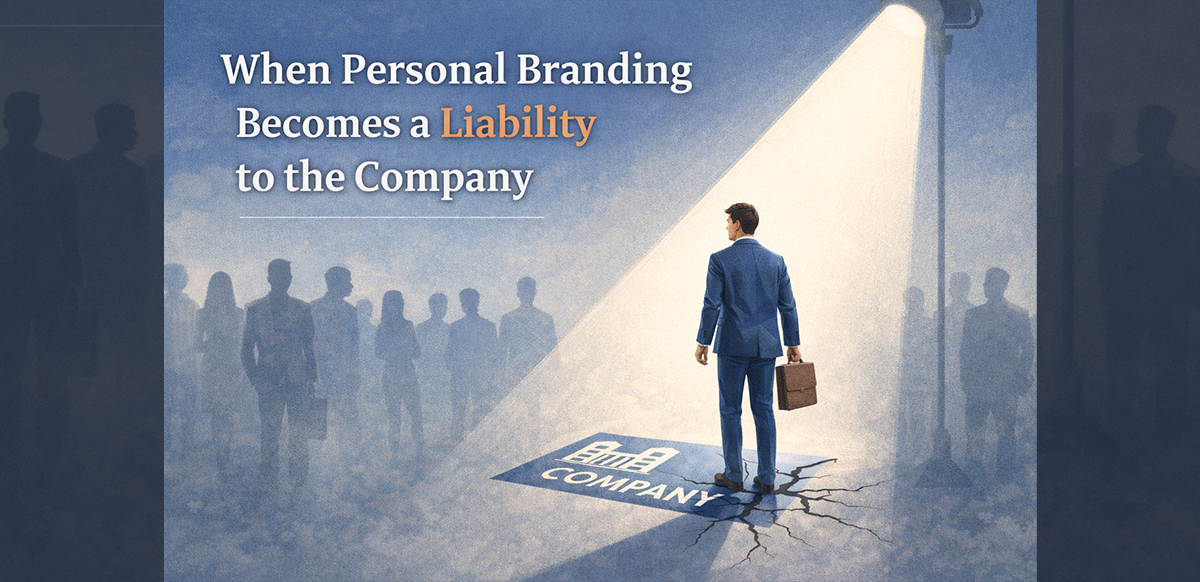
Personal branding can become dangerous when an agent’s audience, loyalty, or influence exceeds the agency’s control. Agencies need a framework to benefit from personal brands without becoming dependent on them.
Personal branding is not the problem. Misuse is.
In every agency, personal branding is necessary. It builds trust, attracts clients, and creates momentum. Senior agents and team leaders rely on it for good reason.
But there is a point—often invisible—where personal branding stops creating value for the organisation and starts quietly eroding it. This article is about identifying that boundary.
Personal branding exists to accelerate trust. It differentiates one agent from another and helps clients feel safe with a specific person.
Used correctly, it is a multiplier:
There is no argument here.
The Shift Personal branding becomes a liability not when it is strong, but when it becomes structurally dominant. It happens when the "Face" of the business attempts to become the "System" of the business.
Personal branding starts harming the company when these four patterns emerge:
Trust Becomes Non-Transferable (The Single Point of Failure)
This is not excellence. It is risk concentration.
The Privatisation of Intelligence
The company pays the cost of the experience—but the agent owns the asset.
Public Positioning Contradicts Internal Standards
The agent's marketing promises special treatment, unique exceptions, or "I'll handle everything personally."
Meanwhile, the organisation is trying to standardise processes and enable team handovers.
This creates silent friction. The marketing is fighting the operations.
Ambiguous Authority
The organisation loses its centre of gravity.
In almost every case, this happens unintentionally. Strong agents are simply optimising for results. They respond to market signals and do what works fastest.
If the system does not clearly define boundaries, personal branding will naturally expand to fill the vacuum. This is not ego. It is optimisation under unclear constraints.
This misuse hurts agents too—though not immediately. Over time:
The brand becomes strong—but heavy. What once felt like freedom becomes an obligation.
To fix this, we must define the lanes clearly.
Personal Branding answers: "Why should you work with me?"
Company Branding answers: "How does this organisation function?"
When personal branding attracts trust → Good. When personal branding replaces structure → Dangerous.
The distinction is not about visibility. It is about Role Clarity.
Ask yourself honestly:
If the system collapses without you, your personal branding is doing too much work.
Personal branding is a tool. Like any powerful tool, it needs boundaries.
Used correctly, it multiplies value. Used without structure, it concentrates risk.
When personal branding becomes a liability, it is not because the agent is too strong. It is because the system underneath is too weak.
Fix the system, and personal branding returns to what it was always meant to be: a force for growth, not fragility.

Founder of ListingMine and author of Agent for Life. Building ERP for Malaysian real estate agencies since 2008 — and writing to reshape how agencies grow.
More about Marvin Foong →More articles in this topic
This article is one of the sources behind this assessment. Take it to see what you already know and what to read next.
Educational self-assessment. Not a licensing examination or professional certification.