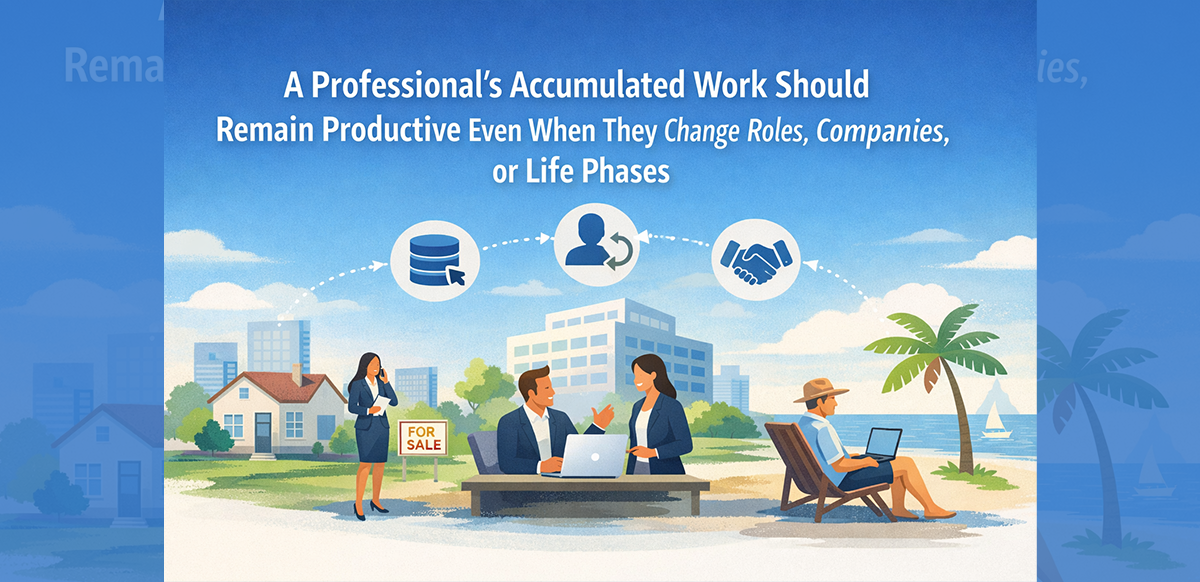
A professional’s listings, relationships, notes, and market knowledge should remain useful beyond one job or company. Career value should be portable across different roles, agencies, and life stages.
Most software products are built around companies. Some are built around transactions. Very few are built around people. The ListingMine model starts from a premise most systems never question:
A professional’s accumulated work should remain productive even when they change roles, companies, or life phases.
At first glance, this sounds reasonable — almost obvious. But once examined closely, it becomes clear why this idea is globally rare. Not because it is technically difficult. But because it breaks how power, control, and monetisation are usually designed.
Almost every professional system in the world embeds a silent rule:
Your value exists only as long as you remain inside the organisation.
This assumption is rarely stated, but it governs everything. When a professional leaves:
This is not a technical limitation. It is an architectural choice — one that prioritises organisational control over human continuity.
1. Most platforms depend on captivity, not continuity
Lock-in is not an accident. It is the business model. Most professional platforms are designed so that:
A system that allows accumulated work to remain productive after exit undermines this logic completely. It replaces fear-based retention with voluntary participation — something most platforms are not built to tolerate.
2. Lifecycle support is usually fragmented across companies
Even when lifecycle support exists, it is almost always split across vendors:
Each system captures a moment. None preserve the whole career. The ListingMine model does something structurally different. It maintains:
This idea only matters if it is concrete.
Here is what it looks like in practice:
In most systems, these transitions destroy value. In the ListingMine model, they preserve it.
Beike
Beike is structurally impressive and often cited as the gold standard of scale.
It succeeds at:
Where it stops short:
Beike optimises the organisation. It does not preserve the individual.
eXp Realty
eXp improves mobility relative to traditional brokerages.
It enables:
But:
Mobility exists — permanence does not.
These are world-class lifecycle systems — for companies. They manage:
They do not model:
They optimise business continuity, not professional continuity.
MLS preserves listings. It does not preserve people.
The rarest part of the ListingMine model is not:
Those are implementations.
The rare part is the stance:
Work done by a professional should continue to compound — even when life changes.
Changing agency. Becoming a team leader. Starting an agency. Taking a break. Exiting the industry. Returning later.
These are not failures. They are valid states. Most systems pretend they do not exist.
ListingMine is not:
Those labels describe features, not intent.
At its core, ListingMine is career infrastructure.
A neutral system where:
The closest analogies are not proptech platforms, but:
Tools that remain useful regardless of where — or whether — you are employed.
When accumulated work remains productive:
This is how industries mature. Not through more rules. But through better architecture.
Most systems ask:
How do we keep users inside?
The ListingMine model asks a harder question:
How do we ensure a professional’s work keeps working — even when life changes?
Most systems are built to own the agent. We built a system that allows the agent to own the future.
That question is rare. Globally. And once asked, it permanently changes what a system must become.

Founder of ListingMine and author of Agent for Life. Building ERP for Malaysian real estate agencies since 2008 — and writing to reshape how agencies grow.
More about Marvin Foong →More articles in this topic