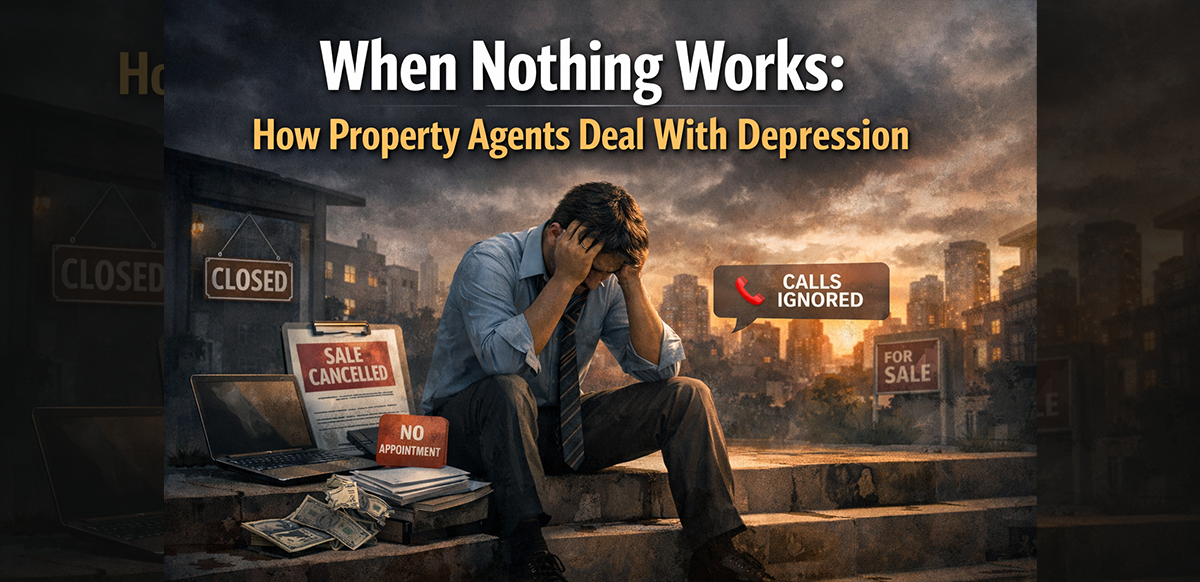
Property agents can face emotional lows when income, rejection, and uncertainty pile up. Support, rest, honest reflection, and practical restructuring are needed when motivation collapses.
There will be seasons when the engine simply stalls.
Cases get aborted at the lawyer's desk for no reason. Appointments convert into "I'll think about it." Messages stay on Read for days. You spend on ads, petrol, tolls, and food—yet your bank account only moves in one direction: down.
The most dangerous part of this phase isn't the lack of income; it's the arrival of a specific, corrosive question: "Am I just not cut out for this?"
When you are tired and financially pressured, you tend to make identity decisions based on structural problems. You feel like you are failing, but you are actually just experiencing the friction of a non-linear system.
In most professions, effort and reward have a visible, linear link. In real estate, that link is severed.
You can work 14-hour days—following up, attending viewings, and preparing documents—and still close zero deals. Unlike a salaried job, there is no supervisor or paycheck to tell you that you are on the right track.
Silence becomes the only feedback.
Silence eventually mutates into self-doubt.
Self-doubt leads to premature exit.
The industry is emotionally brutal because it lacks a constant feedback loop. You are operating in a probabilistic system where you can do everything right and still get the "wrong" outcome for months at a time.
A bad month is rarely a reflection of your talent. It is usually a reflection of Lagging Indicators. The results you see today are often the fruit of seeds planted (or not planted) three to six months ago.
A slump usually indicates one of three things:
You are currently judging your entire future while stressed and exhausted. This is the worst possible state to make a pivot or an identity decision.
If you feel "depressed" despite working hard, it doesn't mean you are weak. It means your effort is real, but your expectations are misaligned with the current market cycle.
Quitting during a depressed phase isn't a failure—but staying long enough to redesign your system is how high-level competence is born.
You are not broken. You are early, you are tired, and you are currently under-calibrated.
Rest, recalibrate, and continue. One good month later, you will barely recognize the version of you that almost gave up today.

Founder of ListingMine and author of Agent for Life. Building ERP for Malaysian real estate agencies since 2008 — and writing to reshape how agencies grow.
More about Marvin Foong →More articles in this topic
This article is one of the sources behind this assessment. Take it to see what you already know and what to read next.
Educational self-assessment. Not a licensing examination or professional certification.