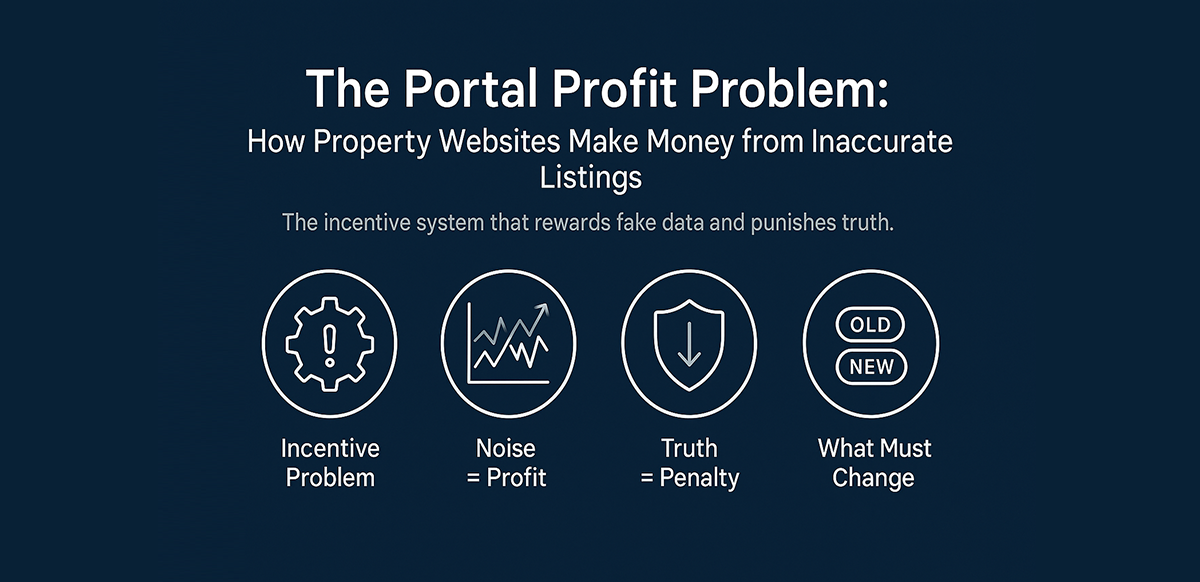
Some portals may benefit from listing volume even when data quality is weak. This creates a conflict between platform traffic and market integrity.
ListingMine Academy | Platform Economics & Industry Reform Insight
Why the current business model rewards fake data, punishes truth, and blocks Malaysia’s real estate progress.
Property portals were created to help buyers find homes and help agents find leads. But economically, they now operate in a business model where:
More listings = more revenue
More clicks = higher engagement metrics
More activity (even fake activity) = stronger pricing power
This creates a fundamental misalignment between portal incentives and market health. Fake listings are not a glitch in the system. They are a profit centre.
Most portals sell:
These models scale profit when two things increase:
Accuracy does not appear anywhere in the revenue equation. So long as agents pay for slots, portals profit — regardless of whether listings are:
The system becomes a content marketplace, not a verified inventory marketplace.
From the portal’s perspective:
A fake low price → attracts more clicks
A duplicated listing → increases inventory count
An unrealistic property → draws curiosity browsing
These are good outcomes under an engagement-driven model.
From the user’s perspective:
It’s deception. From the portal’s perspective:
It’s traffic.
A fake listing is designed to:
generate more views
trigger more enquiries
lead to more time spent browsing alternatives
This artificially inflates:
And in the metrics game, frustration becomes financially valuable. In this model, user frustration is a metric, not a mistake.
A portal flooded with inaccurate data harms:
A. Buyers
They waste time, lose trust, and stop believing prices.
B. Agents
Honest agents are drowned out by spammy competitors.
C. Agencies
Recruitment and brand equity suffer when the public perceives the industry as unreliable.
D. Banks & Valuers
Pricing benchmarks become polluted.
E. The Entire Property Market
Bad data = bad decisions = low liquidity.
The current portal economy profits privately while causing public harm.
The transition required is not technological; it’s economic. We must move from:
| Old Model (Today) | New Model (Future) |
|---|---|
| Quantity-driven | Accuracy-driven |
| Pay-per-listing | Pay-per-verified-unit |
| Engagement metrics | Transaction outcomes |
| Clicks & curiosity | Trust & conversion |
| User frustration | User confidence |
A portal should be rewarded for:
In other words, value creation, not volume manipulation.
A. Verified Inventory Feeds
Portals must move toward ingesting data only from validated sources, systems, or partners.
B. Quality Scoring Algorithms
Listings with verified documents, owner confirmation, and updated pricing should rank higher.
C. Transparent Audit Trails
Every listing should have a provenance record — when verified, by whom, and how recently.
D. Outcome-Based Commercial Models
Shift from “pay to upload” → “pay to transact.”
E. Regulators and Industry Bodies Advocate for Standards
Progress may require treating verified property data as critical market infrastructure, similar to financial data, where:
Only then can the market mature into true digital transparency.
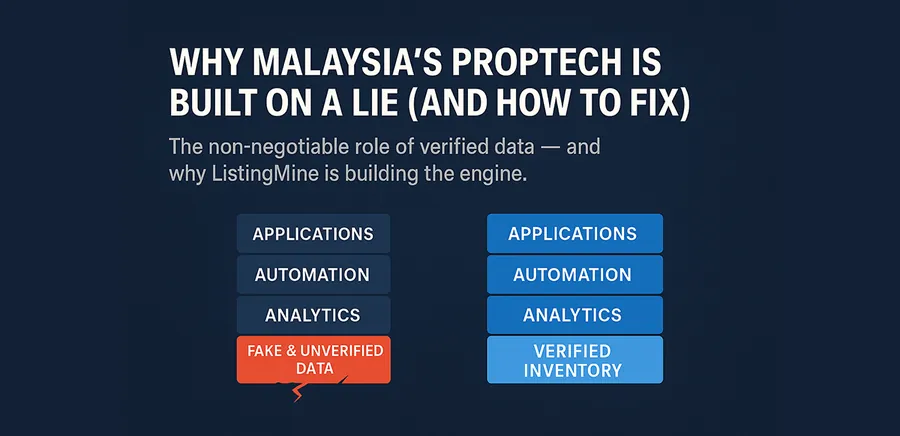
PropTech is not built on apps, websites, or AI. PropTech is built on data — and without verified data, the entire ecosystem collapses into noise.
The platforms and ecosystems that embrace verified truth will define the next era of Malaysian real estate.
The age of profiting from noise is ending. The age of profiting from truth is beginning.

Founder of ListingMine and author of Agent for Life. Building ERP for Malaysian real estate agencies since 2008 — and writing to reshape how agencies grow.
More about Marvin Foong →More articles in this topic
This article is one of the sources behind this assessment. Take it to see what you already know and what to read next.
Educational self-assessment. Not a licensing examination or professional certification.