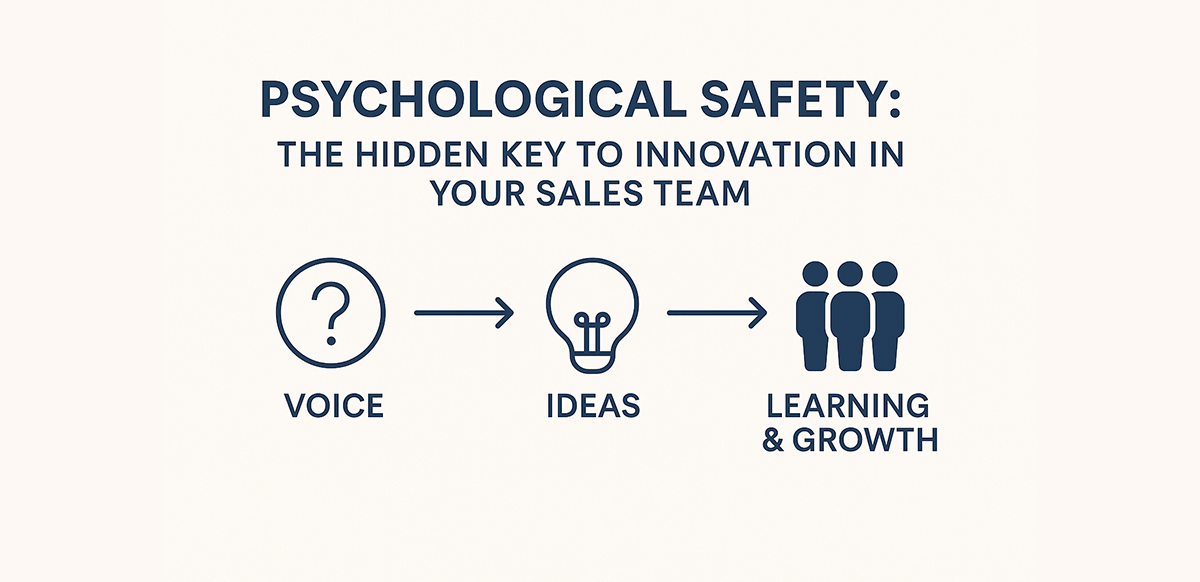
Teams innovate better when agents can raise problems, share ideas, and admit mistakes without fear. Psychological safety supports learning and performance.
Imagine this scene in your weekly meeting: A sharp negotiator has just developed a brilliant strategy to leverage TikTok and VR tours to capture the affluent young professional market. But as your team leader reviews the same old metrics, she hesitates. What if the idea is seen as irrelevant? What if the boss thinks it’s showing off?
She stays silent. A potentially market-defining strategy is lost.
This happens daily in property agencies. The failure isn't a lack of creativity; it's a failure of psychological safety.
Coined by Amy Edmondson of Harvard Business School, psychological safety is the shared belief that the team environment is safe for interpersonal risk-taking. It is the confidence that team members can speak up with ideas, concerns, questions, or even admit mistakes without fear of being humiliated, punished, or ignored.
In the intense, commission-driven world of property sales, this concept is often misunderstood. It does not mean:
When your team doesn't feel safe to speak up, you are doing more than missing out on a few good ideas—you are actively capping your agency's growth and profitability.
In many professional settings, the cultural tendency towards avoiding public embarrassment and preserving reputation or hierarchy are powerful barriers to psychological safety.
A junior agent will naturally feel apprehension or shyness to correct a senior colleague. An employee will hesitate to challenge the founder’s idea for fear of causing them to damage their authority or reputation.
As a leader, it is your direct responsibility to consciously create a counter-culture that makes it not just acceptable, but professionally expected, to voice a different, constructive perspective for the good of the team and the client.
This transformation requires daily, deliberate leadership—not a single training session.
Shift the focus from execution perfection to joint discovery.
Avoid: "Here are your targets; go get them. Don't mess up."
Adopt: "Our goal is to dominate the high-rise market. We're all figuring out the absolute best way to do this. We need your frontline insights. Every week, we'll learn something new together."
The leader must be the first to show vulnerability. Openly admit your own mistakes.
Example: "Team, I need to share a mistake I made. I approved the marketing budget for the luxury campaign without stress-testing the ad spend, and we wasted 20% of the funds. That's on me. What process should we implement next time to prevent this?"
This shows that vulnerability is a strength and a commitment to learning.
Your reaction is the single most important factor. It determines if others will ever speak up again.
Don't rely on the generic "Any questions?" at the end of a meeting.
In the highly competitive property market, your agency’s greatest asset is not your listing portfolio—it's the collective intelligence, creativity, and frontline insight of your sales team.
Psychological safety is the catalyst that unlocks that asset. It is the difference between a team that simply follows the old script and a team that actively helps you innovate, adapt, and ultimately dominate the market.
What is one specific question you can ask your team this week to model vulnerability and invite corrective feedback?

Founder of ListingMine and author of Agent for Life. Building ERP for Malaysian real estate agencies since 2008 — and writing to reshape how agencies grow.
More about Marvin Foong →More articles in this topic
This article is one of the sources behind this assessment. Take it to see what you already know and what to read next.
Educational self-assessment. Not a licensing examination or professional certification.