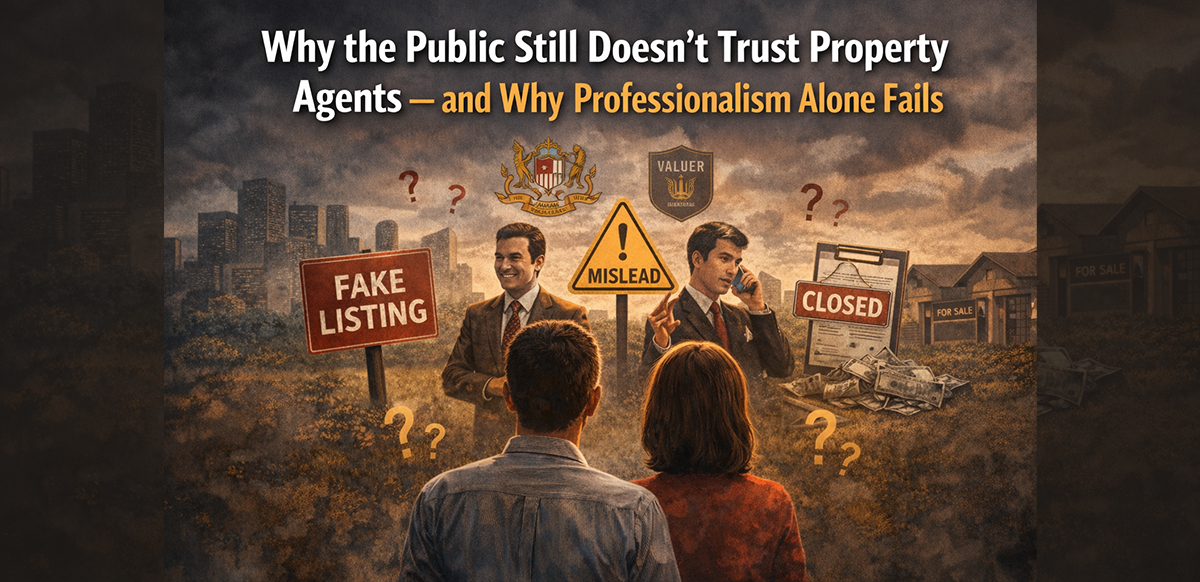
Public distrust cannot be solved by individual good agents alone. Industry-wide systems, verification, transparency, and governance are needed to rebuild trust.
Ask any buyer or seller what they think of property agents, and the answers are depressingly consistent:
This perception has not meaningfully improved for decades.
What makes this frustrating is that it isn't entirely true. Many agents genuinely try to be professional. The industry has a regulator — the Board of Valuers, Appraisers, Estate Agents and Property Managers — a governing law under Act 242, and no shortage of ethics briefings and compliance talks.
Yet public trust remains firmly at the bottom.
That tells us something uncomfortable but critical:
The problem is not a lack of ethics. The problem is a lack of execution.
Most industry conversations start from a flawed assumption:
"We just need more ethical agents."
This misunderstands how trust works at scale.
Malaysia already has rules, codes of conduct, and disciplinary mechanisms. On paper, the industry is regulated. In reality, trust has not improved — because trust does not scale through intention.
A professional agent operating inside a broken system is like a good driver in a city with no traffic lights. No matter how careful you are, the system remains dangerous for everyone.
Trust is not a personal trait. It is a systemic outcome.
Here is the truth the industry rarely states clearly:
An agent can be 100% legally compliant and still be professionally deceptive.
Why?
Most real-world damage happens in a grey zone:
As long as the system tolerates this grey zone, individual professionalism cannot scale.
Before blaming the public, agents should ask one honest question:
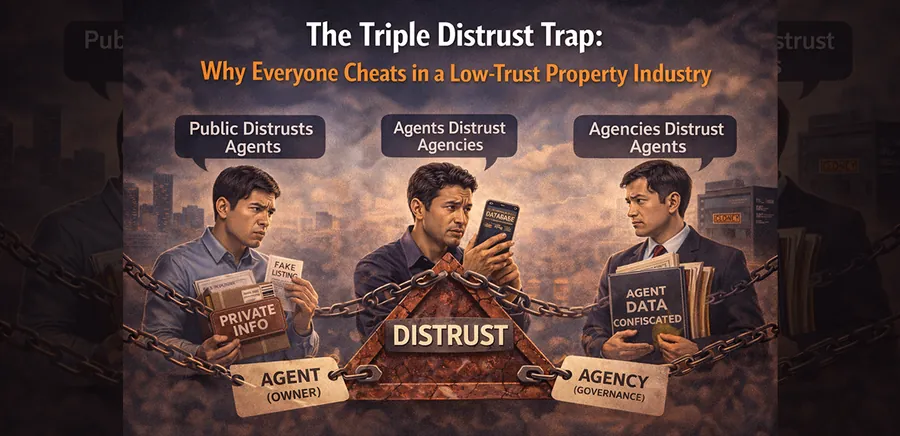
Do agents trust other agents?
Be honest:
Trust is a network effect.
If the nodes inside the network do not trust each other, the network will never earn public trust — no matter how many ethics seminars are held.
Other markets did not fix trust by telling agents to "be kinder".
They built infrastructure.
In the United States, cooperation and listing integrity are enforced through the Multiple Listing Service (MLS). The rule is not trust the agent — it is trust the system that governs the agent.
In China, large-scale cooperation is governed through ACN (Agent Cooperation Network) systems, where software tracks interactions and enforces consequences.
In both systems:
Trust is not emotional. It is structural. Break the rules, and you lose access to data and deals.
Malaysia does not have:
We rely almost entirely on Act 242 — a law never designed to manage:
A national solution would be ideal, but it is not practical in the near term.
Waiting for top-down reform is a losing strategy.
The realistic solution is not national. It is institutional.
Large agencies must stop behaving like recruitment shops and start acting like market architects.
They can build internal ACN frameworks by:
At that point, an agency can honestly tell the public:
"You can trust us because our system makes it difficult to lie — not because we promise not to."
This is where ListingMine ERP + ACN becomes execution infrastructure — not ideology.
ListingMine is best understood as a super-charged Excel for property agencies:
Agencies design their own rules:
All without building software from scratch.
Just as important, ListingMine is built on a principle most systems violate: agents must own their private data.
Trust cannot exist in an industry where experience is confiscated. When agents lose their contacts, listings, and transaction history every time they move agencies, professionalism cannot compound — it resets. Control becomes the business model, and distrust becomes rational.
By returning private data ownership to agents while providing shared governance through ACN rules, ListingMine removes forced dependency and replaces it with voluntary cooperation. Agents can grow long-term assets, agencies can enforce standards, and trust finally has a foundation.
Ownership is not a threat to professionalism.
Ownership is the infrastructure of trust.
Many agencies tried.
They spent millions.
Most failed.
Not because they lacked intelligence — but because:
Software is not a project. It is a living system.
ListingMine absorbs this complexity so leadership can focus on governance, not code.
Public distrust of property agents is not irrational. It is a rational response to a system with no enforcement layer. Trust will not be rebuilt through branding, speeches, or slogans.
It will be rebuilt when:
To agency leaders, the choice is clear:
You can remain a recruitment shop in a broken market — or become the market architect who owns the future of trust.
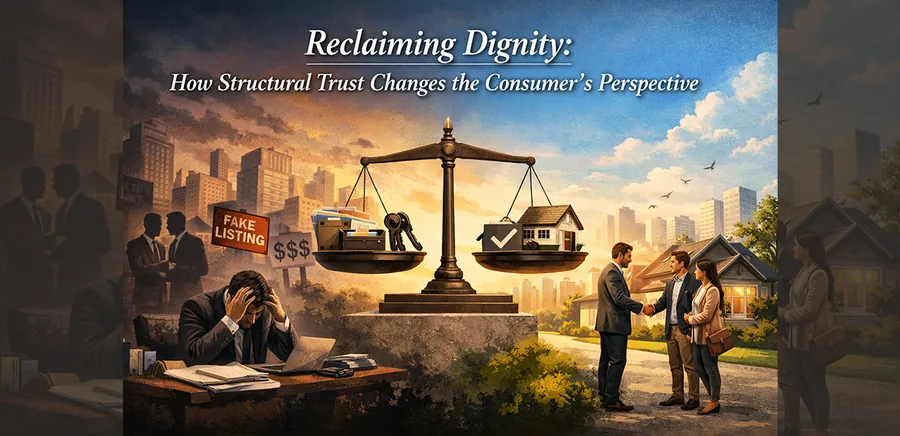
When professionalism lives inside the system — and ownership is respected instead of confiscated — trust finally becomes visible.

Founder of ListingMine and author of Agent for Life. Building ERP for Malaysian real estate agencies since 2008 — and writing to reshape how agencies grow.
More about Marvin Foong →More articles in this topic
This article is one of the sources behind this assessment. Take it to see what you already know and what to read next.
Educational self-assessment. Not a licensing examination or professional certification.