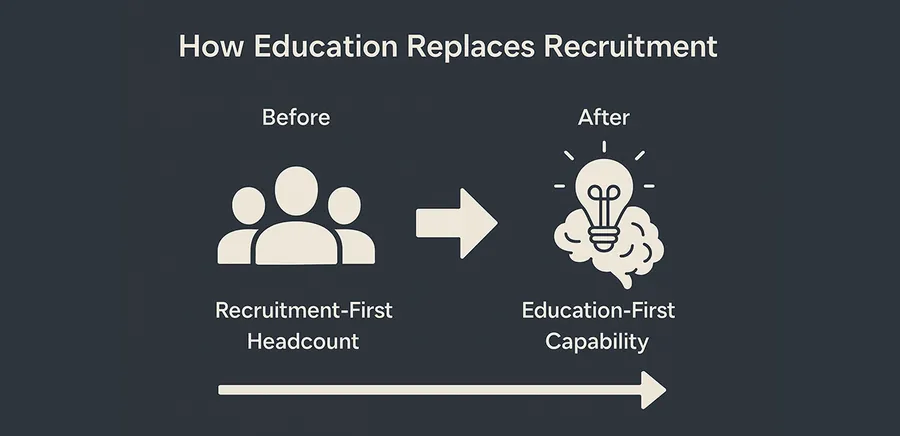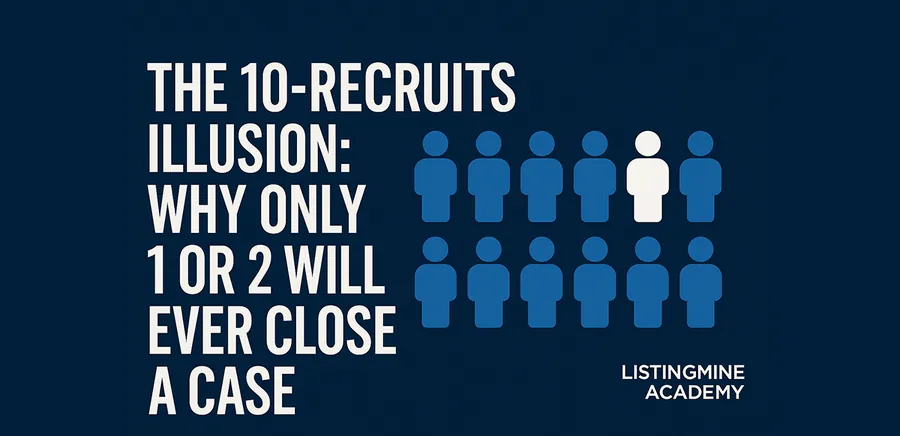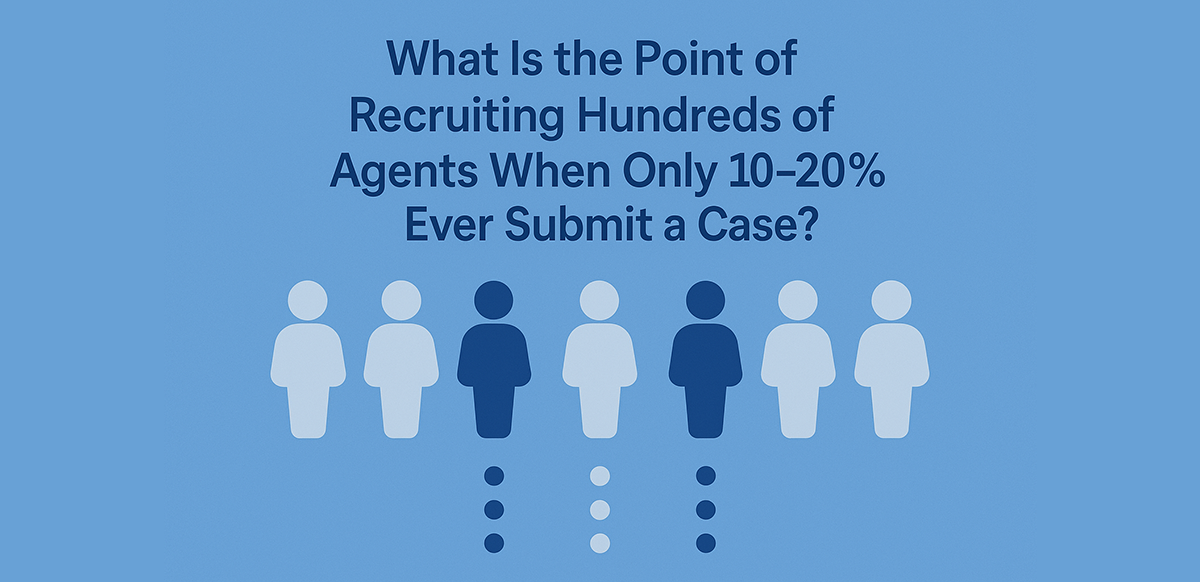
Recruitment numbers are meaningless if most agents never submit cases. Agencies should focus on activation, productivity, and support instead of raw headcount.
Many agencies proudly announce their headcount.
200 agents.
300 agents.
500 agents.
But look closer. Only 10–20% are actually submitting cases. The rest are silent — until their names quietly disappear from the roster. This is not scale. This is leakage. And it is a symptom of a broken operating model.
Recruiting more agents does not automatically create more output.
If:
Then the agency is not growing. It is rolling the dice at scale. The industry has normalised this:
By then, it is already too late.
Most agents do not fail suddenly. They fade.
Month 1: Confused
Month 2: Uncertain
Month 3: Discouraged
Month 4: Detached
Month 5: Gone
Yet many agencies only measure one thing: Did you submit a case?
If the answer is no, nothing happens — until the agent disappears. That is not management. That is abandonment.
Sales is a lagging indicator. By the time someone submits a case, the work has already been done weeks or months earlier.
What agencies should monitor — especially in the first 3–6 months — is leading indicators:
These activities are controllable. Closings are not — especially early on.
If someone is doing the work but not closing yet, that is a coaching problem. If someone is doing nothing, that is a direction problem. Without data, both look the same.
Because manual tracking is painful. Spreadsheets get ignored. WhatsApp updates are unreliable. Managers rely on memory and gut feel. So agencies default to the easiest metric:
Sales or nothing.
This creates two problems:
Both drive attrition.
In an Agent Cooperation Network (ACN) model, contribution is no longer binary. Not everyone needs to close immediately. Agents can contribute through:
With proper infrastructure, these contributions are automatically logged. The system creates a visible contribution score — not just a sales ranking. An agent who sources 10 listings but closes 0 deals is no longer invisible. They are valuable. And the system proves it. Instead of “sales or silence,” agents see:
This is not motivational talk. It is game mechanics applied to professional work. Agencies can now:
People are measured on progress, not just outcomes.
If you only reward closings:
If you reward contribution:
Points, credits, or internal recognition for:
These are not “soft metrics”. They are the work. Sales is simply the final conversion.
If 80% of your agents are silent:
A business model that depends on:
Is not a talent model. It is an attrition model.
Yes, many agencies need to relook at how they operate. Not by:
But by:
With proper architecture, small teams outperform large headcounts.
This level of visibility, fairness, and cooperation is almost impossible to run manually. That is why agencies need infrastructure — not more motivation. Platforms like ListingMine already embed:
This allows agencies to build relevant, modern business models instead of relying on churn.
Recruiting hundreds of agents means nothing if only 10–20% ever submit a case. Silence is not laziness. It is often an unmeasured struggle. Agencies that win the next decade will not be the biggest recruiters. They will be the best operators — measuring progress early, rewarding contribution fairly, and building systems that turn effort into outcomes. Because growth is not about how many agents you recruit. It is about how many you actually develop.

Founder of ListingMine and author of Agent for Life. Building ERP for Malaysian real estate agencies since 2008 — and writing to reshape how agencies grow.
More about Marvin Foong →More articles in this topic
This article is one of the sources behind this assessment. Take it to see what you already know and what to read next.
Educational self-assessment. Not a licensing examination or professional certification.