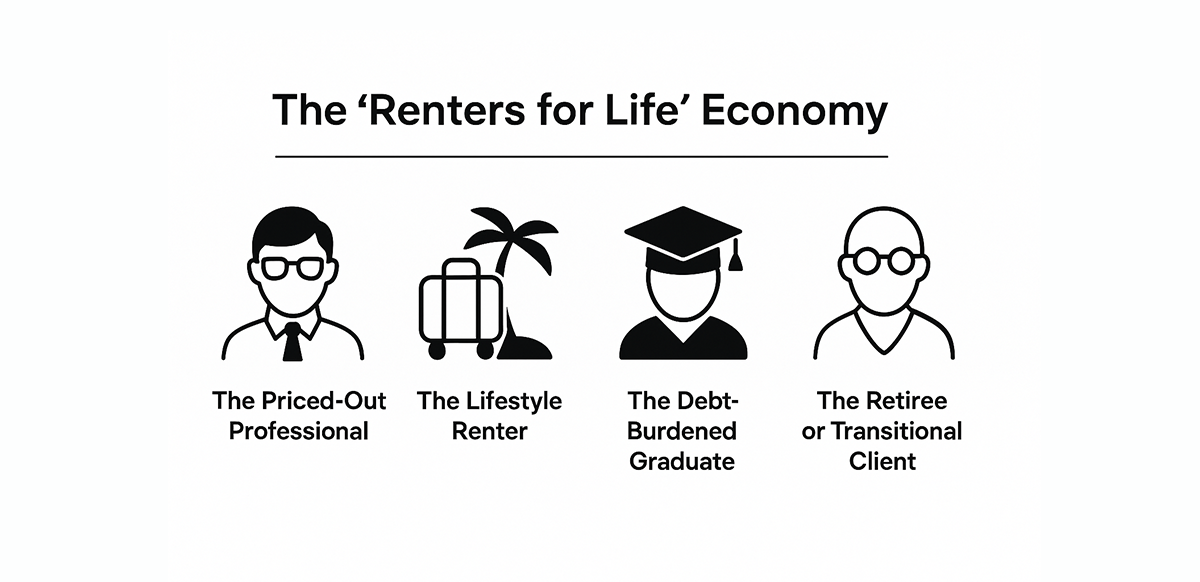
A generation that rents longer changes agency opportunity from one-time purchase to long-term rental service. Agencies need models for recurring tenant and landlord relationships.
For decades, the real estate industry has operated on a simple, cyclical model: help a young couple buy their first home, serve them as they trade up, and eventually help them downsize. The entire engine was fueled by the universal aspiration of homeownership.
But a fundamental shift is underway. A growing segment of the population is becoming "Renters for Life"—not by chance, but by choice or circumstance. This isn't a niche market; it's a generational economic reality. For forward-thinking agencies, this isn't a threat; it's the single biggest opportunity for growth and diversification.
This group is not monolithic. It is a stable, often sophisticated, clientele whose needs go far beyond just finding a roof. They are active participants in a long-term tenancy economy and are not simply "failed buyers."
The old agency model was transactional: close the deal and see the client again in 5-7 years. The new model for the tenancy economy is relational.
Your goal is not to make a single sale, but to become their lifelong housing advisor. This requires a fundamental shift in strategy and services.
Stop treating the tenancy side as a secondary business for new agents. Elevate it. Develop a proven system for tenant representation that rivals your buyer representation.
This is the high-value segment of the market. Companies regularly relocate employees and need a trusted partner to handle their housing needs.
A "Renter for Life" will transact more frequently than a homeowner. Each move is an opportunity. Expand your value proposition to include:
Your messaging must validate the renting lifestyle.
A homeowner might transact three times in 20 years. A "Renter for Life" might move every 2-3 years. Over that same 20-year period, that could mean 7 to 10 tenancy transactions.
The math is clear. By embracing this demographic, you are building a sustainable, recurring revenue stream. You are building a business based on long-term relationships and frequent touchpoints, which is far more resilient to market cycles than one dependent solely on sales.
The agencies that thrive in the coming decade will be the ones that stop waiting for renters to become buyers and start serving them as the valuable, long-term clients they already are. The future of real estate isn't just about selling houses; it's about providing lifelong housing solutions.

Founder of ListingMine and author of Agent for Life. Building ERP for Malaysian real estate agencies since 2008 — and writing to reshape how agencies grow.
More about Marvin Foong →More articles in this topic