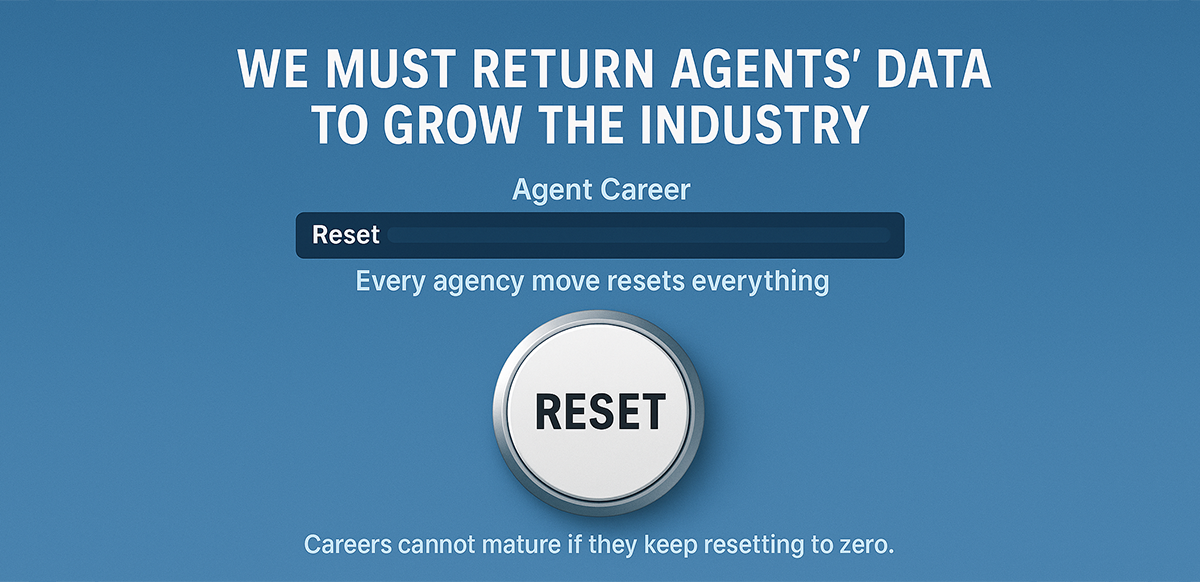
Confiscating agent data weakens career value and discourages long-term professionalism. Returning private data ownership helps agents grow while building more trust in the industry.
Why the Fresh-Graduate Model Failed — and Why Control Is No Longer a Strategy
For more than a decade, the real estate industry operated under a comforting illusion:
"The best way to scale an agency is to hire fresh graduates, train them from zero, and control everything they do."
At the time, it sounded rational. Fresh graduates were compliant. They followed scripts. They asked fewer questions. Experienced agents were labelled "polluted", stubborn, and difficult to manage. So the industry made a deliberate choice:
control over competence.
The results are now in — and every agency already knows the verdict, even if they refuse to say it out loud. Here is a test no amount of branding can escape:
Out of 10 new recruits, how many are still active after 2 years?
If the answer is fewer than 5, the model has failed.
If the answer is 2 or fewer, the model has failed completely.
Do not blame the agents. This is not a discipline problem. This is not a motivation problem.This is a system problem.
There is a harder truth the industry avoids.
If a business model only works for fresh graduates — and collapses the moment experienced agents enter the system — then the model itself is immature. A mature system must be able to:
Any structure that survives only by constantly resetting talent to zero is not scalable. It is fragile by design.
In the past, this limitation might have been excusable. Technology was primitive. Data was hard to separate. Collaboration at scale was difficult. That excuse no longer exists. If a system still depends on keeping agents inexperienced in order to function, the problem is no longer technological — it is philosophical.
The shift toward fresh graduates was not accidental. It was driven by one fear: loss of control.
This is why the industry today looks structurally distorted.
This is not a talent pipeline. It is a talent shredder. Healthy professions do not look like this. The moment a fresh graduate becomes competent, reality hits:
Every time they move agencies, their career resets to zero. So they leave. Not because they failed — but because the system refuses to let them accumulate value. Now ask the question most team leaders quietly avoid.
If you have been in the industry 15–20 years:
How many times have you built a team…
trained them…
hit targets together…
only to watch them leave — and then start again from scratch?
After two decades of building people,
what do you actually own today?
Or are you still rebuilding — again and again — just with different faces?
If the answer is "I'm still rebuilding", the problem is not loyalty.
It is architecture.
The industry did not just burn out fresh graduates. It burned out its leaders too.
Experienced agents are often described as "unmanageable." That diagnosis is wrong.
They are not unmanageable. They are unwilling to be confiscated.
They protect what they built — relationships, reputation, data. When an agency demands total surrender with no ownership, distrust is rational.
The problem was never experience. The problem was forced dependency.
There is no single fix. The solution has two unavoidable directions.
First: Build Infrastructure Experienced Agents Will Actually Join
You cannot rebuild the industry by relying purely on beginners. Experienced agents are not a liability. They are the stress test of system maturity. If your platform cannot attract them, the problem is not the agent — it is the structure.
Second: Return Ownership to Agents
Agents must own:
Agencies should provide governance, compliance, and collaboration — not confiscation. Ownership is not a threat. Ownership is the infrastructure of trust.
We did not invent this principle. We simply built the first platform in Malaysia that refuses to violate it. ListingMine is designed around a simple but radical idea: your data belongs to you.
And any system that grows by taking that away is not scaling — it is extracting. That is why the platform is built with two fundamental layers:
Private
This is where agents store:
No agency can take this away. You decide how it is used.
Group
This is where collaboration happens:
You choose what to share, who to share with, and under what rules. Because the data is yours, you can:
without resetting your career to zero. ListingMine does not trap agents. It respects them.
We are not asking for permission. We are providing the infrastructure that makes permission unnecessary.
Here is the question agency principals rarely ask themselves:
Have you had your business valued recently?
After 10, 15, or 20 years of "growth" — is your effective PE still around 2 times?
If your agency collapses the moment key people leave, if your value does not compound with time, then what you built is not an institution. It is a headcount-dependent operation.
You cannot confiscate your way to growth. You cannot control your way to maturity. A system that resets careers cannot build professionals. A business that hoards data cannot build value. The future belongs to platforms and agencies that understand one principle:
Ownership is the infrastructure of trust.
Return agents' private data — and the industry regains its experience, its trust, and its long-term future. That future has already begun.

Founder of ListingMine and author of Agent for Life. Building ERP for Malaysian real estate agencies since 2008 — and writing to reshape how agencies grow.
More about Marvin Foong →More articles in this topic