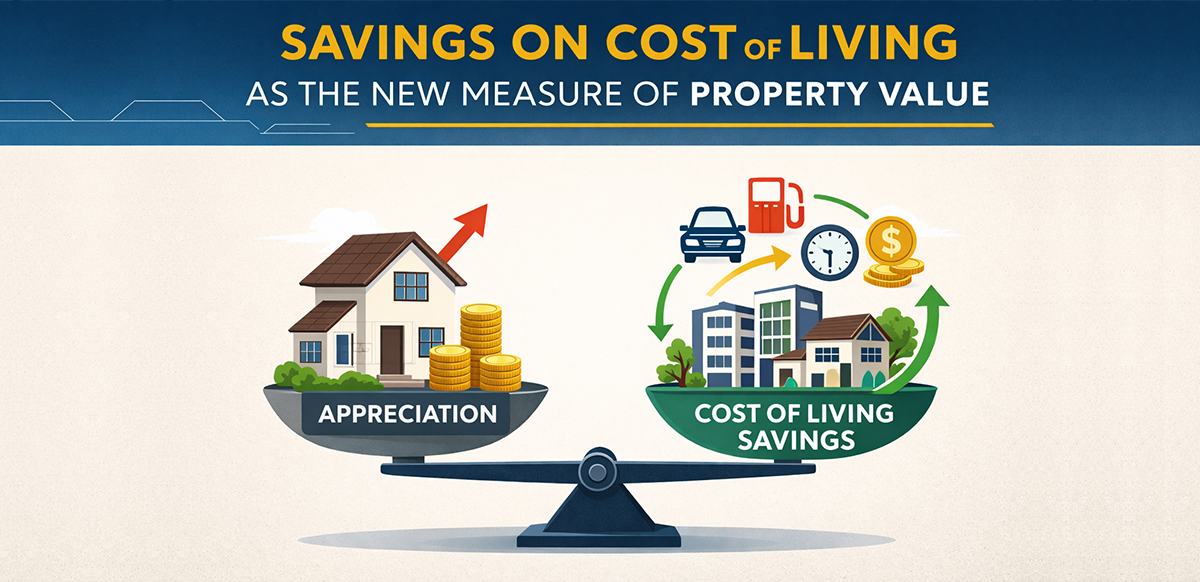
Property value should be measured not only by appreciation, but also by how much a home reduces daily living costs. Transport, convenience, maintenance, utilities, and lifestyle efficiency can change the real value of a property.
There is a familiar statement often repeated in property circles: if a property does not appreciate meaningfully over time, the purchase was a mistake.
Some well-known property educators present this conclusion confidently, supported by supply charts, rental yield projections and transaction comparisons.
The message is simple — appreciation equals success, stagnation equals failure.
The data may be technically sound, but the conclusion rests on the assumption that all buyers share the same motivation.
Consider a practical scenario. A buyer selects a property that costs RM1,000 more per month in instalment than another alternative. Five years later, resale appreciation is modest.
From a price-centric lens, the decision appears weak.
Yet because of integration and location, the same buyer saves RM5,000 per month in total cost of living through:
Over time, the household’s net economic position strengthens despite limited capital growth.
If appreciation is treated as the only measure, this buyer appears to have failed.
If total economic impact is examined, the conclusion changes entirely.
The issue lies in how value is defined.
In property discourse, “value” is frequently reduced to price appreciation or rental yield.
A more complete definition recognises value as the total economic advantage a property creates for its owner over time.
That advantage may arise from:
Within this broader definition sits a measurable component that deserves formal recognition in residential discussions: Operational Yield.
Operational Yield refers to the recurring economic benefit generated by living in the property, independent of resale price.
It includes what is commonly described as Savings on Cost of Living — recurring efficiency that compounds quietly over years.
A traditionalist may argue that appreciation and rental yield are hard numbers, while commuting time or stress reduction are subjective.
However, these factors are not unquantifiable.
If a couple saves two hours per day in commuting, that equates to approximately:
This represents reclaimed human capital.
When one also accounts for:
the household retains long-term health capital, an asset arguably more valuable than financial capital itself.
These are not abstract benefits. They are measurable within the economic reality of the household experiencing them.
Traditional property analysis typically focuses on:
These tools are indispensable for assessing speculative risk and entry discipline.
They measure capital performance effectively.
However, they also carry an embedded assumption:
that appreciation is the primary objective of ownership.
When that assumption goes unexamined, capital performance becomes synonymous with total value.
The analytical error is subtle.
Equating investment performance with economic completeness creates an incomplete evaluation.
The broader definition of value is not controversial in the business world.
Factory owners sometimes purchase industrial properties with only 20 years of leasehold remaining, and in some cases even 10 years.
From a narrow property-residual-value perspective, short tenure appears unattractive.
However, if the location enhances:
the business value generated during those remaining years can significantly outweigh tenure concerns.
The property is evaluated based on what it enables, not solely on its resale horizon.
Similarly, multinational corporations frequently pay premium rents for Grade A office towers rather than leasing cheaper shop-office alternatives.
The rental premium may appear large in isolation, but companies generating significant revenue evaluate property differently.
They consider leverage gained through:
In commercial settings, Operational Yield is understood instinctively.
Residential discourse often fails to apply the same reasoning.
History shows that comparison-based tools have limits.
Several well-known developments were once criticised as overpriced:
These developments were evaluated relative to surrounding supply and historical pricing patterns.
The analytical method itself was not inherently flawed.
What it struggled to capture was transformation.
Each development created structural advantages:
Comparison analysis measures continuity.
It does not always capture structural change.
These examples are not presented to celebrate appreciation.
They illustrate a narrower point:
when tools designed to measure comparables are applied to transformational contexts, misjudgements can occur.
If the framework can misread transformation, it can also misread purpose.
Most Malaysians purchase homes primarily for occupation rather than speculation.
Many will not experience dramatic appreciation.
When non-appreciation is equated with failure, a large segment of ordinary buyers is judged using a framework they never adopted.
Some buyers consciously prioritise:
Their objective is stability and operational advantage rather than maximum resale profit.
Operational Yield improves household economics immediately and predictably.
If RM5,000 per month in recurring savings is achieved:
At a 6% yield, an investor would require approximately:
to produce the same annual benefit.
Framed purely in financial terms, recurring efficiency can rival or exceed speculative gains.
Savings on Cost of Living is therefore not a defensive excuse. It is a legitimate economic return.
Supply and yield analysis remain essential tools.
They measure capital performance effectively.
However, they capture only one layer of property value.
They do not fully measure:
When advice reduces every outcome to appreciation alone, it simplifies a multi-dimensional decision into a single metric.
That simplification may be convenient, but it is incomplete.
For many owner-occupiers, Operational Yield is more immediate and reliable than speculative appreciation.
It strengthens economic position month after month, regardless of resale timing.
Value is not determined solely by what a property can be sold for tomorrow.
It is also determined by what it returns — economically and humanly — while it is being lived in today.

Founder of ListingMine and author of Agent for Life. Building ERP for Malaysian real estate agencies since 2008 — and writing to reshape how agencies grow.
More about Marvin Foong →More articles in this topic
This article is one of the sources behind this assessment. Take it to see what you already know and what to read next.
Educational self-assessment. Not a licensing examination or professional certification.