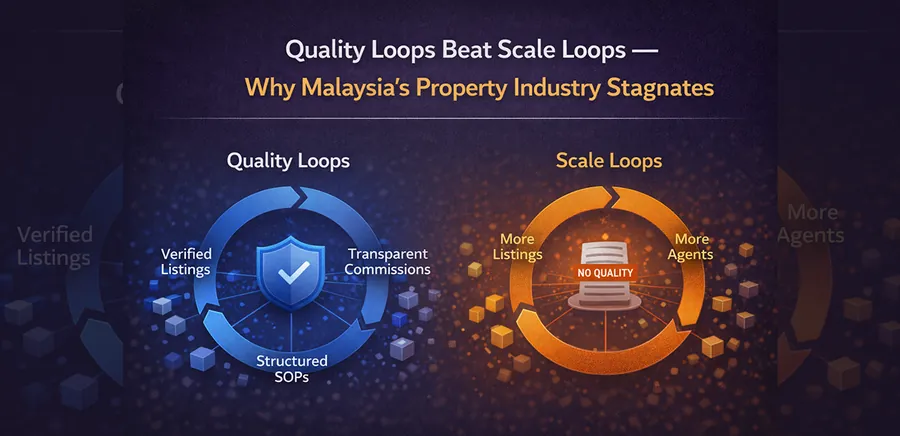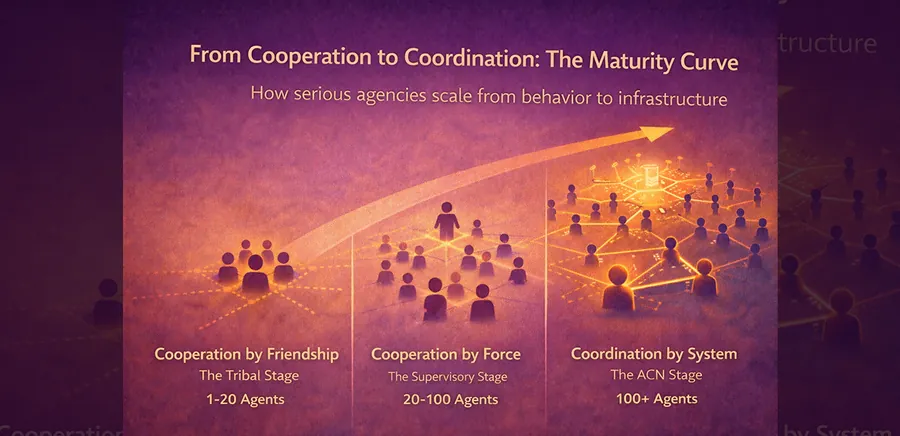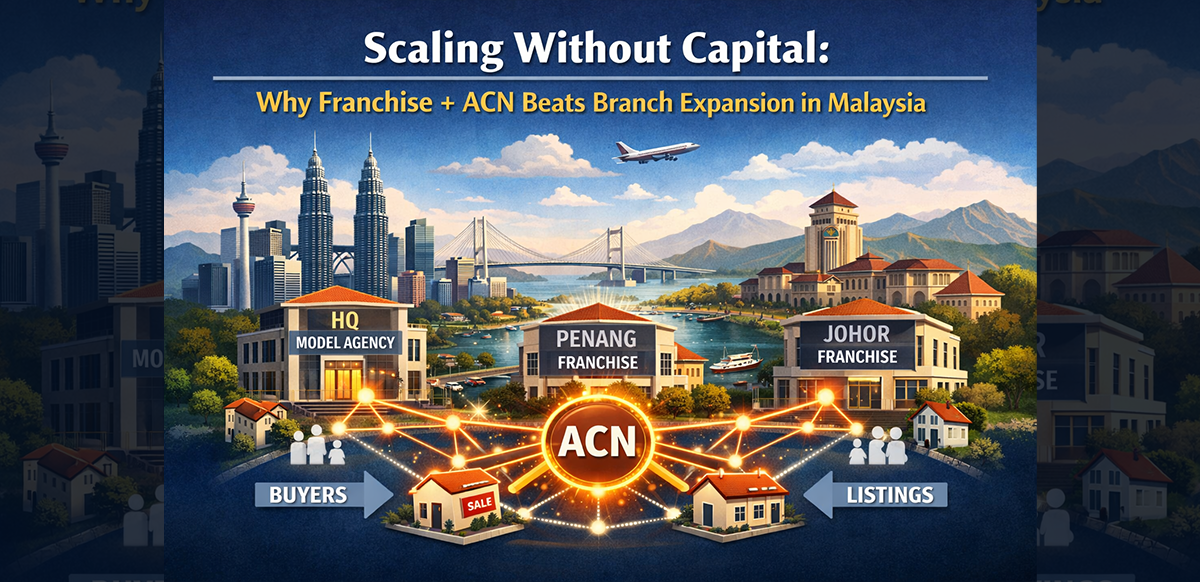
Franchise plus ACN can scale cooperation without heavy branch costs. This model may suit Malaysia better than expensive physical expansion.
Malaysia's property industry does not suffer from a lack of demand or agents.
It suffers from a lack of coordination across cities.
Most property agencies believe growth is a function of physical presence: more branches, more agents, and more advertising. All three are capital-intensive, and all three scale poorly. In a fragmented market, branch expansion multiplies fixed costs, recruitment multiplies churn, and advertising multiplies portal dependency.
The most capital-efficient way to scale is not to own more assets, but to connect existing silos into one system.
A successful independent agent or small agency in Johor Bahru, Penang, or Kuching does not need another "collaboration tool." They already have PropertyGuru and their personal WhatsApp networks.
The real question they ask is: "Why should I give up my sovereignty?"
The answer is not just coordination; it is durability. You do not join for what you can do alone today; you join for what you cannot do alone tomorrow. By joining the Franchise + ACN, a local leader gains:
This model does not start with franchising; it starts with Internal Domination. Before expansion, you must prove the ACN rules work within your own "Model Agency."
Low cost is the reward for this hard work, not the starting condition. You must first use the system to:
Once your own team closes faster and retains agents better than any rival in your home city, the expansion pitch becomes undeniable.
Direct expansion fails because HQ carries the "Management Bloat" of rent and local payroll. Franchising flips the cost structure:
Franchising solves the reach problem, but it introduces a new danger: fragmentation.
Pure franchising usually fragments into "isolated islands" that compete with each other. The Agent Cooperation Network (ACN) is the mandatory "glue."
ACN is not a collaboration tool; it is a market-clearing and settlement layer for agent contributions.
Malaysians are interstate buyers by default (Penang ↔ KL ↔ Johor). Without ACN, trust breaks at state borders and buyers "die in transit."
With ACN:
To prevent fragmentation, the ACN must run on rules, not goodwill. This is scientific management, not culture talk.
| Metric | Traditional Branch Model | Franchise + ACN Model |
|---|---|---|
| HQ Fixed Cost | High (Rent/Salaries) | Near Zero |
| Expansion Speed | Slow (High CapEx) | Fast (Plug-and-Play) |
| Network Effect | Linear (1+1=2) | Exponential (Liquidity compounds) |
| Competitive Moat | Visibility/Hype | Structural Infrastructure |
Malaysia does not need more fragmented agencies; it needs coordination infrastructure. By proving the ACN locally and then franchising to reach every major city, you are not just building a real estate company. You are building the transactional rails that the rest of the industry will eventually be forced to plug into.
Scaling is no longer about how many offices you own. It is about how much of Malaysia's coordination gap you can close.
Because coordination infrastructure compounds, late adopters don't compete — they connect.

Founder of ListingMine and author of Agent for Life. Building ERP for Malaysian real estate agencies since 2008 — and writing to reshape how agencies grow.
More about Marvin Foong →More articles in this topic