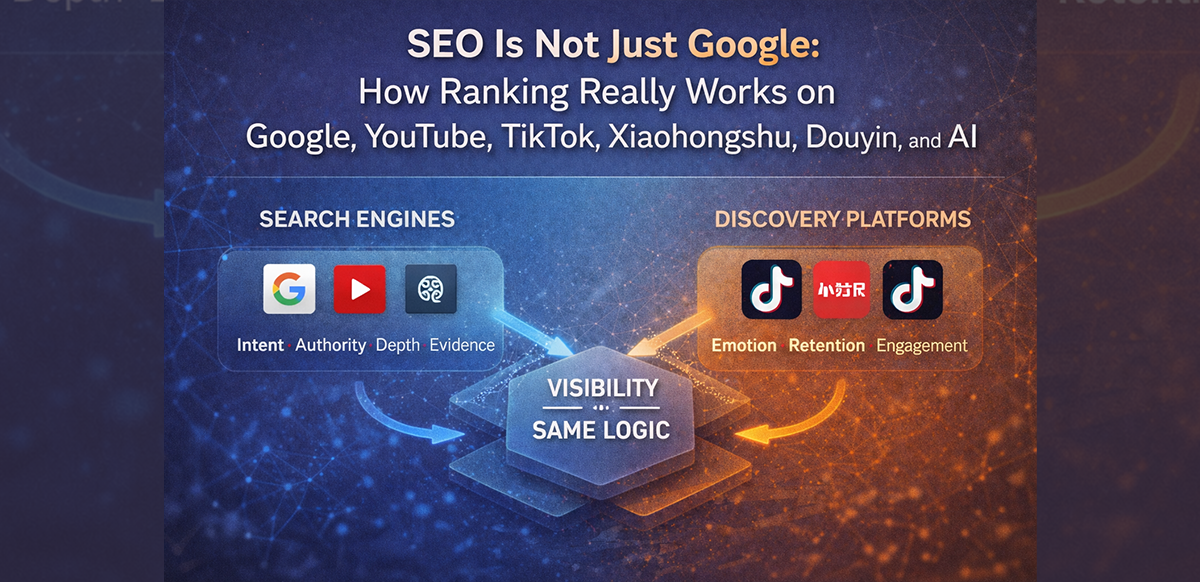
Search visibility now happens across multiple platforms, not only Google. Agents and agencies must understand ranking on video platforms, social search, and AI answers.
Most people hear "SEO" and immediately think of Google. That assumption alone is why so much effort gets wasted.
In reality, SEO is not a Google tactic—it is a visibility principle that plays out differently across every platform. To use it properly, you must separate the core principle (which never changes) from the platform logic (which always does).
SEO means one thing: Aligning your content with a platform's ranking signals so it appears when a user expresses intent.
The principle is universal. What changes is:
This explains why content that performs well on Google often fails completely on TikTok—the structural mismatch is too high.
You do not need to memorize six algorithms. You only need to understand two types of platforms.
Search Engines: Intent-Driven (Google, YouTube, AI Search)
People arrive with a problem. They are asking: "How do I do this?" or "Who can solve this?"
How Ranking Works: These platforms reward relevance, depth, authority (E-E-A-T), and evidence of real-world experience.
The Property Advantage: Problems like loan rejections or strata disputes exist today and five years from now.
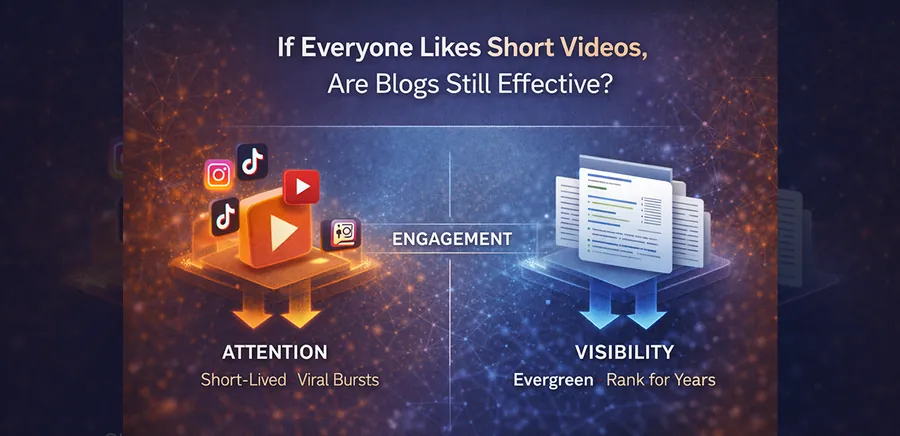
The Lifespan: Search content compounds. An article or video created today can still bring leads in 2027 because the problem still exists.
Discovery Engines: Interest-Driven (TikTok, Douyin, Xiaohongshu)
People do not arrive with a problem. They arrive to be entertained, inspired, or distracted.
How Ranking Works: The algorithm asks, "Does this make people stay longer?" It rewards dopamine, emotion, and speed.
The Property Struggle: Property is a slow, cognitively demanding decision. Discovery platforms are optimized for fast habit loops.
The Lifespan: This content is ephemeral. If it doesn't "go viral" in 48 hours, the effort is often lost.
TikTok and Xiaohongshu do not hate property. They hate low-value commercial spam. When content is suppressed, it's not a shadowban—it's a relevance failure.
To survive discovery platforms, you must pivot:
One core piece of intelligence should result in multiple executions:
AI (ChatGPT, Gemini) does not rank virality; it extracts answers.
If your best thinking lives only in short videos, Google cannot trust it and AI cannot cite it. You leave no "digital residue." Short-form creates familiarity, but search-friendly, structured content creates authority.
Bad: "My day at work."
Good: "What to do when a developer delays vacant possession."
If an agent only does TikTok, they are a performer. If they build searchable knowledge, they are an authority.
Performance burns energy; Authority builds equity. Stop chasing the "algorithm of the week" and start building a library of solved problems. That is the only SEO effort that never gets wasted.

Founder of ListingMine and author of Agent for Life. Building ERP for Malaysian real estate agencies since 2008 — and writing to reshape how agencies grow.
More about Marvin Foong →More articles in this topic
This article is one of the sources behind this assessment. Take it to see what you already know and what to read next.
Educational self-assessment. Not a licensing examination or professional certification.