Serious agencies need multiple forms of power, including brand, data, systems, leadership, capital, distribution, and cooperation. Depending on only one power source creates fragility.
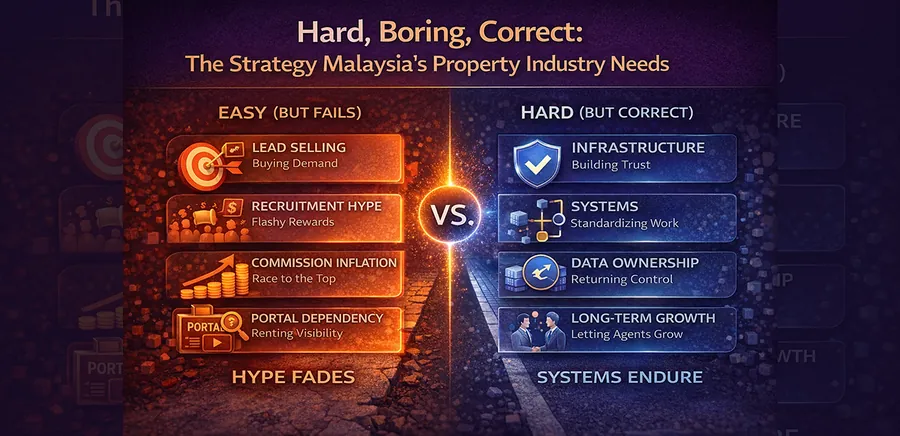
Most agencies fail for the same reason: they try to grow volume before they build power. They recruit faster than they mature, chase leads before they earn trust, and install software before they change behavior.
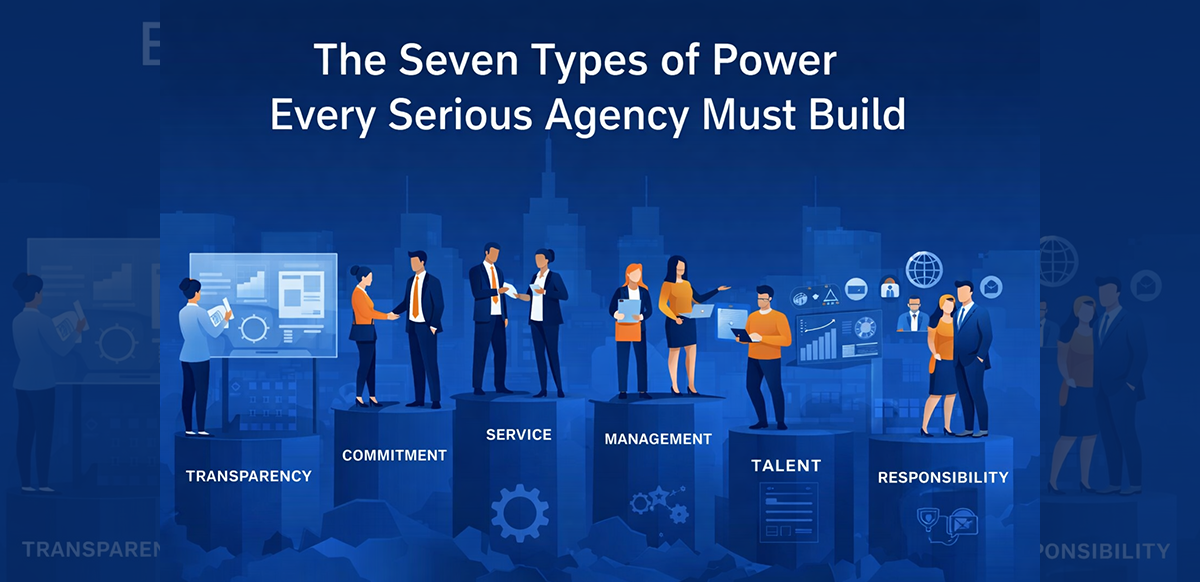
Sustainable agencies are not built on hype. They are built on seven structural powers that compound over time. These powers are uncomfortable to build—which is exactly why they work as a competitive moat.
Trust beats persuasion every time. Transparency means removing information asymmetry structurally.
The Challenge: If everyone knows everything, how do we compete?
The Strategy: You compete on integrity, not information hoarding. In a transparent environment, the agency that wins is the one the client believes will still act correctly after the contract is signed.
Promises only matter when failure has consequences. Most agencies talk about "service excellence" but never define it.
The Strategy: Commitment power converts vague intentions into measurable behavior. Clients don't trust "best effort"; they trust clear standards backed by accountability. An agency without defined commitments doesn't have flexibility—it has chaos.
Real service starts from the client's perspective, not your commission model.
The Strategy: Service power requires the discipline to reject clients you cannot serve well. It means designing workflows around the outcome, not the agent's convenience. Busy does not mean useful; value is determined by the problem solved.
Culture does not scale. Systems do. Agencies are not driven by motivation; they are driven by management.
The Strategy: Management power provides standardized workflows, shared language, and consistent decision logic. Without management power, growth only amplifies chaos. With it, even average teams produce reliable results.
Talent is not just hiring; talent is the standardization of excellence. The Strategy: Talent power comes from clear capability standards and behavior-based recognition. High performers earn their reputation through auditable actions, not seniority or titles. In a modern agency, undefined "talent" is a liability.
Technology amplifies thinking—it does not replace it. It only works when the underlying service philosophy is correct.
The Strategy: Every effective system feels awkward and restrictive at first. Technology power belongs to the agencies that persist long enough to let the structure become instinct. If you quit during the "awkward phase," you haven't bought a tool; you've bought an expensive distraction.
Responsibility is the final filter. You can execute flawlessly and still fail ethically.
The Strategy: Agencies without responsibility eventually turn predatory—extracting value from the market instead of creating it. Responsibility power protects the ecosystem. It ensures that the agency pulls others upward, not just sideways into a race to the bottom.
These seven powers are not tactics; they are structural forces.
Agencies built on these foundations do not collapse under pressure. They do not depend on "star agents," temporary trends, or market cycles. They last.
In a Malaysian industry crowded with noise, the hardest path is the only durable one.

Founder of ListingMine and author of Agent for Life. Building ERP for Malaysian real estate agencies since 2008 — and writing to reshape how agencies grow.
More about Marvin Foong →More articles in this topic