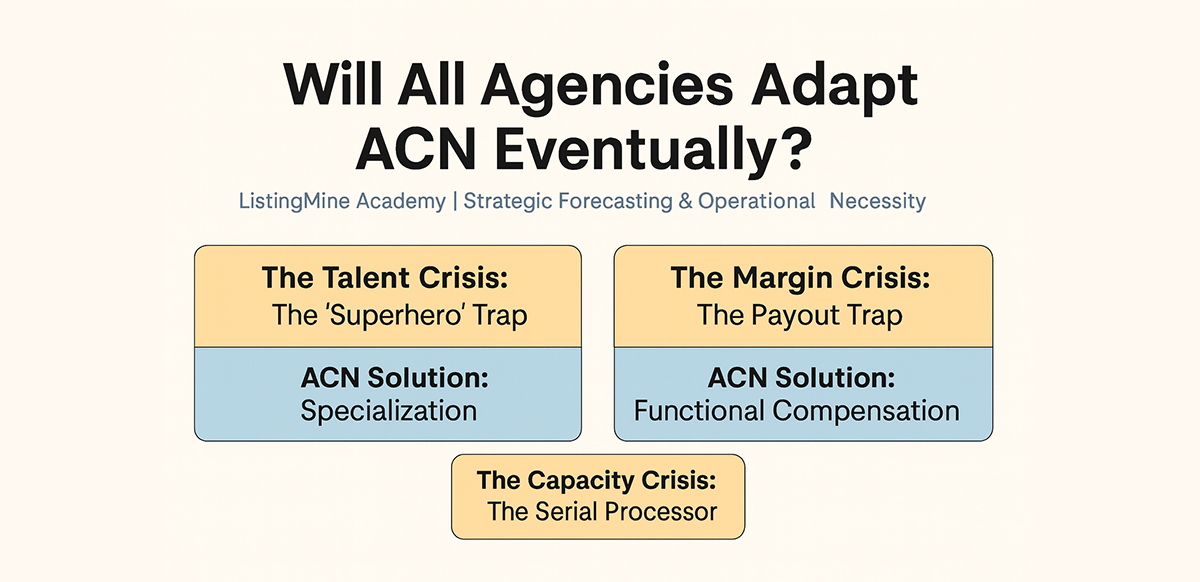
Not every agency must adopt ACN immediately, but cooperation complexity will push more agencies toward structured role-based systems. ACN becomes more valuable as scale and collaboration increase.
ListingMine Academy | Strategic Forecasting & Operational Necessity
Yes.
All agencies should adapt ACN — and all agencies will adapt ACN — whether by choice or by competitive force.
ACN is not a trend.
It is a structural evolution, driven by the failure of the traditional, personality-driven model to scale, retain talent, or deliver consistent client service in the digital era.
The real question for principals is not:
“Should I adopt ACN?”
but rather:
“How quickly can I build the system before market forces erase my margins?”
The traditional real estate agency model is collapsing because it relies on the Super Agent — a single individual executing a modern transaction serially across 20–40 tasks.
This model creates low enterprise value, high fragility, and unserviceable inconsistency because of three structural failures:
Modern agency work requires mastery of wildly different skill domains:
Failure:
The traditional model expects a beginner to master all these at once. They burn out, fail early, or survive only through personal networks. This is why turnover is catastrophic — the Leaking Bucket Problem.
ACN Solution:
ACN restores survivability by enabling specialisation. A new agent can immediately contribute by focusing on their strongest skill:
This creates instant income, improves early traction, and dramatically increases retention.
Failure:
Agencies become trapped in a race toward 100% payout, leaving:
The agency becomes a low-profit administrative hub, not a scalable enterprise.
ACN Solution:
ACN shifts compensation from Hierarchy (overrides) to Function (roles).
Commission is paid only for actual contribution, not imaginary titles or upline structures.
This:
Traditional agencies depend on the Super Agent performing all tasks one at a time.
Failure:
The Super Agent is a serial processor.
If they have 10 hot leads, 9 suffer while 1 gets attention.
This causes:
ACN Solution:
ACN is a parallel processor.
By separating roles:
multiple tasks run at the same time. Throughput increases. Timeline compresses. Client satisfaction rises.
This is the foundation of exponential capacity scaling.
Adopting ACN is not a software decision. It is a strategic protection against market collapse.
A traditional agency today is consciously choosing:
In contrast, an ACN agency builds:
| Model | Value Proposition | Risk Profile | Scaling Potential |
|---|---|---|---|
| Traditional | High commission to the Agent | High — revenue collapses when agents leave | Linear — must clone rare Super Agents |
| ACN | High service and efficiency to the Client | Low — system continues even when people change | Exponential — roles scale capacity |
Traditional Model → Ego-Based Business
Personality-driven, fragile, low valuation (1–3x P/E).
ACN Model → Institution-Based Business
System-driven, scalable, high valuation (institutional P/E).
Eventually, the market will always choose: the Institution over the Ego.
Adaptation is not optional.
It is the only path to long-term survival and enterprise value.

Founder of ListingMine and author of Agent for Life. Building ERP for Malaysian real estate agencies since 2008 — and writing to reshape how agencies grow.
More about Marvin Foong →More articles in this topic