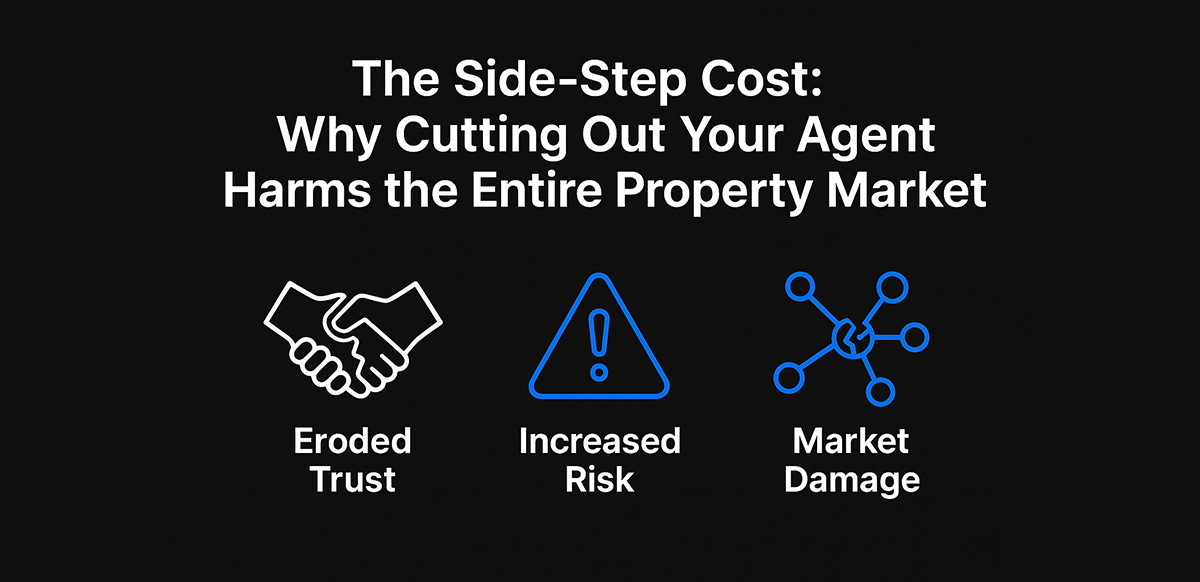
Cutting out agents may save a fee in one transaction but weakens trust, cooperation, and professional incentives. The wider market suffers when service contribution is ignored.
ListingMine Academy | Ethics, Professionalism & Industry Reform
In Malaysia, it has become increasingly common for buyers or tenants to take an agent’s time, expertise, and service—and then approach the owner directly to avoid paying commission. To many consumers, this feels like a clever shortcut.
In reality, bypassing the agent is one of the most damaging behaviours in the real estate ecosystem. It erodes trust, weakens professional standards, and ultimately harms the very consumers who believe they are “saving money”.
To understand why, we must begin with the economic foundation of the industry.
Real estate is the only profession where the practitioner invests work, time, travel, negotiation, and risk first—and only gets paid if the outcome succeeds. Other industries do not operate this way:
Lawyers charge regardless of outcome.
Consultants charge by the hour.
Medical services require payment before treatment.
Matchmaking, recruitment, and advisory roles charge upfront.
But agents? If the deal fails, the agent earns nothing—no matter how much work has been done.
This leads to a crucial analogy: Asking an agent to work for free is like asking a surgeon to operate on the promise of payment only if you survive. It inverts the fundamental logic of professional risk.
The service is real. The effort is real. The risk is real. Compensation should be real as well.
Many consumers are not acting maliciously; they are responding to structural weaknesses in the industry.
A. Lack of Standardisation and Clear Role Definition
Most Malaysians cannot articulate:
What an agent must deliver
What protections the agent provides
Why commissions exist
What value is added beyond “opening doors”
This uncertainty creates confusion about the legitimacy of fees.
B. Agents Compete Through Information, Not Professional Structure
This point is crucial. Malaysia lacks a unified, verified property database. As a result:
Each agent holds fragmented, inconsistent information
Consumers “extract” that information and bypass the agent
Value appears tied to data access instead of professional skill
This misunderstanding is structural, not personal. When an agent’s perceived value is merely access to scattered, non-verified information, the consumer naturally wonders what they’re paying for.
The solution is to shift value from gatekeeping data to orchestrating safe, compliant, high-integrity transactions. Without this shift, bypassing will always feel “logical”—even though it is deeply harmful.
C. The Market Normalises Ethical Shortcuts
Because the public is not educated on:
Real estate law
Fiduciary duties
Transaction risk
Document compliance
Fraud exposure
Professional representation
Many believe bypassing the agent is harmless. It is not.
Consumers think they “save money”, but they unknowingly trade savings for risk.
A. Weaker Negotiation Outcomes
Agents know:
Pricing benchmarks
Seller psychology
Market tactics
How far each side can stretch
Going direct often leads to overpaying.
B. Loss of Transaction Protection
Without an agent:
No proper offer structure
No due-diligence on title or ownership
No anti-fraud procedures
No compliance screening
No enforcement mechanism
No buffer between buyer and seller disputes
Consumers inherit all risk—often unknowingly.
C. Degradation of the Industry
Bypassing agents creates a downward spiral:
The consequence is not individual—it is systemic.
Every healthy property marketplace relies on:
Once trust collapses, no amount of regulation or marketing can repair the industry. Bypassing the agent is not merely unfair. It destabilises the entire foundation of real estate transactions.
Malaysia does not lack hardworking agents. What Malaysia lacks is the infrastructure to support professionalism.
A. Verified Listing Networks (ACN Infrastructure)
When listings are authenticated, consumers no longer treat information as a commodity they can extract and reuse.
B. Clear Buyer Representation Models
Mature markets separate:
Listing agent = protects seller
Buyer agent = protects buyer
Malaysia must adopt this clarity.
C. Transparent Service Standards
Consumers must understand:
The steps involved
The risks mitigated
The work documented
The process governed by a system
D. System-Based Governance (ERP, Audit Trails)
Viewing logs, communications, and documentation should be timestamped and verifiable.
E. Consumer Education
Ethical behaviour produces structural benefits. Unethical shortcuts produce structural decay.
F. Proof-of-Work Visibility (Technology-Enabled Transparency)
To build trust, consumers should be able to see:
This transforms commission from a “mysterious cost” into a visible professional fee tied to proven work. Transparency is not just a feature. It is the foundation of trust.
Cutting an agent out may feel like a shortcut, but it ultimately harms the market, the industry, and the consumer.
A professional marketplace requires:
Service
Trust
Compensation
Transparency
Honour
These are not luxuries. They are infrastructure.
A market thrives when service, trust, and compensation are aligned. Choosing to honour that alignment isn't just about being fair to your agent—it's an investment in a more trustworthy, efficient, and professional property market for everyone.

Founder of ListingMine and author of Agent for Life. Building ERP for Malaysian real estate agencies since 2008 — and writing to reshape how agencies grow.
More about Marvin Foong →More articles in this topic
This article is one of the sources behind this assessment. Take it to see what you already know and what to read next.
Educational self-assessment. Not a licensing examination or professional certification.