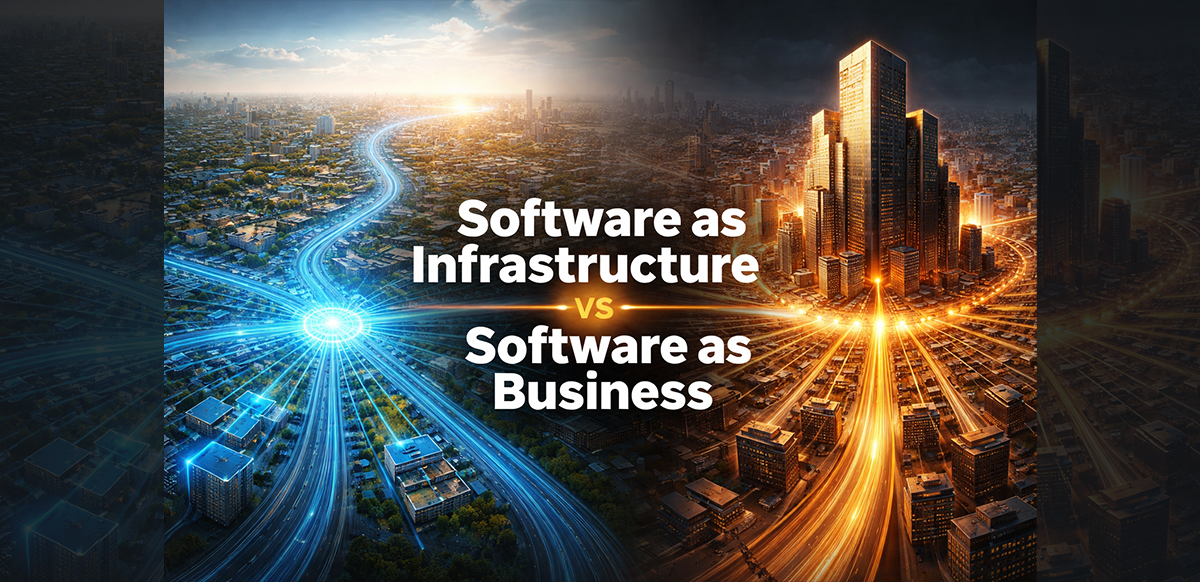
Software can be treated either as a product to sell or as infrastructure that improves an entire industry. ListingMine’s direction is closer to operating infrastructure for agents and agencies.
The Structural Choice Between Extraction and Generation
Most agency leaders believe they are selecting a system to manage listings, commissions, and internal workflows. In reality, they are selecting the direction in which economic gravity will flow. Software is not simply a productivity tool; it is an architectural decision that determines whether value accumulates inward toward a central entity or outward toward participants in the ecosystem.
The distinction between Software as Business and Software as Infrastructure is therefore not technological. It is structural. One model consolidates power. The other distributes it. One extracts long-term dependency. The other generates long-term capability.
Over time, this difference compounds.
Software as Business is designed primarily to strengthen the organization that owns it. In this model, the system functions as a strategic instrument of consolidation. Data centralizes. Governance standardizes. Participation increases institutional leverage. The more deeply participants embed their operations within the system, the more difficult structural movement becomes.
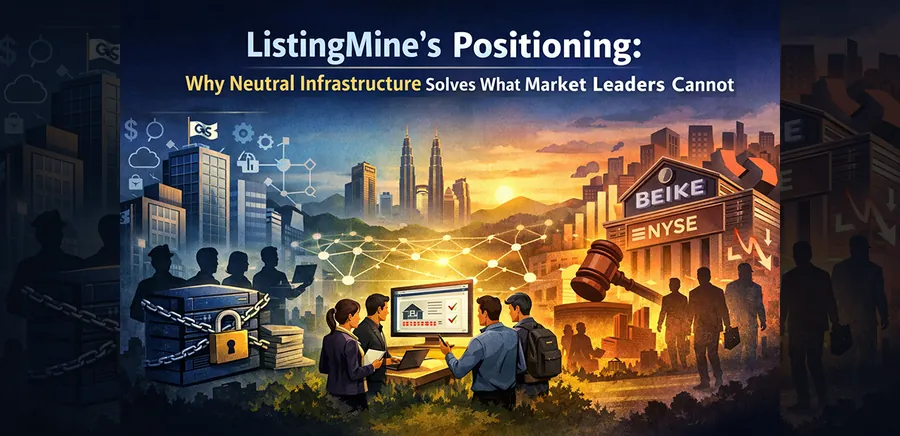
A clear and sophisticated example of this model is Beike in China. Beike’s ACN (Agent Cooperation Network) integrates verified listings, structured cooperation roles, automated commission allocation, and strict operational governance across a massive network. Operationally, the system is impressive and highly effective. It has reduced transaction friction at scale and professionalized coordination in a fragmented market.
However, the ACN exists within Beike’s corporate framework. As participation expands, economic gravity consolidates inward. Data flows toward the center. Governance authority strengthens the parent entity. The network’s success increases the company’s dominance. Agents and brands operate within a corporate architecture that ultimately reinforces centralized control.
This is not a flaw. It is design.
Software as Business scales efficiency and simultaneously scales dependency. It is structurally extractive in that long-term value concentrates toward the entity that owns the rails.
The structural cost of extractive software models rarely appears during onboarding. It appears when mobility becomes necessary. An agent’s database, negotiation history, buyer relationships, and transaction records represent more than information; they represent professional inheritance. They are the accumulated memory of a career.
When systems are architected around corporate control, professional inheritance may not remain fully portable. Agents who move affiliations may find that digital continuity does not travel seamlessly. Teams that restructure may discover that workflow logic is tightly coupled to institutional frameworks. Agency owners who wish to redesign commission structures mid-cycle may encounter vendor dependency and structural friction.
None of this reflects technical inadequacy. It reflects architectural intent. Software as Business prioritizes institutional stability over participant sovereignty. It protects the system before it protects portability.
Inward gravity offers security, but it resists movement.
Infrastructure operates under a different economic philosophy. Roads do not compete with drivers. Electricity does not absorb appliance brands. Internet protocols do not demand identity surrender. Infrastructure enables activity without claiming ownership of the outcomes built upon it.
This is the structural philosophy behind ListingMine. ListingMine does not function as a brokerage or centralized marketplace. It positions itself as operational infrastructure that agents, team leaders, and agency owners build upon. Its Private CRM structure allows agents to retain continuity of data. Its Group-based ERP framework enables commission logic to be configured without expensive customization cycles. Event-triggered commission allocation embeds transparency into workflow rather than relying on institutional enforcement.
In this architecture, the system grows stronger when participants grow stronger. It does not accumulate power by absorbing them. It generates capability outward rather than extracting value inward.
Software as Infrastructure is structurally generative. It compounds participant leverage instead of consolidating central dominance.
The ACN model demonstrates that structured cooperation significantly improves transaction trust and speed. Verified inventory, role-based commission allocation, and audit-ready documentation create predictable collaboration frameworks. The success of Beike proves that ACN can transform industry efficiency.
The crucial distinction lies not in the mechanics but in ownership of the rails.
Governance becomes embedded in process logic rather than enforced through centralized authority. Economic gravity distributes outward.
The mechanics may appear similar. The political economy is not.
Malaysia’s property ecosystem is characterized by decentralization, frequent agent mobility, and diverse agency structures. Regulatory frameworks such as PDPA reinforce the importance of data governance and accountability. Market cycles shift rapidly, requiring commission flexibility and agile restructuring.
In such an environment, extractive architectures may introduce friction over time.
An infrastructure-oriented approach aligns more naturally with these realities.
In decentralized markets, generative systems compound faster than extractive ones.
| Dimension | Software as Business | Software as Infrastructure |
|---|---|---|
| Economic Gravity | Inward (central consolidation) | Outward (distributed capability) |
| Data Ownership | Institution-centered | Participant-centered |
| Commission Flexibility | Policy-driven | Configurable |
| Mobility | Structurally resistant | Structurally portable |
| Growth Effect | Strengthens the owner | Strengthens the ecosystem |
| Economic Nature | Extractive | Generative |
This comparison is not moral judgment. It is architectural analysis.
Software as Business monetizes participation and reinforces corporate moats. As scale increases, the central entity captures more value and participant dependency deepens. The system’s success strengthens the owner’s position.
Software as Infrastructure monetizes access and strengthens participants. As scale increases, ecosystem capability grows without requiring absorption. The rails remain neutral, and value creation remains distributed.
Both models can achieve scale and efficiency. The difference lies in who captures the compounded value over decades.
Real estate technology is evolving toward verified inventory, automated commission logic, transparent collaboration, and audit-ready workflows. These elements are no longer optional. The strategic question is whether they will be embedded within extractive corporate engines or implemented as generative infrastructure.
Beike demonstrated that centralized ACN can transform coordination at scale. An infrastructure approach demonstrates that similar cooperation logic can exist without requiring brand absorption or economic consolidation.
Software ultimately determines whether participants are building durable equity within their own structures or contributing to the expansion of a larger moat.
The choice between Software as Business and Software as Infrastructure is therefore not about features. It is about sovereignty, professional inheritance, and the direction in which economic gravity will flow.
Over time, extractive systems consolidate power. Generative systems distribute it. The architecture chosen today determines which future compounds.

Founder of ListingMine and author of Agent for Life. Building ERP for Malaysian real estate agencies since 2008 — and writing to reshape how agencies grow.
More about Marvin Foong →More articles in this topic
This article is one of the sources behind this assessment. Take it to see what you already know and what to read next.
Educational self-assessment. Not a licensing examination or professional certification.