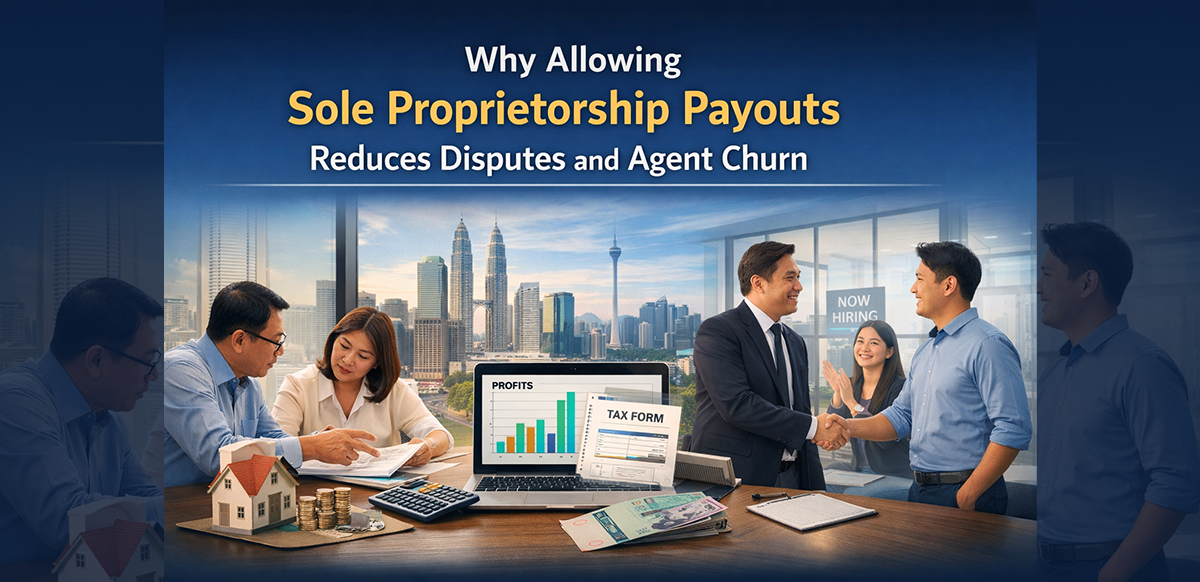
Allowing SP payouts can reduce payout disputes and simplify agent business arrangements. Flexible payout structures help agencies lower friction and retain professional agents.
For agency principals, commission disputes and agent churn are not "people problems".
They are structural payment problems.
Agencies that insist on paying commissions only to personal names often believe they are enforcing discipline. In practice, they are creating friction, mistrust, and unnecessary exits—especially among productive agents.
Allowing commission payouts to an agent's Sole Proprietorship (SP) does not weaken control. Done properly, it reduces disputes, stabilises teams, and improves compliance clarity.
Here is the commercial logic.
Agents rarely dispute commissions because of greed. They dispute them because of anxiety.
The Problem: When commissions are paid to personal accounts, a single RM80,000 month looks like a massive personal income spike. The agent feels immediate tax panic because they cannot visibly offset the RM30,000 they spent on ads and runners over the last 4 months to close that deal.
The Conflict: This financial pressure turns small administrative delays into emotional battles.
The Solution: SP payouts allow the agent to match the income against their business expenses before tax hits. This lowers their financial anxiety—and when anxiety drops, "petty" disputes disappear.
Principals know this truth: Agents are not employees.
They pay their own ads, transport, and support staff. They carry their own risk. Yet, when an agency insists on personal-name payouts, the system sends a contradictory signal: "You are a business—but we will treat you like a gig worker."
Allowing SP payouts resolves this mismatch.
Commercial Maturity: Conversations shift from "my salary" to "my business revenue."
Retention: Senior producers stay where they feel treated as B2B partners, not subordinates.
Top agents rarely leave because of a 1–2% commission difference. They leave because of operational drag.
If an agent feels that your payout structure is "causing" them unnecessary tax stress, they will quietly plan an exit to an agency that "gets it."
Allowing SP payouts removes a non-productive friction point that your competitors will gladly exploit to poach your top earners.
When agents feel the system is unfair, they compensate informally:
A clean SP payout structure formalises everything.
Audit Defensibility: You receive a proper Invoice from the agent's business. You pay into a business account. The paper trail is cleaner for the Agency's own tax deductions than a personal payment voucher.
A common fear is: "If we allow SP payouts, we lose control."
The Reality: You actually gain clearer regulatory leverage.
Withholding Tax (Section 107D): If a resident agent (individual or Sole Prop) earned >RM100,000 in the previous year, the Agency is legally required to withhold 2% of their commission and remit it to LHDN.
CP58 Reporting: The Agency still issues Form CP58 to report the income.
What stays with the Agency:
You are not losing control of the money; you are simply directing the net amount to a more efficient destination.
When an experienced agent leaves, the Agency loses deal velocity, mentorship for juniors, and market reputation.
Replacing a senior producer costs far more than the minor administrative adjustment of updating a bank account field to an Enterprise name. In many agencies, the agents most frustrated by rigid payout structures are precisely the ones you cannot afford to lose.
Allowing SP payouts signals:
This attracts senior agents, team leaders, and producers with longevity. It filters out short-term opportunists without driving away long-term value creators.
Allowing commission payouts to Sole Proprietorships does not reduce agency authority or increase tax risk.
It stabilises long-term relationships.
The agencies with the lowest friction are not the strictest. They are the ones that design systems aligned with how the industry actually works.
This document is for general business strategy and informational purposes only and does not constitute professional legal, tax, or accounting advice. Agencies should ensure all payouts comply with current LHDN regulations, including Section 107D (Withholding Tax) and SST registration thresholds where applicable. Always consult a qualified tax advisor or company secretary before altering payment policies.

Founder of ListingMine and author of Agent for Life. Building ERP for Malaysian real estate agencies since 2008 — and writing to reshape how agencies grow.
More about Marvin Foong →More articles in this topic
This article is one of the sources behind these assessments. Take one to see what you already know and what to read next.
Educational self-assessment. Not a licensing examination or professional certification.