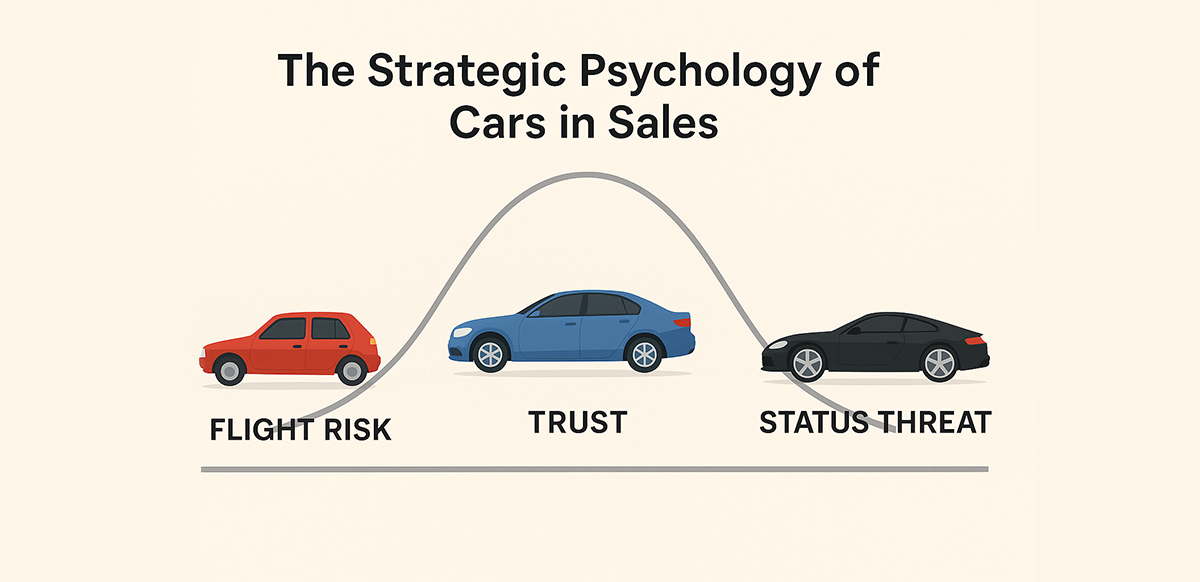
Car image affects how clients and agents judge credibility, success, and trust. Looking too poor or too rich can both create wrong assumptions in sales.
In sales, your car is not a trophy. It is a communication device.
Most agents misunderstand this. They assume the relationship is linear:
More expensive car → More successful image → More deals.
This is false.
The relationship is a Bell Curve. Go too low, and you trigger risk signals. Go too high, and you trigger status tension.
The goal is not to impress. The goal is to stay in the zone of trust.
Driving a visibly old, poorly maintained car is not "humility" in a high-value transaction environment. It is a liability.
When a client is considering a five-figure booking fee or a seven-figure purchase, they are subconsciously assessing Counterparty Risk. A dilapidated car raises silent questions:
At this level, you often lose trust before the conversation begins. Money avoids instability—even perceived instability.
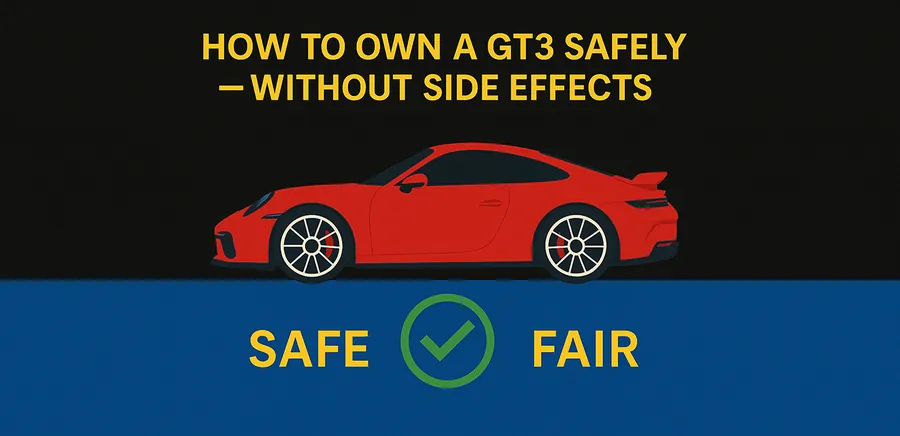
At the other extreme is a different failure mode. When an agent arrives in a Porsche, supercar, or visibly excessive vehicle, the signal often backfires.
Sales is a service role. The psychological hierarchy must remain intact: The Client is the Principal. You are the Advisor.
When your car significantly outshines the client's, two things happen:
A. The "Overpaid" Reflex Instead of thinking "He must be good," the client thinks:
"His commissions are too high. I'm funding this lifestyle."
This quietly increases resistance to fees and creates negotiation friction.
B. The Status Tension Many clients—especially business owners and investors—want to be the most successful person in the room. If you visibly out-rank them in status symbols, you introduce unnecessary ego tension.
Deals are often delayed or withheld not for rational reasons, but emotional ones.
The Rule: Never make the client feel financially inferior in a transaction where they are the ones paying. Winning the status game often means losing the deal.
This is why vehicles like the Toyota Camry, Honda Civic, or Mazda CX-5 dominate sales cultures worldwide.
They sit in the Non-Threatening Competence Zone. They solve three problems simultaneously:
At this level, the car disappears—and that is exactly what you want.
The Kancil: Signals instability. Clients fear Execution Risk.
The Supercar: Signals excess. Clients question your Fees.
The Toyota: Signals reliability. Clients feel Safe and in Control.
Be stable enough to be trusted. Be modest enough to be liked. Be neutral enough to be invisible.
Let the client drive the Porsche. You drive the deal.
That is how professionals win quietly—and consistently.

Founder of ListingMine and author of Agent for Life. Building ERP for Malaysian real estate agencies since 2008 — and writing to reshape how agencies grow.
More about Marvin Foong →More articles in this topic