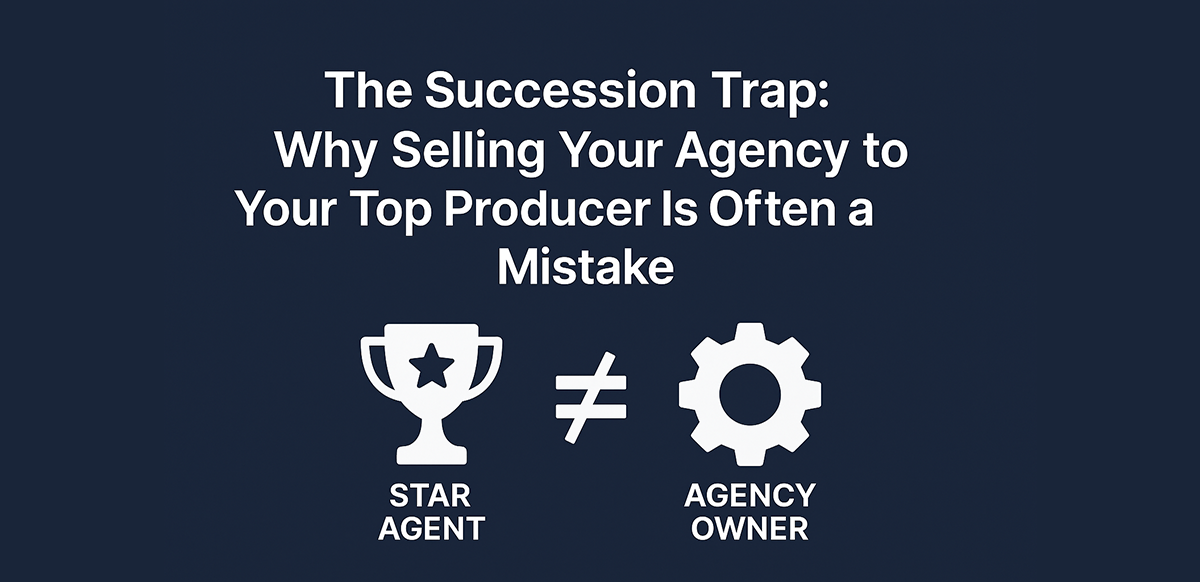
Top producers are not always suitable successors because selling and running an agency require different skills. Succession needs leadership, finance, systems, and culture fit.
For many agency founders, the transition plan feels simple and satisfying: sell the firm to your best negotiator. They're loyal, they know every client, and they top the leaderboard.
But running an agency is a different sport entirely. Handing the entire firm to your star agent is often like replacing a master conductor with a brilliant solo violinist. The skills required for each role are fundamentally, and profoundly, different.
The core of the problem is a mismatch of competencies. The traits that make someone a legendary sales agent are not the ones needed to successfully manage a business and scale an organization.
| Star Player Excels At (Tactical Focus) | Agency Owner Must Excel At (Strategic Focus) |
|---|---|
| Closing, persuasion, and personal pipeline management. | Strategy, organizational design, and long-term goal setting. |
| Relationship farming and individual contribution. | Finance (P&L, cash flow, budgeting, and capital allocation). |
| Tactical execution and managing self. | Systems: HR, compliance, marketing infrastructure, and mentoring. |
Asking someone to leap from one column to the other without years of preparation is precisely where most successions fail.
1. The Operator vs. Entrepreneur Dilemma
Your top producer is an excellent operator—they thrive within the system you built. But can they build, maintain, and evolve that system? They often lack the passion or the skill for essential entrepreneurial tasks: handling payroll, securing software contracts, maintaining compliance, and managing the marketing budget. They want to sell; they do not want to run the company.
2. The Relationship Transfer Illusion
A large portion of your agency's true value lies in the founder's goodwill—the loyalty of key vendors, landlords, and investors tied directly to you. When you step away, a significant amount of that personal relationship capital leaves with you. The ensuing client attrition post-handover dents the firm's valuation and kills momentum.
3. The Vendor-Financed Risk
Your top producer earns a great income, but they typically lack the capital for a full buyout. This often forces the founder into a vendor-financed deal, where your retirement becomes a loan to an inexperienced owner. If the new owner struggles with profitability, your financial security is directly jeopardized.
4. The Culture Shock
The transition from peer to boss is toxic to culture. Dynamics trigger departures; resentment can build among former equals, and the "family" you built can erode rapidly. The top producer may lack the nuanced leadership skills to manage conflict and preserve the organizational morale that made the agency successful.
Selling your legacy requires a strategic approach, not a sentimental default.
Succession is a long-term project. Name potential candidates and immediately agree on a non-sales learning path focused on management and finance.
Test their leadership capacity in low-stakes environments before entrusting them with the whole firm. Their success in these areas is the real readiness indicator:
Often, the best buyer is not inside your firm. A strategic buyer, a larger competitor, or a complementary merger partner can provide a higher valuation and a de-risked retirement by offering a clean cash exit.
The most balanced path involves a small cross-functional team (e.g., top sales agent + operations manager + property manager) pooling capital, risk, and—most importantly—skills. This creates a balanced leadership team ready to manage the full complexity of the business.

Founder of ListingMine and author of Agent for Life. Building ERP for Malaysian real estate agencies since 2008 — and writing to reshape how agencies grow.
More about Marvin Foong →More articles in this topic
This article is one of the sources behind this assessment. Take it to see what you already know and what to read next.
Educational self-assessment. Not a licensing examination or professional certification.