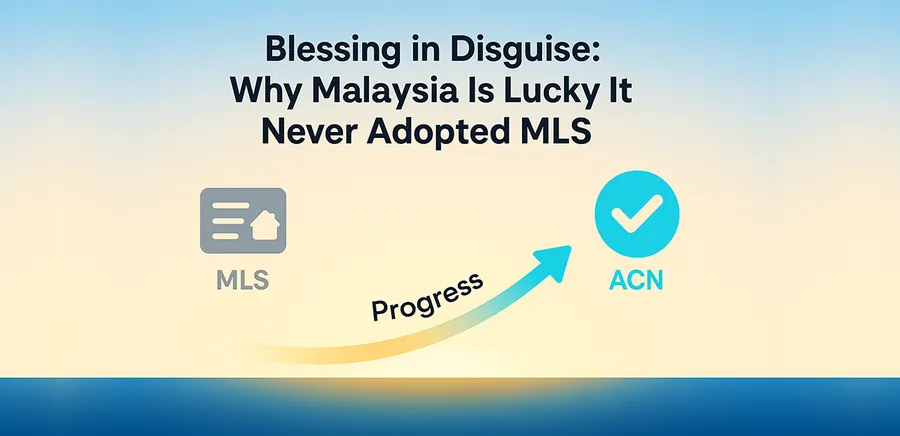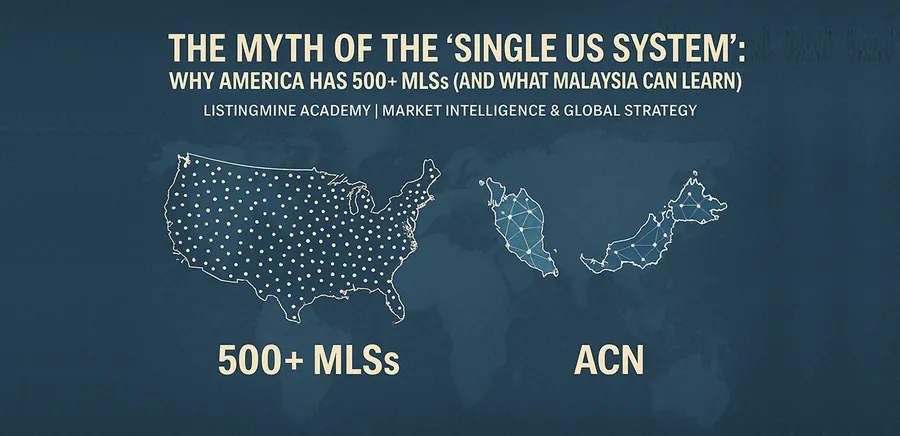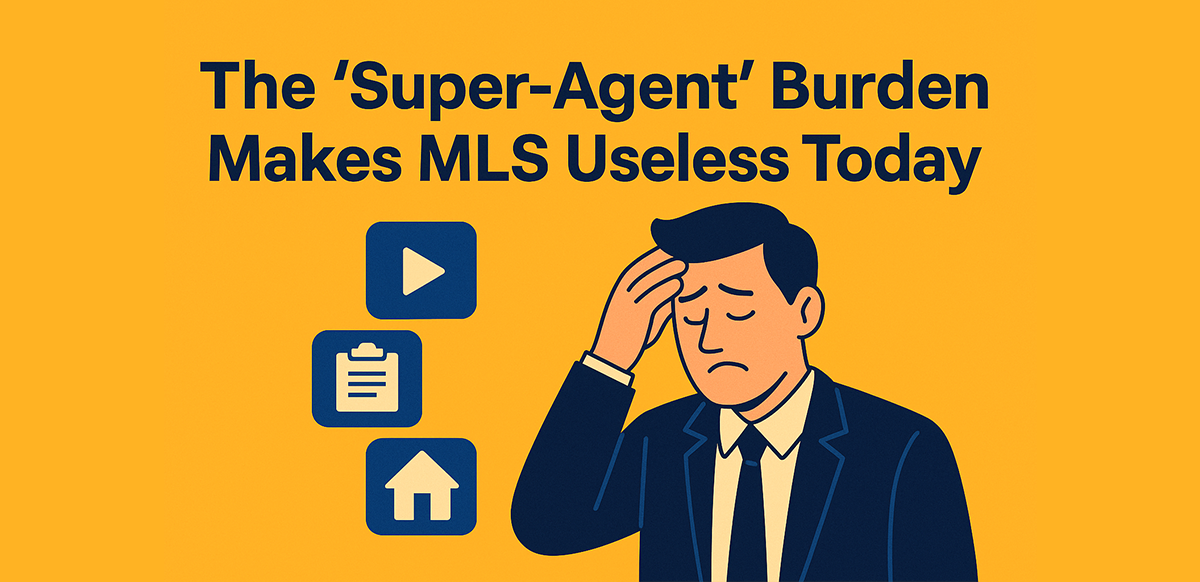
Modern agents are overloaded with too many tasks for a simple MLS-style listing system to solve their problems. ACN can distribute work across specialized roles instead of expecting one super-agent to do everything.
ListingMine Academy | Real Estate System Design
The Multiple Listing Service (MLS) was created for a simpler world:
One agent listed a property
One agent brought the buyer
Two roles
One cooperation workflow
And in that era, MLS was genuinely effective.
But the modern real estate industry no longer operates on two roles.
Agents today are multi-discipline operators carrying more responsibilities than any legacy system was designed to support.
The industry evolved.
MLS did not.
And that mismatch is now structural.
A modern agent is expected to be:
This is not a job — it is a production pipeline.
This unsustainable expectation is the Super-Agent Burden.
MLS assumes agents can do everything.
A modern system recognises that no one should.
Despite this reality, MLS still recognises only two roles:
Listing Agent
Buyer Agent
This alone makes MLS deeply misaligned with modern practice.
To understand why MLS collapses today, we must first acknowledge what made it powerful.
| Traditional MLS Strength | Why It Worked in the Old Era | Why It Fails in the Modern Era |
|---|---|---|
| Full-time staff & human verification | Improved consistency when data was simple | Salary-based staff cannot verify ownership, appointment letters, or compliance; they check form, not truth |
| Low subscription fees (non-profit model) | Affordable and predictable cost | Subscription = cost even with zero closings; modern agents prefer success-based economics |
| Strong laws & rigid governance | Gave the industry stability | Laws restrict adaptability; MLS cannot change role structures, workflows, or commission logic |
| Centralised data for visibility | Solved scarcity of information | Visibility is abundant; centralisation breaks in a verification-first ecosystem |
| Cooperation culture (in theory) | Worked when there were only two roles | MLS cannot track contributions, timestamps, evidence, or distribute incentives fairly |
The strengths that once made MLS useful now limit it.
Modern transactions involve 8–12 contributors, but MLS still only acknowledges:
Listing Agent
Buyer Agent
This results in:
MLS cannot remain relevant in a multi-role environment because its architecture cannot see the multi-role environment.
To understand why ACN replaces the MLS model, compare them side-by-side:
| Category | MLS (Legacy Model) | ACN (Modern Architecture) |
|---|---|---|
| Role Structure | 2 roles | 8–12+ micro-roles |
| Contribution Tracking | None | Time-stamped proof-of-work |
| Commission Allocation | Fixed 50/50 or negotiated split | Automated, verified, role-weighted |
| Economic Model | Subscription (pay even if no success) | Success-based (aligned incentives) |
| Verification | Staff check formatting only | Evidence, logs, audit trails |
| Workflow Flexibility | Rigid; cannot adapt | Roles added/removed instantly |
| Governance | Committee-based, political | Automated enforcement; PDPA/AMLA compliant |
| Technology Fit | Built for visibility | Built for verification |
| Scalability | Breaks under complexity | Thrives in team-based environments |
The difference is structural:
MLS = visibility era
ACN = verification era
ACN is not a blockchain, not a public ledger, and not a committee-run platform.
It is a role-based transaction log inside the ERP:
Every action (add listing, verify unit, schedule viewing, conduct viewing, submit offer, confirm loan) creates a time-stamped event.
Each event locks to a role, agent, listing, and transaction.
Events cannot be edited — only appended.
The commission engine reads these events to determine who contributed what.
This is what “proof-of-work” means in ACN:
traceable evidence, not memory or opinion.
Commission allocation is equally straightforward:
The agency defines role weights
The system detects who fulfilled each role
The ERP allocates commission automatically
No politics, no manual overrides, no disputes.
MLS became bureaucratic because rules were set at the industry level:
Association bylaws
Committees
Mandatory procedures
Static role definitions
The ACN model avoids this trap completely.
ACN governance is bottom-up:
Rigid on proof.
Flexible on culture.
This is why ACN can evolve at the pace of the market — without waiting for industry committees to agree.
Real estate will always be a human business.
Agents still:
ACN does not replace these human elements.
ACN removes the friction that damages them:
Misunderstandings
Screenshot disputes
“He said, she said” debates
Middle-management politics
Ambiguous contributions
With a neutral, event-driven backbone, cooperation becomes cleaner — not colder.
ACN strengthens the human relationship by removing the parts that ruin relationships.
Many clients prefer to deal with one trusted point of contact.
ACN supports this perfectly.
Under ACN:
It is similar to how:
A surgeon fronts a medical team
A lawyer fronts a legal team
A pilot fronts an aviation crew
The client gets simplicity.
The agent gets support.
The system ensures fairness.
ACN doesn’t eliminate the super-agent — it rescues them from burnout.
Western markets cannot evolve easily:
Strong MLS associations
Fixed bylaws
Rigid workflows
Frozen two-role structures
Subscription-based economics
Committee-driven politics
Malaysia avoided all of this.
Because MLS never took root here, Malaysia now enjoys:
Malaysia can build a pure, distributed, verification-first ACN ecosystem from day one.
This is a structural advantage that MLS-dominated markets cannot replicate.
MLS’s original strengths are now weaknesses:
Human verification → no truth
Subscription pricing → wrong incentives
Strong laws → frozen evolution
Centralisation → incompatible with verification
Two-role structure → cannot support modern workflow complexity
The Super-Agent Burden reveals the truth:
MLS is misaligned with how real estate actually works today.
Modern real estate requires:
These are the foundations of ACN.
MLS belongs to the visibility era.
ACN belongs to the verification era.
And Malaysia is uniquely positioned to lead this evolution.
If you’re serious about understanding how Malaysia’s real estate industry will evolve, explore the full library at ListingMine Academy.
Every article is original writing from the ListingMine founder—rooted in real operational experience, system architecture, and agency economics.
You’ll learn how to:
Topics include:
Commission architecture
Leadership strategy
Governance and compliance
ACN workflow design
ERP logic and automation
Agency economics
Market evolution
When you’re ready, create your ListingMine account and follow the built-in steps to launch your agency’s ERP:
No consultants
No manual configuration
No custom coding
No theory
Just a system that works — and grows with you.

Founder of ListingMine and author of Agent for Life. Building ERP for Malaysian real estate agencies since 2008 — and writing to reshape how agencies grow.
More about Marvin Foong →More articles in this topic
This article is one of the sources behind this assessment. Take it to see what you already know and what to read next.
Educational self-assessment. Not a licensing examination or professional certification.