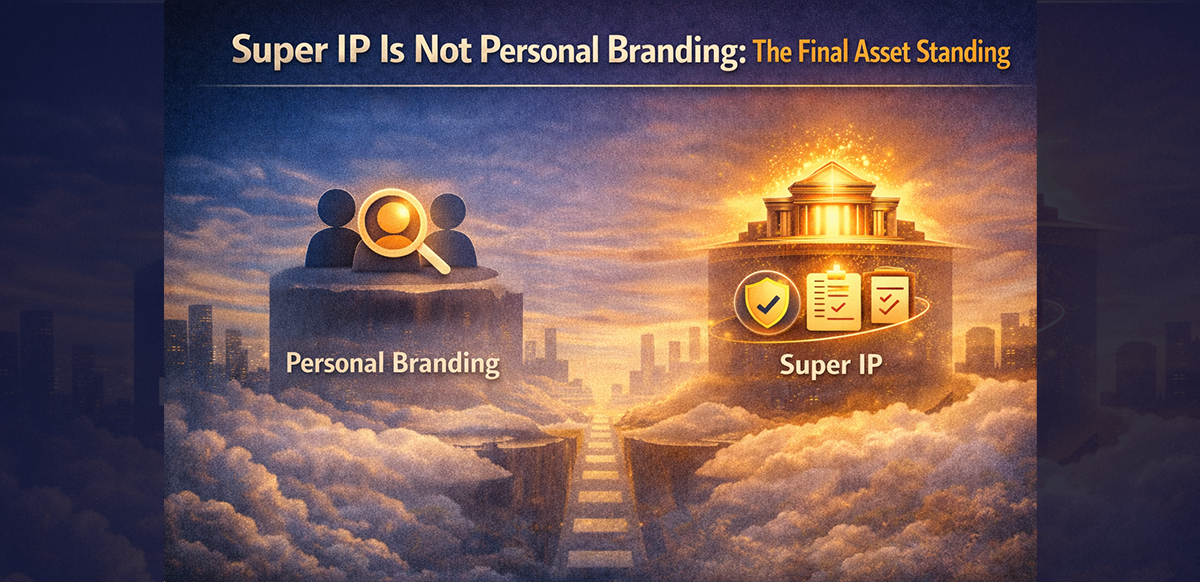
Personal branding creates attention, but Super IP creates durable intellectual property that survives platform changes and career shifts. The strongest agent asset is reusable knowledge, doctrine, and market authority.
The Malaysian property transaction is being hollowed out. Portals own the listings. Developers own the launches. Banks own the financing. Lawyers own the paperwork. Technology has eaten every other point of scarcity. What is left for the agent is supposed to be trust.
But even trust—when built on handshakes, office signboards, and generic “personal branding”—is now being commoditized. It is copied, diluted, and traded cheaply. The only trust that still holds value is architected, scalable, and portable.
That is Super IP. Not as a trend, but as the final asset standing when everything else becomes a cheap, copyable feature.
Most agents fail not because they are bad at branding, but because they are building the wrong thing.
A personal brand is found on search. It is passive, reactive, and demand-driven. It answers an existing question (e.g., "Who is an agent in PJ?") only after intent is already formed.
A Super IP is discovered before the search even begins. It is active distribution. It appears at the moment of confusion, fear, or pre-decision anxiety. It is the oracle that answers the question before the client knows how to phrase it.
A personal brand is a name; a Super IP is a destination. People don’t look for it—they gravitate toward it, because that is where clarity lives.
A standard personal brand tells people what you do. A Super IP dictates how people think. It installs itself into the client’s mental operating system as the default logic for a specific, high-stakes scenario.
The Three Battlefield Components
The agency-first model is collapsing quietly. Consumers no longer trust corporate logos or "Number 1 Agency" claims. They trust practitioners whose content feels like real work, not promotion.
At the same time, the Attention Tax is rising. As paid ads get more expensive, lead quality drops and competition increases. Super IP doesn’t just eliminate ads; it creates organic discovery and inbound intent.
This isn’t branding. It’s capital efficiency. And in any efficient market, capital compounds for the few. This leads to the SEO Paradox of the mind.
The market can only accept a few "top-of-mind" IPs because of cognitive load. A buyer or seller does not have the bandwidth to follow 30 experts; they will keep 2–3 in memory per niche.
This creates Power Law outcomes:
Trying to be a "generalist" today is like trying to rank for a head keyword against a billion-dollar incumbent. You will pay the Attention Tax forever.
The only escape is to own a Long-Tail IP—to be the micro-category king of a patch of problem-soil so specific that comparison disappears.
If you cannot out-shout incumbents, you must out-architect them.
The future of the Malaysian market is not a bigger agency; it is a network of high-trust nodes.
In this model, property moves from a relationship-based art to knowledge-based engineering. You don't need a thousand mediocre agents to behave well; you build rails where trust is earned by proof and reputation is portable.
Super IPs are the front-end trust layer. The system is the back-end enforcement layer.
The market is already speaking. The "good agent" is dying; the Micro-Category King is being born.
You have two paths:
Super IP is not about popularity. It is about being the only person in the room when a specific, valuable problem needs solving.
That is not a strategy anymore—it is the only exit from the commodity trap.

Founder of ListingMine and author of Agent for Life. Building ERP for Malaysian real estate agencies since 2008 — and writing to reshape how agencies grow.
More about Marvin Foong →More articles in this topic