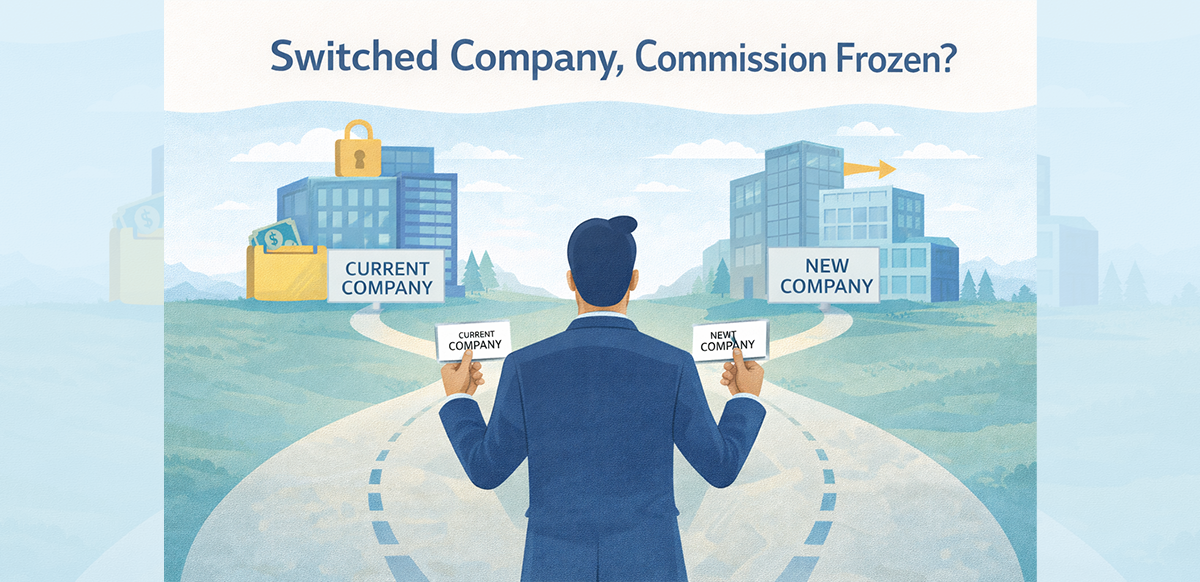
Agents who change companies may face frozen or delayed commissions if rules, timing, or documentation are unclear. Proper commission records and exit procedures protect both agents and agencies.
In Malaysia’s property industry, there is a situation that many agents recognize but rarely discuss openly. An agent decides to leave their current agency because they feel misaligned with the commission structure, leadership style, growth path, or operational culture.
The decision may have been developing for months. However, at the moment they are ready to move, a structural complication appears: several commissions are still pending.
Technically, the income has been earned through effort, negotiation, and follow-up, yet it has not been formally released.
This creates a tension that is both financial and psychological. The agent wants to resign, but resignation feels risky because a significant portion of income remains inside the existing structure.
As a result, different responses appear:
The central issue is not whether this behavior occurs. The deeper question is whether such a culture reflects a mature professional ecosystem.
From the agent’s perspective, commission-based income creates immediate financial sensitivity. Unlike salaried employment, cash flow in real estate is irregular and often delayed.
If multiple transactions are pending completion, the amount tied up can represent months of personal income.
When an agent considers switching companies, the fear is not abstract. It directly affects:
The agent may reason that they:
In their mind, the commission represents completed effort.
Therefore, linking payout timing to continued affiliation can feel restrictive. The agent may simply be trying to protect income they believe they have already earned.
When survival and financial certainty are involved, caution becomes rational.
However, when agents feel unable to exit openly because income remains pending, the environment begins to cultivate silence rather than transparency.
A more sensitive situation sometimes appears during transition.
An agent has internally decided to leave but has not officially resigned because commissions are still pending.
During this period:
From the old company’s perspective, this behavior appears unacceptable.
The agent is still legally affiliated, still benefiting from the company’s credibility, yet channeling business elsewhere.
It appears disloyal and unethical.
From the agent’s perspective, however, the reasoning may feel defensive rather than malicious.
This dual perspective exposes the fragility of the transition process.
When exit rules are unclear, behavior shifts underground.
What should be a professional handover becomes a quiet strategic maneuver.
A healthy system does not force people into such dilemmas.
From the agency’s perspective, commission release is not purely a matter of goodwill.
Transactions can collapse before full completion.
Administrative responsibilities also remain even if an agent leaves mid-process.
Agencies often structure commission payout around completion milestones for operational protection.
This is viewed as risk management rather than punishment.
Agencies may believe that agents who leave before completion should still remain accountable for unresolved issues.
Both sides therefore operate from understandable logic:
Yet rational logic does not automatically produce a healthy culture.
When agents feel compelled to switch companies discreetly while waiting for commission clearance, a structural signal appears.
The signal is mistrust.
If exit procedures were predictable and fair, secrecy would not be necessary.
Instead, several behaviors emerge:
Instead of a professional transition, the process becomes political.
Loyalty becomes conditional on financial timing rather than belief in shared direction.
At the same time, agencies respond defensively.
This cycle gradually reinforces itself.
Mobility itself is not unhealthy.
In Malaysia’s property sector:
The issue is not movement. The issue is the structure surrounding movement.
If an agent cannot leave openly without fearing loss or delay of earned commission, the system may rely on financial leverage as a retention mechanism.
If agencies fear releasing commission quickly, the system may lack structural safeguards.
When transitions lead to silent resignations and secret submissions, exit mechanisms become emotionally charged rather than structurally clear.
A healthy ecosystem requires:
When clarity exists, secrecy becomes unnecessary.
At its core, the issue is architectural rather than personal.
If earned value remains tightly bound to affiliation, transitions will always produce tension.
Healthy systems separate several elements clearly:
Mature industries design systems that protect both sides.
Transparency replaces suspicion. Structure replaces leverage.
Malaysia’s property industry is still evolving. Much of its culture remains relationship-driven rather than system-driven.
However, as digitization and standardization increase, there is an opportunity to build cleaner transition mechanisms.
Doing so strengthens institutional trust rather than weakening agencies.
When an agent switches company and commission feels frozen, and when new cases quietly flow elsewhere before official resignation, it reveals more than individual behavior.
It reveals structural fragility.
Organizations that retain people through belief cultivate long-term strength.
Organizations that retain people through friction cultivate silent exits.
The industry does not need to eliminate mobility.
It needs to normalize transparent movement.
Until that clarity exists, the question “Switched Company, Commission Frozen?” will continue to circulate quietly in conversations.
And whenever something must be handled quietly instead of clearly, it signals that architecture—not just attitude—requires improvement.

Founder of ListingMine and author of Agent for Life. Building ERP for Malaysian real estate agencies since 2008 — and writing to reshape how agencies grow.
More about Marvin Foong →More articles in this topic
This article is one of the sources behind this assessment. Take it to see what you already know and what to read next.
Educational self-assessment. Not a licensing examination or professional certification.