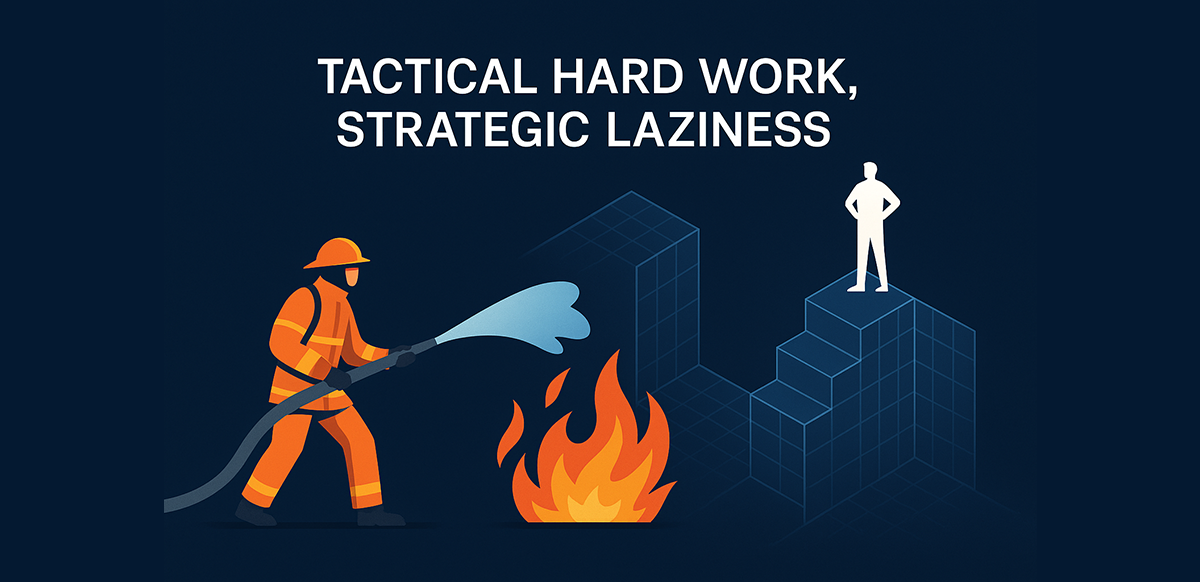
Agents and bosses may work hard daily while avoiding strategic thinking. Long-term success requires working on the right system, not only doing more tasks.
Why Agency Owners Stay Busy — But Never Move Forward
Most agency owners work themselves into the ground.
They are excellent tactical operators — solving problems every hour, running from one fire to another, and constantly making urgent decisions to keep the lights on.
But beneath this daily churn of "doing," a quiet truth is hiding:
They are not being strategic at all.
They are trapped in tactical hard work that masks strategic laziness.
True tactical discipline means solving a problem once.
Strategic laziness means solving the same problem repeatedly — because fixing the root cause feels too difficult, too abstract, or too politically risky.
Every agency in survival mode follows the same self-defeating loop:
Problem: Top agents leave.
Reaction 1 (Tactical Fix): Raise commission or offer a massive signing bonus.
Result: Short-term calm, long-term fragility.
Reaction 2 (Strategic Laziness): Recruit replacements, pour more energy into training — only to repeat the cycle six months later.
It feels productive because you're always doing something.
But all you're doing is managing churn.
And churn isn't a problem to eliminate.
It's a constant to design around.
Every founder eventually confronts a hard truth:
You cannot stop people from leaving. No contract or bonus scheme is foolproof.
The real question is — when they do leave, does your ecosystem retain the relationship, or does it lose the transaction?
That's the hidden difference between defensive agencies and designed networks.
When your system is built on override hierarchy, churn breaks everything — the chain collapses.
When your system is built on Alliance-style external co-broking — a structure where teams can still close deals across agencies — churn becomes survivable.
Because when a person leaves, they don't leave the network.
They remain within the same Alliance co-broking layer, still matching listings, sharing buyers, and contributing to your ecosystem's GMV (the total value of all deals flowing through your network).
That's not control.
That's design.
The Alliance ACN model takes this a step further.
It doesn't just retain people — it retains brands.
Under the ACN framework:
This model scales trust horizontally — turning competitors into collaborators without blurring their boundaries.
And once you embrace this mindset, it starts solving other long-term problems too:
In short — you stop losing value every time someone moves.
You start compounding it.
Control is cheap.
Trust is expensive — and therefore valuable.
You can't stop churn.
But you can absorb it through system design.
That's what separates a tactical operator from a strategic builder.
| Old Model (Strategic Laziness) |
New Model (Strategic Design) |
|---|---|
| Retention by fear and override | Retention by fairness and proof |
| Loyalty enforced by hierarchy | Loyalty sustained by shared ecosystem |
| Each exit weakens the company | Each exit expands the network |
| Boss manages churn manually | System redistributes value automatically |
Strategic laziness doesn't mean doing less.
It means building frameworks so complete that your system works harder than you do.
When your Alliance co-broking layer keeps people connected,
when your ACN model keeps brands aligned,
when your ERP allocates commissions by proof, not personality —
That's when you earn the right to be lazy.
Not lazy in effort.
Lazy in management.
Because the machine finally runs itself.
Every agency can survive by working harder.
Only the next generation will grow by designing smarter.
You don't have to build a company that is immune to churn — that's impossible.
You have to build a network that thrives despite it.
That's the real strategic laziness:
the kind where your system — not your stress — keeps the business alive.

Founder of ListingMine and author of Agent for Life. Building ERP for Malaysian real estate agencies since 2008 — and writing to reshape how agencies grow.
More about Marvin Foong →More articles in this topic