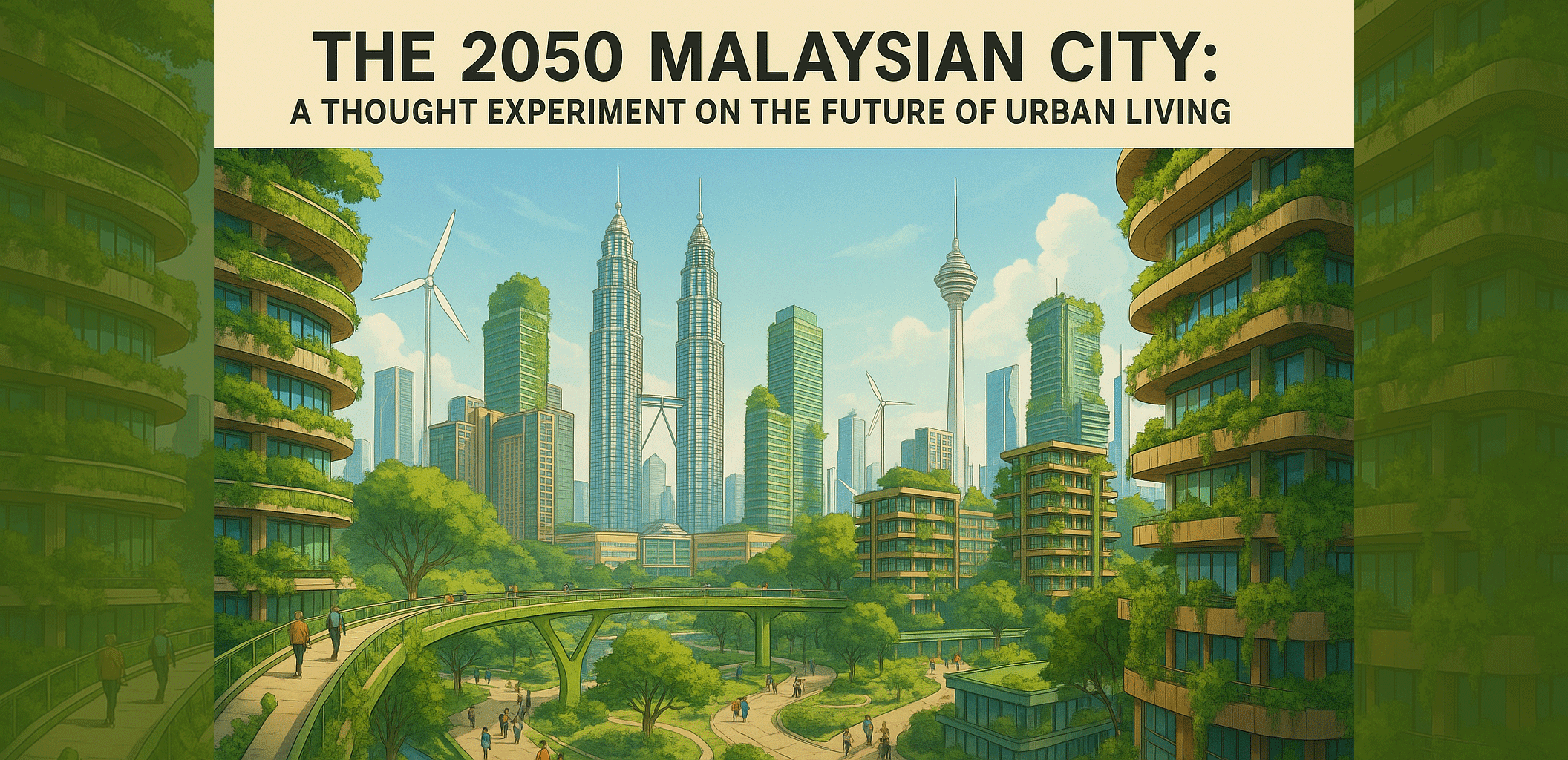
Malaysia’s future cities may be shaped by demographics, transport, density, work patterns, climate, and technology. Agents should think long term about urban demand.
Beyond buildings and transport—toward a living system built on trust, resilience, and shared humanity.
By 2050, more than 88 % of Malaysians will live in cities. This transformation is happening under the twin pressures of population growth and climate disruption. Resilience is no longer optional; it’s a matter of national security. Rising heat, sea-level threats, and supply-chain fragility make future-proofing not just an environmental issue, but a civic obligation.
Malaysia’s urban future isn’t about taller towers or smarter grids—it’s about whether we can build cities that remain livable, inclusive, and profoundly human. This is a thought experiment—not in architecture, but in values.
A city can be efficient without being alive. The challenge of 2050 is to keep our humanity intact inside an urban machine.
Between home and work lies the heart of community—the third place. Hawker centres, parks, open terraces, and digital-free lounges are the oxygen of urban life. They spark unplanned connections in a world otherwise scheduled by algorithms.
Malaysia’s identity lies in coexistence. Vertical kampungs—high-rise communities designed with shared kitchens, terraces, and prayer halls—will fuse the kampung spirit of gotong-royong with futuristic design, ensuring density doesn’t erase belonging.
A human-centric city is one that guards mental balance. Biophilic design integrates nature into every block; quiet districts buffer against noise stress; wellness centres and tele-therapy pods are embedded within 15-minute neighbourhoods. A truly advanced city doesn’t just connect people—it restores them.
Smart cities can easily become surveillance cities if ethics lag behind engineering.
Every citizen’s data must be treated like public water or power—a right, not a commodity. Ownership, consent, and transparency are core utilities of digital life. A smart city that isn’t fair is simply a faster engine for socio-economic inequality.
A mature city knows how to fail gracefully. Manual overrides, paper trails, and off-grid micro-grids act as safety nets when systems crash. True resilience isn’t total automation—it’s the humility to plan for imperfection.
Every Malaysian must have access to the same digital backbone—whether in Bukit Bintang or Bario. Smart infrastructure without universal access only deepens division.
Greenwashing dies in 2050. Real sustainability means ecological literacy embedded in every decision.
Cities become living ecosystems again. Sky gardens form migratory corridors, vertical mangroves filter runoff, and “pollinator balconies” turn high-rises into sanctuaries. Architecture stops fighting nature and starts co-evolving with it.
Waste is redefined as a resource. Building-level composting, greywater recycling, and material banks allow each neighbourhood to operate like a mini-ecosystem. Construction waste is logged, reused, and traded locally instead of exported.
Hydroponic towers rise from old car parks, rooftop farms crown residential blocks, and community gardens line every transit hub. The urban food grid shortens supply chains, enhances nutrition, and reconnects citizens to the soil beneath the skyline.
Mobility in 2050 is equitable by design. Autonomous vehicle (AV) networks serve as shared, on-demand shuttles connecting zero-fare public-transit zones. Hyperloop-style regional connectors link Penang, KL, and Johor within hours, decentralising opportunity. Smart grids balance solar surpluses from rooftops with real-time city demand. Infrastructure becomes quietly intelligent—anticipating human need instead of dictating it.
The most advanced cities aren’t those with the most sensors—but those with the most trust.
Data-driven governance lets citizens see how budgets, energy, and mobility are managed in real time. Success metrics shift from traffic flow to Social Cohesion Indexes (SCI)—tracking inclusion, participation, and shared prosperity. Citizens co-design urban policies through transparent digital platforms, replacing petitions with participation.
It’s 2050. Aisha, a designer in Johor Bahru, starts her day with yoga in her sky garden. She drops her daughter at a school ten minutes away and buys breakfast from a hawker using her city-wallet. Her first meeting is in a nearby co-working pod—no commute required. At noon, a smart-grid alert offers discounts for running appliances during peak solar hours. In the evening, she borrows a community tool via app, checks air-quality levels, and cycles to the waterfront. Her world is dense and digital—but also calm, restorative, and deeply human.
These are not technical problems—they’re moral ones.
The 2050 Malaysian city is not a fantasy of technology—it is a test of governance, empathy, and imagination. Its measure of success will not be connectivity, but community. Its progress will not be speed, but fairness.
If we build with wisdom today, 2050 won’t be a future we fear—it will be a future we’ve earned together.

Founder of ListingMine and author of Agent for Life. Building ERP for Malaysian real estate agencies since 2008 — and writing to reshape how agencies grow.
More about Marvin Foong →More articles in this topic