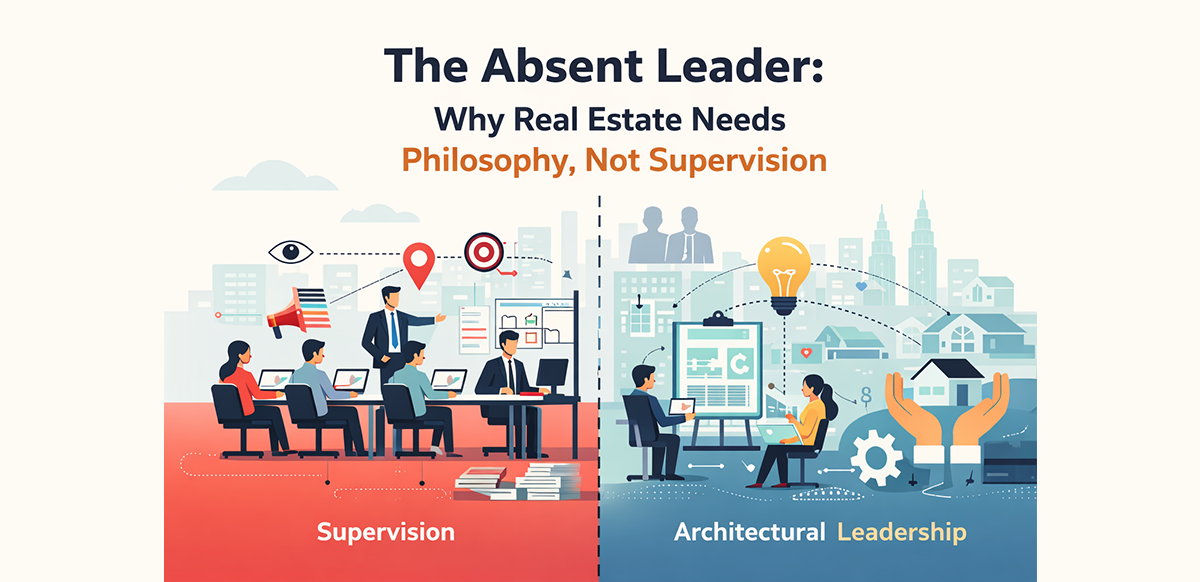
Real estate teams cannot depend only on constant supervision. Clear philosophy gives agents decision principles when the leader is not present.
In the Malaysian real estate sector, we have no shortage of managers. What we lack is institutional leadership.
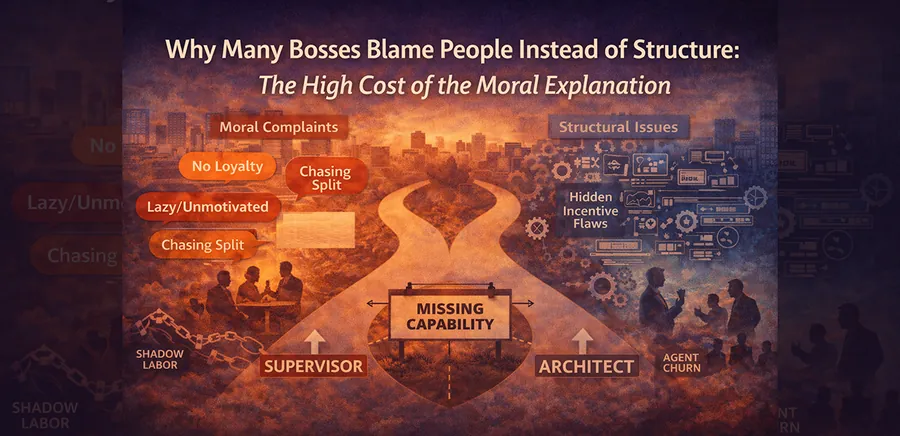
Management ensures activity. Leadership defines direction. The difference becomes obvious when supervision disappears. If productivity collapses the moment oversight is removed, what existed was control, not conviction.
History offers a recurring phenomenon. Many political and religious figures commanded extraordinary loyalty from people who never met them. Their followers never attended daily briefings. They never received personal supervision. Yet they acted with clarity, sacrifice, and consistency.
Why? Because those leaders did not merely manage people. They embedded a belief system.
They created Presence Through Absence. The real estate industry has not yet institutionalized that level of philosophical leadership.
When individuals act with conviction for leaders they have never personally met, the source of that discipline is not charisma alone but doctrinal clarity.
A shared framework replaces supervision, and alignment replaces monitoring.
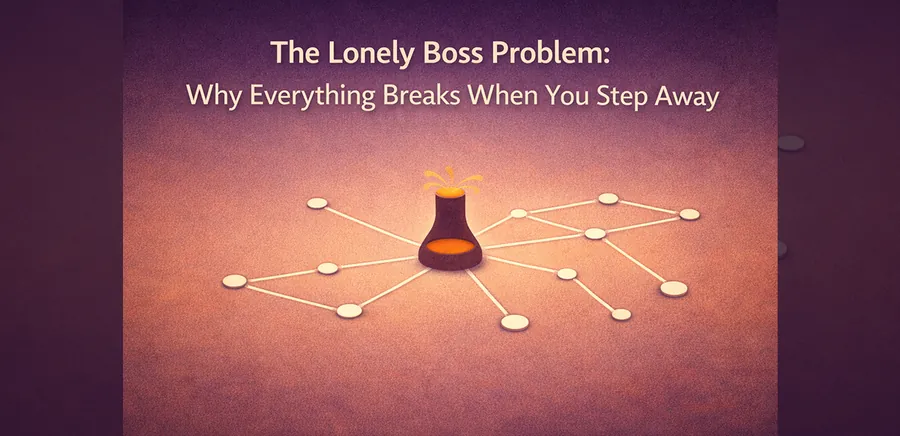
In many agencies today, however, leadership remains proximity-dependent. Performance improves when the leader is present and declines when attention shifts elsewhere. Such a structure is inherently expensive because it demands continuous emotional and managerial energy from the top.
True leadership creates coherence that survives absence.
It establishes a shared understanding of purpose that does not require daily reinforcement. When philosophy is clearly articulated, agents understand not only what actions to take but why those actions matter within a broader structural vision.
The result is self-regulation rather than imposed compliance.
In this sense, leadership becomes more efficient as clarity increases. Supervision remains useful, but it is no longer the primary driver of alignment.
Much of the Malaysian agency landscape remains personality-centered. Authority is frequently tied to visible success, lifestyle symbolism, or production records.
While such traits may generate admiration and short-term loyalty, they rarely produce institutional durability.
When leadership depends heavily on personality, it becomes fragile because performance is linked to continuous visibility.
Principle-centered leadership operates differently. It shifts authority from the individual to the underlying logic of the system.
Instead of asking agents to follow a person, it invites them to commit to a coherent framework.
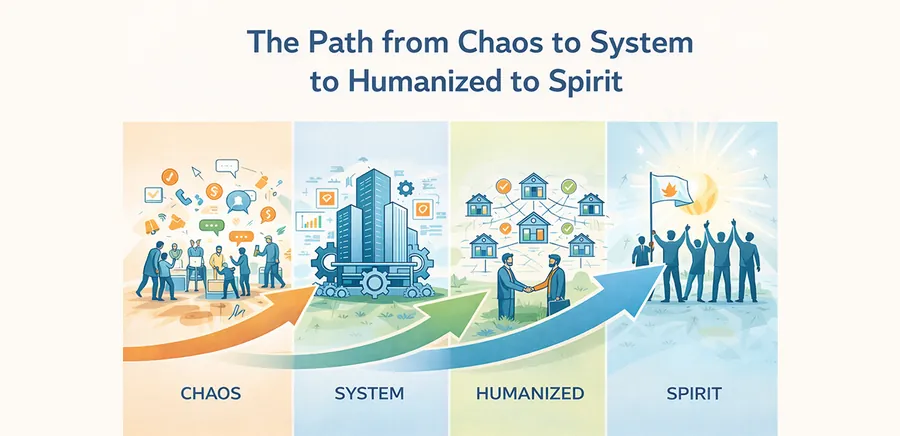
This shift transforms leadership from performance into architecture.
Organizations that endure beyond their founders do so because their doctrines are embedded in practice. Participants are not motivated solely by personal attachment; they are guided by structural clarity.
In contrast, proximity-based leadership weakens when the leader’s presence diminishes because the philosophy has not been fully internalized.
The Malaysian property sector currently operates within a high-friction leadership model.
Recruitment, retention, and motivation often rely on emotional reinforcement rather than institutional coherence.
Leaders expend significant energy sustaining morale because the system itself does not generate conviction.
Growth becomes dependent on constant managerial input instead of compounding architectural strength.
This vacuum often produces centralized control structures in which software, processes, and hierarchies are designed primarily to monitor output rather than distribute understanding.
When systems are extractive rather than generative, leaders must continuously supply energy that architecture fails to provide.
The result is managerial exhaustion and fragile scale.
The next phase of evolution in the Malaysian property market will not be determined by who recruits the most agents or spends the most on incentives.
It will be shaped by those who articulate the clearest and most coherent philosophy about how the industry should function.
Asymmetric conviction enables smaller, disciplined organizations to outperform larger but structurally disorganized ones.
When agents believe they are participating in a model that enhances professional sovereignty rather than reinforcing centralized dependency, their commitment deepens.
Structural hope is not mere optimism; it is confidence in a coherent architecture.
When participants see themselves as contributors to shared infrastructure rather than replaceable units within a corporate hierarchy, discipline becomes internalized.
Conviction reduces supervision cost because alignment emerges from belief rather than pressure.
In a modern property ecosystem, leadership must be architectural rather than performative.
It involves designing systems that continue to function even when the leader is not physically present.
It requires articulating principles clearly enough that participants can make consistent decisions independently.
When leadership becomes embedded in structure, it becomes capital-efficient.
In such systems, the leader’s absence does not create confusion. The shared logic guides action.
Agents are not following a personality; they are operating within a framework they understand and trust.
This is how institutions endure beyond individuals.
Philosophy becomes operating infrastructure rather than inspirational rhetoric.
The Malaysian property industry is not lacking ambition, talent, or effort.
What it lacks is institutional philosophy strong enough to transcend proximity.
The current model remains overly dependent on the boss being physically present to maintain intensity.
Momentum frequently depends on visibility rather than conviction.
Until philosophy is embedded into structure, scale will remain vulnerable to absence.
The future will belong to those who recognize that leadership is not primarily the management of people but the construction of belief systems.
When conviction is built into organizational architecture, supervision becomes secondary.
Participants act not because they are being watched but because they understand and believe in the system itself.
At that point, leadership ceases to be a daily performance and becomes durable infrastructure capable of sustaining growth beyond the individual who first articulated it.

Founder of ListingMine and author of Agent for Life. Building ERP for Malaysian real estate agencies since 2008 — and writing to reshape how agencies grow.
More about Marvin Foong →More articles in this topic