The Agency Boss's Vetting Guide: Should You Take That Developer Job?
In short
Agency bosses should evaluate developer projects based on payout timing, product fit, pricing, stock quality, support, and risk. Not every project is worth taking.
To every agency leader, the developer job is a siren song: guaranteed stock, brand visibility, and the promise of big bonuses. But behind the glossy proposals are landmines that can quietly decimate your cash flow, drain your team's morale, and lock up your best agents for a year—with zero payoff.
An appointment is not a trophy; it’s a business partnership. You must vet the developer ruthlessly. The wrong decision doesn't just waste effort; it actively consumes your agency's future.
Here is the essential due diligence checklist before you put your agency’s name on the line.
1. Product Vetting: Are You Selling Value or Vapour?
No amount of agent effort can sell an unmarketable product. Your first job is to protect your agents from a doomed mission.
Ask the Hard Questions:
- Target Match: Does their ideal buyer profile align with your agency’s active, existing buyer pool?
- Competitive Edge: What is the clear, quantifiable differentiator? If the project is priced above market sentiment or is structurally difficult to explain, walk away.
- Market Alignment: Is the layout and concept a fit for current demand? You are not in the business of performing miracles; you are in the business of margin.
2. Cash Flow Killer #1: Delayed Payouts
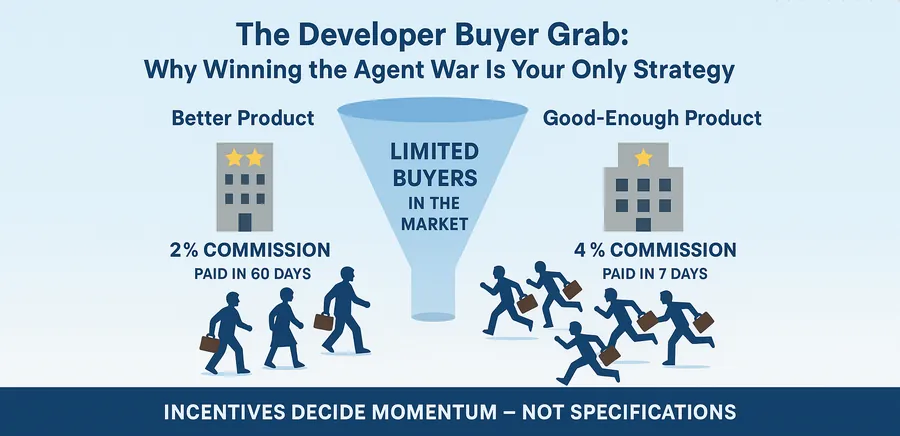
The commission amount is secondary to the payout timeline. A slow-paying developer is a silent killer of agency morale and retention.
Demand Transparency on Terms:
- The Schedule: What is the exact written timeline in the appointment letter? Is it 7 days or 2 years post-SPA signing?
- The Record: Get references. What is their documented past record with other agencies?
- The Risk: A predictable, lower commission is infinitely better than a huge commission that breaks your agency’s cash flow cycle. Slow pay is worse than low pay.
3. Commission Structure and Marketing Support
A developer's financial commitment shows how much they genuinely value your partnership. Higher base commission is obviously preferred, but look beyond the percentage to the added leverage they provide.
Assess the Full Value Package:
- Incentives & Tiering: Are there appealing tiered bonuses, free trips, or other incentives for achieving specific KPIs? These are crucial for boosting agent motivation and retention.
- Co-Marketing Support: Does the developer offer a budget for roadshows, overseas exhibitions, or local marketing fees? A developer who supports your marketing efforts is sharing the upfront cost and risk of the sale.
- The Leverage: A developer who provides marketing funds and performance incentives is giving your agency financial leverage that reduces your out-of-pocket costs and increases your effective margin.
4. Financial Gatekeeper: Vetting the End Financier
The developer's ambition means nothing if the buyer's loan can't cross the finish line. The end financier determines your deals' closure rate.
- Stick to the Majors: Prioritize developers backed by mainstream banks with recognized compliance standards.
- Warning Signs: Smaller or lesser-known financiers often lead to delayed disbursements, non-standard approval processes, and a higher rate of stalled sales—all through no fault of your team.
- Your Risk: If the bank fails to move, your sale collapses, and your agent's hard work is wiped out.
5. Legal Due Diligence: Where is the APDL?
This is non-negotiable. Selling without the Advertising Permit and Developer’s License (APDL) turns your agency into a volunteer waiting game.
- The Critical Line: Without an APDL, every booking is a risk. No APDL means no legal Sale & Purchase Agreement (SPA), which means no commission and no closure. Until APDL is issued, you’re selling a dream—not a legally recognised product.
- The Time Trap: Many agencies have held hundreds of bookings for months, only to have buyers back out when the APDL stalls.
- Decision Point: If the APDL isn't out within a confirmed, imminent timeline, you are committing your team to work for zero payout guarantee.
6. Reputation Check: Rumours Are Early Data
In this industry, rumours are your early-warning system. Use your network—a five-minute call to another agency boss can save you twelve months of regret.
- Agency Network: Are there whispers of unpaid commissions or broken promises?
- Leadership Track Record: Are the founders known for abrupt management, shifting goalposts, or questionable financial health?
- New Developer Test: If the developer is new, they must earn your trust. Demand transparency on their project funding, land title status, and cash flow plan to honour your commission. In this industry, silence is also data.
7. Assess the Opportunity Cost
This is pure business leadership. Your agency has limited manpower. Every bad developer job you take forces you to say NO to better, higher-margin opportunities elsewhere.
Run the Math:
- How many deals are required just to break even on your man-hours and marketing spend?
- Is the developer providing qualified leads, or expecting your agents to self-generate everything while facing product resistance?
- Are you being treated as a strategic partner or a disposable sales vendor?
If the projected effort and opportunity cost outweigh the potential margin, the "appointment" is a severe burden in disguise.
Final Verdict: Due Diligence Is Your Leadership
A serious developer welcomes tough questions because they need real partners, not blind promoters.
Your job is to protect your agency’s most precious asset—its trust, time, and cash flow. Saying "no" to a bad appointment is often the most profitable decision you will make all year.
A good developer amplifies your success. A bad one consumes it. Choose wisely, lead responsibly. Leadership is not about chasing every deal—it’s about defending your margins.