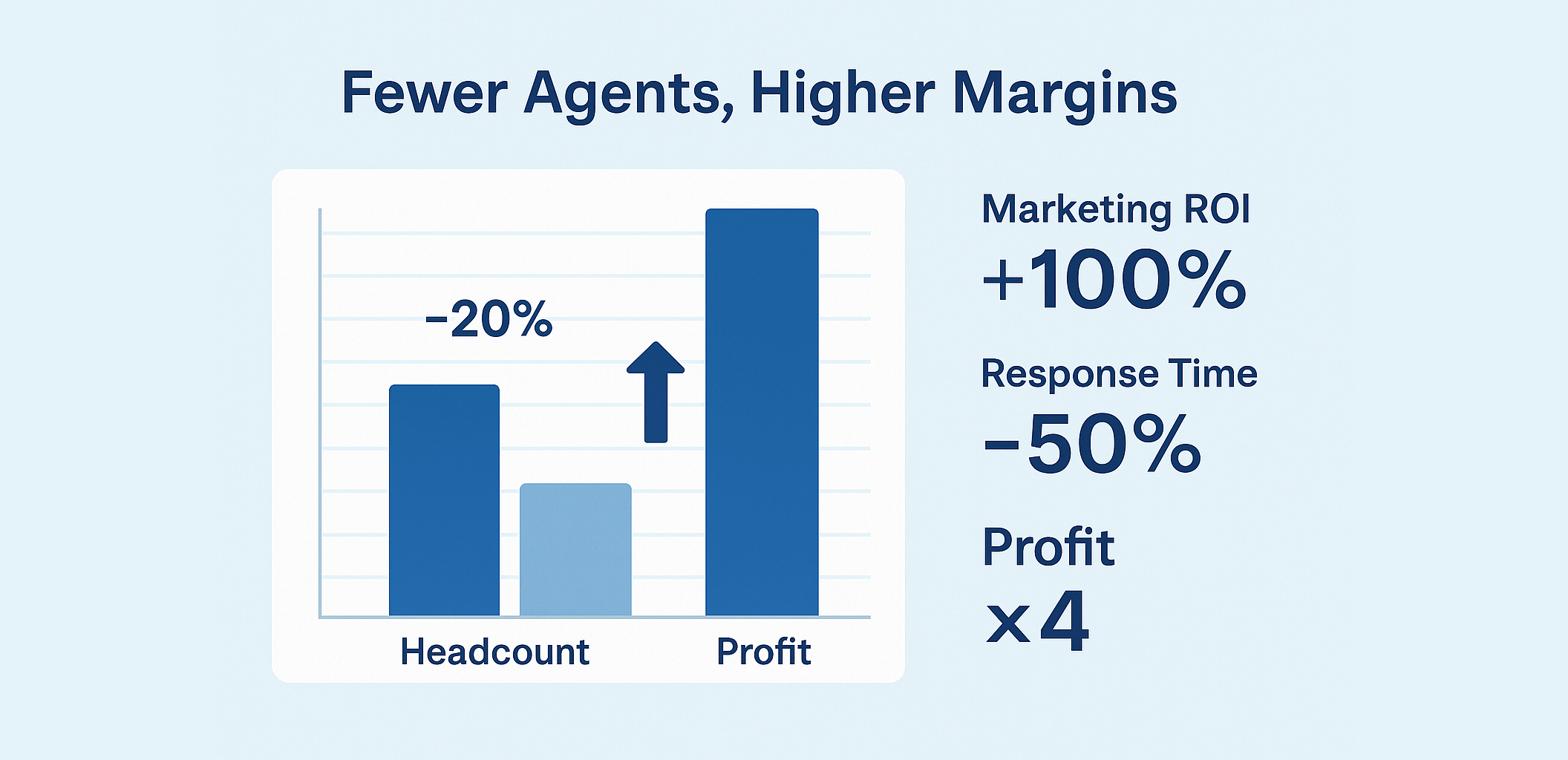
Removing inactive or harmful agents can improve profit, culture, and management focus. Quality of agents matters more than headcount size.
When Productivity Beats Headcount: How One Agency Discovered That Fewer Agents Can Mean More Money.
Most real estate agency owners chase a faulty metric: headcount. They assume more agents equals more revenue. But as one Malaysian agency learned the hard way, the exact opposite is often true.
For years, this agency was paralyzed by the Pareto Principle: 80% of revenue came from 20% of the team. The problem was far deeper than simple underperformance; low-output agents were actively consuming time, leads, admin attention, and team morale. Worse, top performers were leaving because the environment rewarded mediocrity. The result? Bloated payroll, unfocused leadership, and stagnant profit.
The agency realized its low-output agents were more than just deadweight—they represented negative performance across the entire organization:
The firm was structurally designed to support its weakest links, effectively capping its own potential.
The managing director made a radical strategic decision: a comprehensive, data-driven audit via their ERP system. The goal was to replace sentiment with statistics.
The audit mapped every agent’s efficiency:
The outcome was definitive: Nearly 25% of the team hadn't closed a deal in six months yet consumed 60% of the admin workload and 40% of the marketing spend. The choice became clear: trim the bottom 20% immediately.
The period immediately following the cleanup felt risky, but the results were transformative within 90 days:
By removing the deadweight, the company instantly regained clarity, cultural purpose, and robust cash flow.
Agency leadership realized that culture doesn't change when you try to motivate the bottom; it changes when you protect the top performers.
When agents who produce nothing receive the same time and resources as those driving 80% of revenue, the high performers stop caring. By enforcing measurable standards and sharing results openly, the agency shifted from a people-count business to a performance-based institution.
The decision wasn't just about firing; it was about rebuilding the structure so the problem could never recur. The agency institutionalized a framework that codified fairness and accountability:
This systemic structure made leadership scalable and consistently fair. Once the framework took over, the principal could finally focus on growth instead of managing internal mediocrity.
If you are running an agency today, ask yourself the defining question: Would your top 10 agents perform better or worse if your bottom 20% disappeared tomorrow?
Growth isn't just about endless recruiting—it's about aggressively raising the performance floor. When you reward structure, accountability, and discipline, profit doesn't just happen—it follows naturally.
Framework builds freedom. Firefighting burns it.

Founder of ListingMine and author of Agent for Life. Building ERP for Malaysian real estate agencies since 2008 — and writing to reshape how agencies grow.
More about Marvin Foong →More articles in this topic
This article is one of the sources behind this assessment. Take it to see what you already know and what to read next.
Educational self-assessment. Not a licensing examination or professional certification.