Shadowing seniors is not enough when the market and tools have changed. Modern apprenticeship needs structured training, systems, and measurable skill transfer.
For decades, the Malaysian real-estate industry has relied on a single, unquestioned pillar: Apprenticeship. Pair a new recruit with a "Senior." Tell them to follow closely. Assume success will transfer through proximity.
This model worked when the market was simple. In today's environment, it is not just inefficient—it is structurally dangerous. Because apprenticeship teaches imitation, not system design.
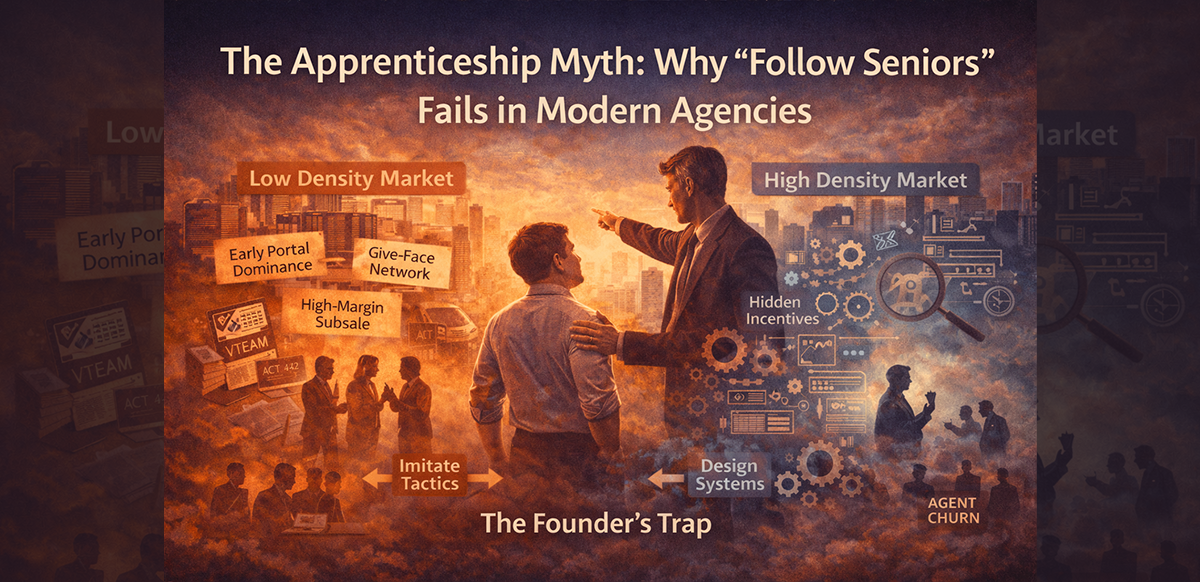
The core flaw in "Follow Seniors" thinking is the assumption that markets are static. They are not. Many of today's successful Seniors built their careers in a lower-density environment:
Their success was real—but contextual. When a Junior copies their behavior without understanding that context, they are applying a 2010 solution to a 2026 problem. And when it fails, no one knows why.
Apprenticeship trains Juniors to copy tactics: how the Senior talks, how they dress, and how they "handle people." But tactics are not systems. Tactics are the what. Systems are the why.
| Imitation (Tactics) | Architecture (Systems) |
|---|---|
| "Do what the Senior does." | "Understand how the lead funnel actually works." |
| "Watch how they negotiate." | "Analyze incentive alignment between parties." |
| "Copy their listing style." | "Study platform algorithms and network effects." |
| "Work as hard as they do." | "Design workflows that eliminate Shadow Labor." |
Imitation is fragile. When the Senior's niche disappears or the algorithm changes, the Junior—trained only to copy—has no diagnostic tools left.
The best Seniors are often Natural Producers. They win through charisma, intuition, and experience. But charisma cannot be taught, and intuition cannot be automated.
When agencies rely on apprenticeship, they are attempting the impossible: cloning personalities instead of building systems. The result is predictable:
This is how agencies fall into the Founder's Trap.
Apprenticeship survives not because it is effective—but because the industry lacks the language of structure. When a Senior cannot explain why their method works in terms of economics, incentives, or attribution logic, they default to: "Just watch me and do the same."
This is not wisdom. It is a failure of formalization. Without language, training becomes anecdotal.
With language, training becomes architectural.
Apprenticeship works in crafts where the tools never change. Real-estate today is not a craft industry. It is a system-driven, capital-efficient, algorithm-mediated market.
You don't need agents who are better clones. You need agents who are better system operators.
ListingMine Academy exists to replace imitation with architecture. We don't teach motion; we teach the machine.
Imitation says:
Architecture says:
That is the difference between copying outcomes and engineering repeatability. In modern agencies, repeatability beats talent—every time.

Founder of ListingMine and author of Agent for Life. Building ERP for Malaysian real estate agencies since 2008 — and writing to reshape how agencies grow.
More about Marvin Foong →More articles in this topic
This article is one of the sources behind this assessment. Take it to see what you already know and what to read next.
Educational self-assessment. Not a licensing examination or professional certification.