Senior agents often fail to train juniors because their knowledge is informal and unstructured. Apprenticeship needs repeatable systems, not casual shadowing.
Every agency dreams of a "next generation" that's better trained, faster closing, and more disciplined than the last. But in most teams, that dream never happens because mentorship depends on personality, not structure.
When senior agents are chasing deals, training juniors becomes optional. When juniors don’t learn fast enough, seniors stop sharing. When that loop breaks, the agency loses its most valuable asset: knowledge transfer.
Most agencies rely on goodwill, not systems, to develop talent. This creates an unsustainable cycle: A senior takes a junior "under their wing," but as soon as deals pile up, the senior retreats to survival mode. The junior, left undertrained, burns out or leaves.
This failure isn't malice; it’s entropy. Human mentoring fails because agencies never install structured transfer mechanisms that make training measurable, repeatable, and rewarded.
The problem isn't the people—it’s the lack of process. Seniors rarely grow their successors due to these five structural flaws:
| Cause | Description |
|---|---|
| Misaligned Incentives | Seniors are paid to close, not to teach. Without mentorship KPIs or overrides, coaching time is perceived as lost income. |
| Zero Documentation | Know-how lives only in heads and chat logs. No templates or case trails exist, making the knowledge transfer invisible and unscalable. |
| Lack of Visibility | Leaders can't see who's transferring what. There are no dashboards to track mentorship ROI or a junior's progress along defined skill bands. |
| Ego and Insecurity | Without transparent credit, top performers often guard their knowledge, feeling that sharing means losing their competitive edge. |
| No Time Bank | The system gives no measurable credit for teaching, ensuring "urgent" work (sales) always wins over "important" work (succession). |
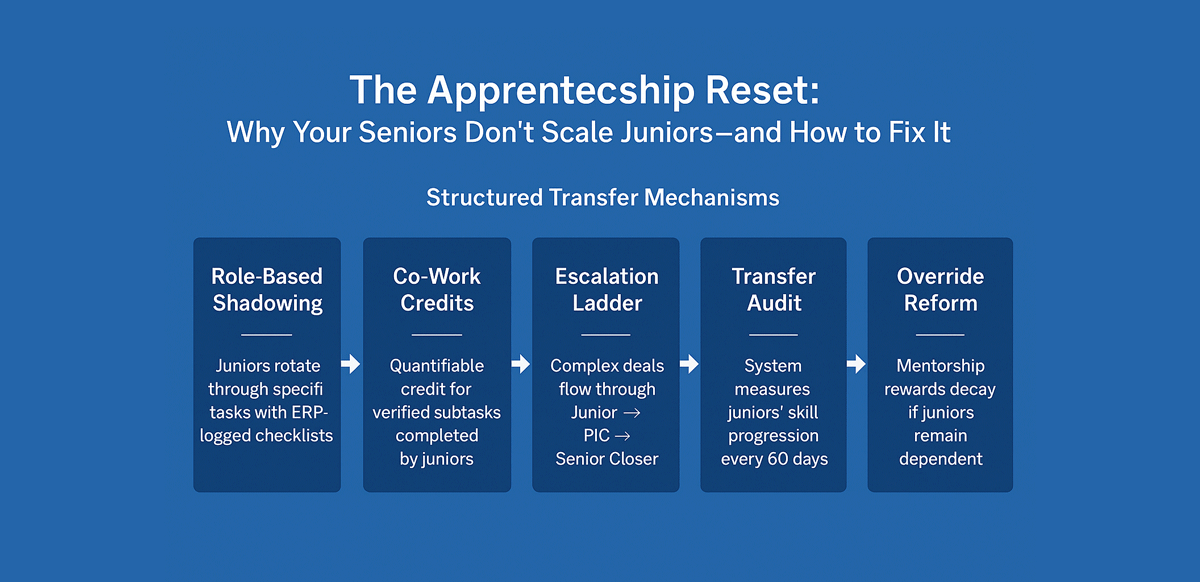
To truly reset the culture, mentorship must shift from charity to infrastructure—through Structured Transfer Mechanisms. These are automated, trackable, and reward-linked pathways for knowledge flow.
| Mechanism | Description | Impact |
|---|---|---|
| Role-Based Shadowing | Juniors rotate through specific tasks (e.g., listing prep) with ERP-logged checklists. | Progress is tracked by system, not memory. |
| Co-Work Credits | The Agency OS attributes quantifiable credit when a junior completes a verified subtask (e.g., supervised viewing). | Mentorship generates a measurable ROI for the senior. |
| Escalation Ladder | Complex deals flow through a clear chain (Junior → PIC → Senior Closer) with timestamped audit trails. | Juniors learn by doing and observing best practices within a defined structure. |
| Transfer Audit | The system automatically measures how many juniors move up defined skill bands every 60 days. | The KPI shifts to skill creation, not just revenue closure. |
| Override Reform | Mentorship rewards decay unless the juniors reach independent performance milestones. | Rewards creating capacity, not dependency. |
When these structured mechanisms live inside your Agency OS, mentorship stops being a hope and becomes a habit. The system automatically:
Tracks every learning event (deal roles, verified documents, supervised viewings).
Assigns quantifiable mentorship points.
Generates data-driven leaderboards showing who creates the most capable juniors.
That’s how an agency graduates from manual training to scalable apprenticeship—where culture lives in the process, not in people.
A senior who closes 10 deals is valuable. A senior who trains 5 others to close 10 deals each is irreplaceable.
The modern agency’s competitive edge lies in how efficiently experience becomes infrastructure. To scale sustainably, the system must protect and measure transfer, not just transactions.
When the Agency OS codifies teaching into workflow, every follow-up, document, and viewing becomes an apprenticeship event. That’s how you build an organization where seniors scale juniors—and the culture scales itself.

Founder of ListingMine and author of Agent for Life. Building ERP for Malaysian real estate agencies since 2008 — and writing to reshape how agencies grow.
More about Marvin Foong →More articles in this topic
This article is one of the sources behind this assessment. Take it to see what you already know and what to read next.
Educational self-assessment. Not a licensing examination or professional certification.