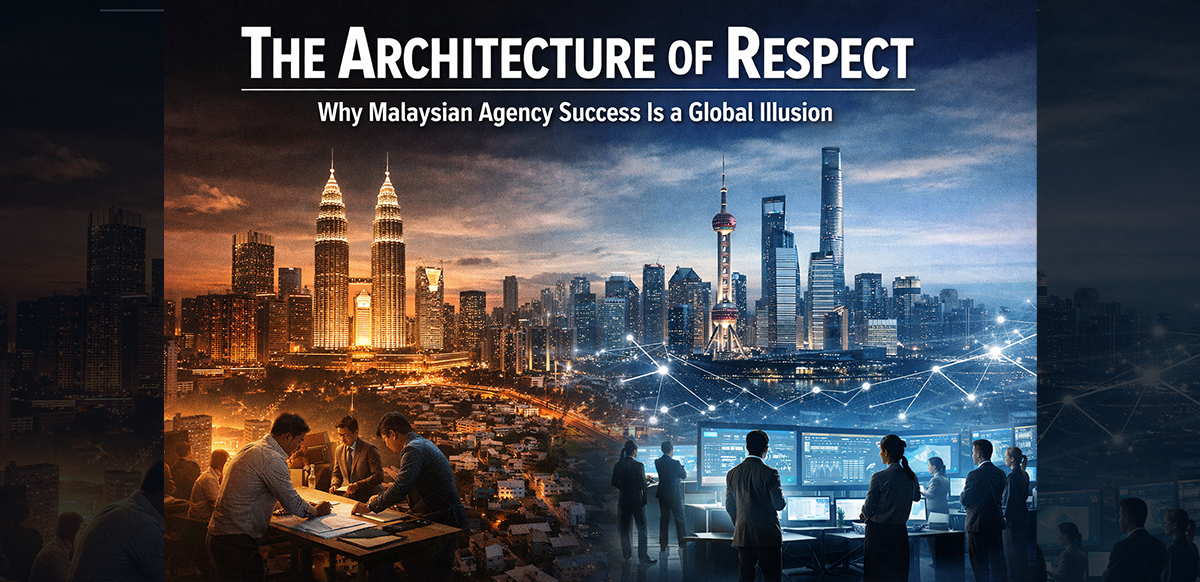
Malaysian agency success can look impressive externally while lacking deep respect, systems, or sustainability. Real respect requires structural strength, not only visible growth.
Many Malaysian real estate agencies eventually reach a plateau that feels like a peak. You've built a career. You close deals consistently. Your team respects you. Life feels stable—almost comfortable.
For a while, it feels like you've arrived. Then you travel overseas.
The illusion usually shatters in a regional office like JLL in Shanghai. You sit through what feels like a routine internal presentation. Someone casually references a single industrial or factory transaction.
It lands with quiet, clinical cruelty: Your entire year of sales volume doesn't equal one of their routine deals.
Not a trophy transaction. Not a once-in-a-career outlier. Just a normal Tuesday. No one mocks you; no one needs to. Scale speaks for itself. Your "success" suddenly looks like a rounding error in someone else's spreadsheet.
Next, you visit Beike or Lianjia. This is where the discomfort deepens—because it stops being about deal size and becomes about architecture. You realize you are losing on every operational front:
These are not just brokerages. They are vertically and horizontally integrated operating systems. They don't merely "sell houses." They orchestrate the entire property value chain:
In Malaysia, we often see these as "side incomes." In mature markets, they are data nodes. This is not diversification; it is control over dependency.
The most profound gap isn't capital or talent. It is language. In Malaysia, we are not just missing solutions—we are missing the vocabulary required to even describe our problems.
We know something is wrong. But we don't know what the problem is called. While we rely on vague descriptors like "hustle" and "street smarts," global leaders operate with precise technical language across every limb of the business:
An industry without language is an industry without levers. You cannot optimize a process you haven't defined. You cannot fix a system you cannot name.
You try to explain how things work back home. You talk about relationships, experience, and street smarts. They listen politely. But behind their eyes is a single unspoken thought: Why are you spending so much effort… for something this small?
To the global industry, Malaysia is not a market to study. It is not a system to learn from. In theory, it is labeled "underdeveloped." In practice, the conclusion is simpler: Don't waste time.
Most international consultancy firms operating in Malaysia are not here because the market matters to their bottom line. They are here to plant a flag. A dot on the HQ map to satisfy multinational clients. They don't expect to extract top-tier value from this office; it is a checkbox for regional coverage, a place for leftover deals.
The market is perceived as too fragmented, too low-trust, and too illegible. Attention shifts to Vietnam, Cambodia, Philippines, or Singapore—markets that feel more concentrated, more structured, or simply more worth the effort.
Malaysia? Fragmented. Low trust. No shared rails. No enforceable standards. Not offensive. Just irrelevant. That is the hardest truth to swallow.
This is not a talent problem. Malaysia has capable agents, hardworking team leaders, and smart principals. In fact, many top Malaysian talents now work in China precisely because we are multilingual and adaptable.
The failure is structural:
As a result, every agency peaks early. You feel big—until you see the real world.
If Singapore can earn global respect despite its size, why can't Malaysia? We have the population, the land, and the strategic geography. What we lack is not potential; we lack the infrastructure layer to unlock it.
Ironically, the world's most mature markets now face their own ceiling: Monopoly Gravity. In China, massive incumbents suffocate innovation before it can mature, while in the USA, the legacy MLS system often acts as a protective barrier to entry rather than a bridge for new models.
Malaysia has none of that. No single organization is large enough to kill a new standard before it forms. This is our Blank Slate: the opportunity for a truly innovative infrastructure player to become the standard—an opportunity that no longer exists in mature markets. We believe ListingMine can provide that foundation—not through hype, but through infrastructure.
Malaysia does not need louder agents. It needs quiet, boring, correct infrastructure. Respect is earned only when:
This cannot be achieved by a single hero agency. It requires belief in shared rails.
When that happens, the question from international visitors will finally change. They won't ask why we work so hard for so little. They will ask:
"How did you make a fragmented market behave like a system?"
That is how respect is earned.

Founder of ListingMine and author of Agent for Life. Building ERP for Malaysian real estate agencies since 2008 — and writing to reshape how agencies grow.
More about Marvin Foong →More articles in this topic