Agents who only sell remain trapped in manual effort and limited time. Delegation, systems, and cooperation allow them to move from labour to leverage.
On the surface, property agents "sell houses."
This belief is reinforced everywhere—training programs, sales scripts, KPIs, and motivational talks. Agents are taught how to close, negotiate, overcome objections, and persuade buyers to act. The underlying assumption is simple: success comes from selling harder and better.
That assumption is wrong.
The agent does not own the property. They do not decide to sell. They do not bear the economic risk of holding the asset. The seller does. Once you remove the sales mythology, the reality becomes clear:
Agents do not sell assets. They operate on delegated authority.
When agents fail to understand this, they don't just lose deals—they lose their career longevity.
Most "professional skills" taught to agents are conditional skills.
Selling techniques only become relevant after a seller delegates the right to sell.
Property selection only becomes relevant after a buyer delegates the right to search and decide.
When a seller appoints an agent, they are not merely hiring a service provider. They are temporarily transferring decision power and informational control over an asset. For that period, the agent becomes the custodian of the property's market-facing reality.
Without this delegation, skill has no market value. You can be the best negotiator in the country, but if no one has entrusted you with authority, your skill is mathematically irrelevant.
Skills do not create transactions. Delegation enables skills.
In a fragmented, noisy market, the agent's true function is not persuasion—it is information refinement. The market is flooded with data: fake listings, stale prices, soft buyers, and performative sellers.
Data is cheap. High-fidelity information is rare.
An agent's value lies in converting noise into signal:
Commission is not payment for persuasion. It is payment for successful information matching under delegated trust. When information fidelity drops, matching fails. When matching fails, delegation is withdrawn.
Trust is often taught as rapport, likability, or personal branding. That framing trivializes it. Trust is a structural requirement for information flow.
Without trust, the "gears" of the transaction seize up because critical information is withheld:
Trust is not emotional; it is mechanical. Without it, the transaction engine cannot turn.
Many agents burn out because they confuse conditional authority with ownership. When a deal collapses, they internalize it as a personal failure of "selling ability."
In reality, most failures occur upstream because the delegation was weak, partial, or unstable. This is why motivation fails and systems endure.
Motivation is required when you are trying to force outcomes through willpower.
Systems are required when you are managing delegated authority.
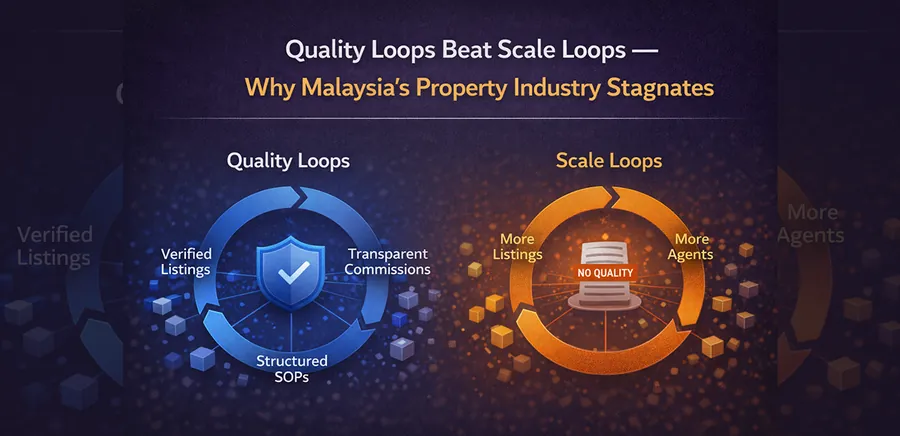
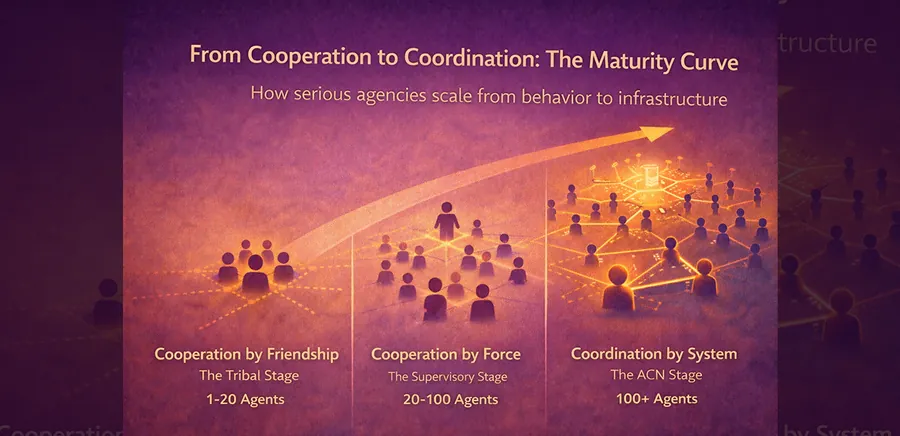
A proper system (like an ACN or a robust ERP) preserves information fidelity, documents intent, and converts trust into a repeatable process. Agents who rely on willpower sell harder; agents who rely on systems compound credibility.
A real estate agent is not a protagonist pushing a deal forward. They are a temporary custodian of power. Their job is not to move property; it is to earn authority, preserve information integrity, and match intent precisely.
Stop trying to be the "main character" of the transaction. Focus on:
Sales techniques matter—but only after delegation exists. Before that, the real work is credibility, reliability, and system design.
That is the architecture of the modern agent.

Founder of ListingMine and author of Agent for Life. Building ERP for Malaysian real estate agencies since 2008 — and writing to reshape how agencies grow.
More about Marvin Foong →More articles in this topic