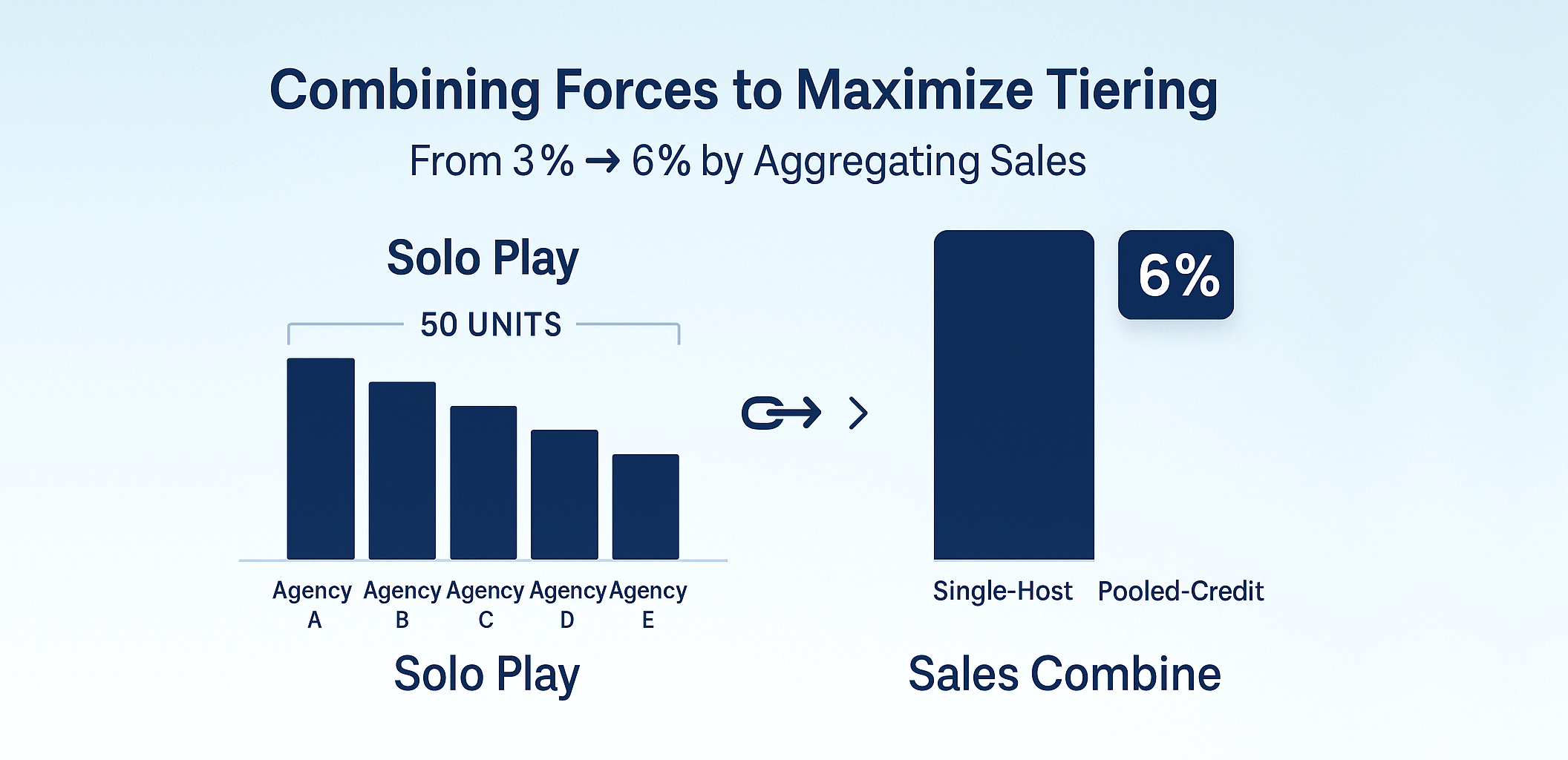
Agencies can improve project commission outcomes by coordinating sales volume to reach better tier structures. Collective strategy can outperform scattered individual selling.
A new launch drops. To “minimize risk,” the developer appoints 4–5 agencies and offers tiering: 3% base rising to 6% at a high target (e.g., 50 units). Competition is supposed to drive sales. In reality, it fragments effort—and most agencies never reach the top tier alone.
Split across multiple appointments, a 50-unit target is steep. A typical outcome:
Everyone remains stuck at 3% while the developer still gets velocity.
Experienced bosses coordinate. They aggregate bookings under one credited channel to cross the top tier, then share the upside privately. The developer sees one high-performing channel; the agencies convert fragmentation into margin.
| Scenario | Units | Rate | Per-Unit | Total |
|---|---|---|---|---|
| Solo (49) | 49 | 3% | RM15,000 | RM735,000 |
| Combined (50) | 50 | 6% | RM30,000 | RM1,500,000 |
Difference: +RM765,000 unlocked by crossing the final threshold. Per unit, moving from 3% to 6% adds RM15,000—a decisive premium worth coordinating for.
“We’re forming a sales pool to hit your top tier within the launch window. You get velocity and simpler reconciliation. Either credit under one code or issue a pool side letter. Apply the top-tier rate to all pool units booked in the window.”
Tiering rewards volume. Cooperation turns fragmented appointments into collective scale—and scale into margin. Combine forces, align counting rules with the developer, and unlock the difference between 3% and 6%.

Founder of ListingMine and author of Agent for Life. Building ERP for Malaysian real estate agencies since 2008 — and writing to reshape how agencies grow.
More about Marvin Foong →More articles in this topic
This article is one of the sources behind this assessment. Take it to see what you already know and what to read next.
Educational self-assessment. Not a licensing examination or professional certification.