From Founder-Led to Framework-Led — The Inevitable Evolution of Sustainable Leadership
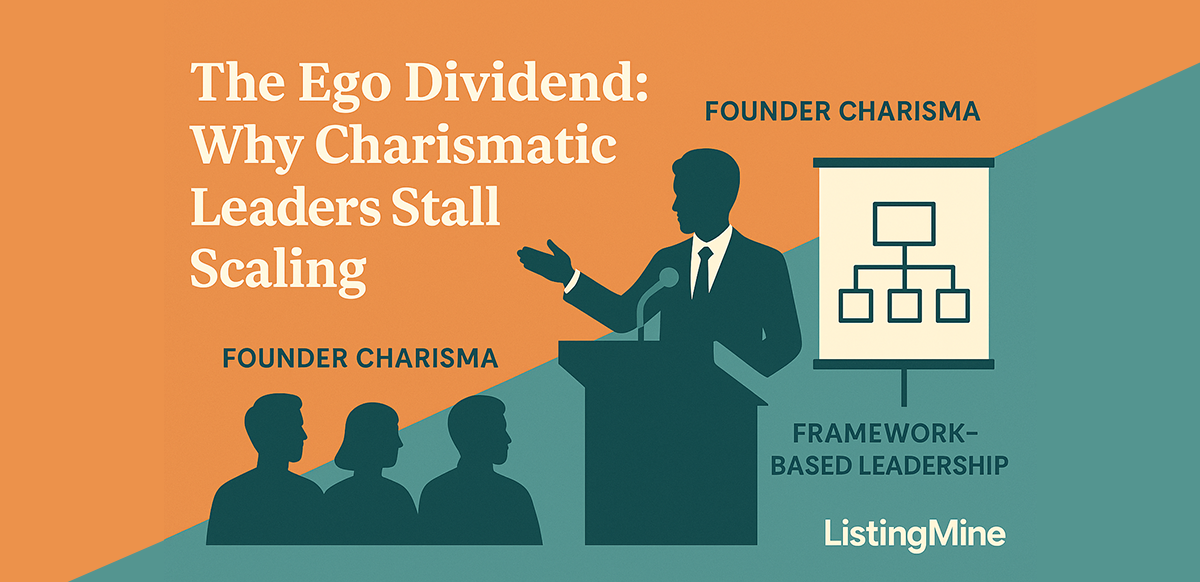
Charismatic leaders can attract people but also become the bottleneck when everything depends on personality. Scaling requires systems that outlive charisma.
In the early phase of any startup or agency, charisma is rocket fuel. The founder’s energy, confidence, and vision attract talent, clients, and investors. Decisions are fast because they all flow through one person. But over time, this same centrality becomes the bottleneck. The business doesn’t scale—it clones.
Every process, pitch, and problem-solving style reflects the founder’s personal rhythm. Team members stop thinking independently; they start guessing what the founder wants. When that happens, the company’s growth curve bends downward—not because the market changes, but because the organization can’t function without its original spark plug.
This is the Ego Dividend: short-term speed and alignment gained through charisma, paid for with long-term scalability debt.
| Dimension | Founder-Led Energy | Framework-Led Energy |
|---|---|---|
| Decision-making | Intuitive, fast, emotional | Data-driven, consistent, teachable |
| Motivation | Loyalty to the leader | Belief in the mission and system |
| Communication | One-to-many inspiration | Many-to-many synchronization |
| Accountability | Based on personal trust | Based on transparent process |
| Risk | Dependency on one person | Distributed resilience |
In the founder-led phase, leadership feels magnetic. In the framework-led phase, it feels boring but repeatable. And that’s the point—boring is scale.
Many charismatic founders unconsciously design their companies to orbit around themselves. They mistake emotional connection for operational control. But charisma is not a system—it’s a signal. It inspires belief, but belief without structure becomes chaos.
The longer this continues, the more fragile the organization becomes:
The result? The founder must work harder just to maintain the same output—a treadmill of diminishing returns masked by applause.
The inflection point of maturity comes when the leader stops asking,
"How do I get everyone to think like me?"
and starts asking,
"How do I design a system that thinks without me?"
Framework-based leadership replaces personality with predictability:
This shift doesn’t erase charisma—it institutionalizes it. The founder’s original vision becomes embedded into repeatable workflows, policies, and rituals that can scale without emotional exhaustion.
Transitioning from charisma to framework requires humility. It’s not about suppressing ego—it’s about redeploying it. The real test of greatness isn’t whether the company grows because of you, but whether it grows without you.
The founder’s new job becomes architecting culture, not directing behavior. To trade ego dividends for system dividends is to build something that outlives your energy—and that’s the mark of a true builder.
Charisma starts revolutions. Frameworks build civilizations. A founder who understands both creates organizations that endure beyond their own personality gravity.

Founder of ListingMine and author of Agent for Life. Building ERP for Malaysian real estate agencies since 2008 — and writing to reshape how agencies grow.
More about Marvin Foong →More articles in this topic
This article is one of the sources behind this assessment. Take it to see what you already know and what to read next.
Educational self-assessment. Not a licensing examination or professional certification.