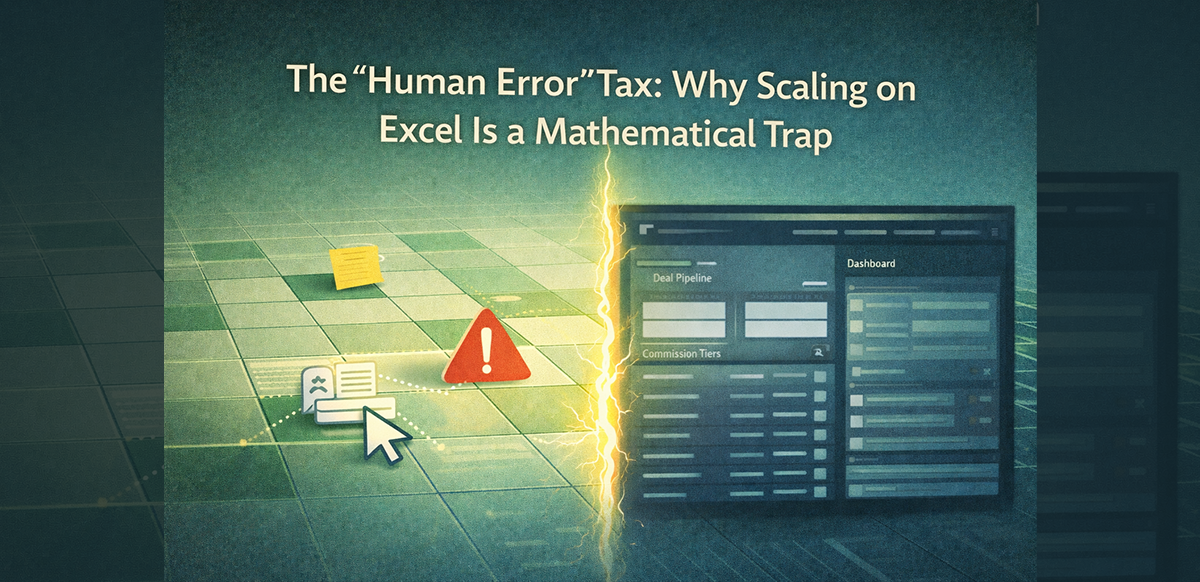
Excel-based scaling creates hidden error costs through manual entry, formula mistakes, duplicated work, and weak audit trails. Even half-ERP workflows remain fragile when critical calculations still depend on spreadsheets.
In the early days of an agency, Excel feels like a miracle. It absorbs every creative commission split, every “special” override, every one-off exception. It bends instantly to founder intuition. Nothing else comes close.
But the very property that makes Excel powerful at small scale is what makes it lethal at large scale. In a spreadsheet, flexibility is permission to be wrong. As an agency grows from 10 to 100 agents, error does not increase linearly—it compounds. What begins as a manageable mess becomes systemic fragility.
Excel survives in the property industry not because principals are backward, but because Excel allows something most systems don’t: Real-time thinking. Every master spreadsheet is a living record of:
The spreadsheet is not “messy.” It is compressed intelligence. The problem begins when Excel stops being a scratchpad and becomes the source of truth. At that moment, the Human Error Tax is born.
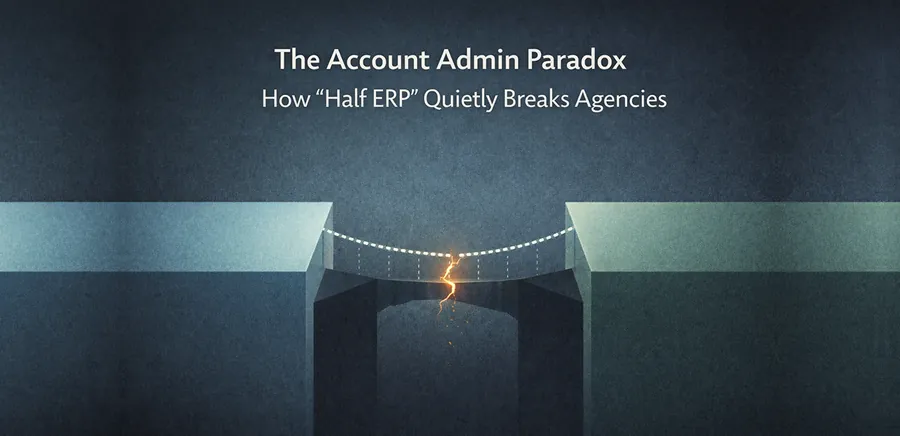
Many agencies believe they have already moved beyond spreadsheets. They use an ERP for deal registration, agent profiles, and basic reporting. But when it comes to the most sensitive logic—commissions, overrides, special cases—the reality is always the same: “Export to Excel first.”
This creates what most agencies actually run on today: Half ERP + Half Excel. This is not a hybrid system. It is still Excel. Because the source of truth remains manual.
The moment a workflow requires exporting data, manual adjustment, and copy-pasting, the system has lost authority.
Which means formulas can break, links can drift, and history can be overwritten. From a risk perspective, nothing has changed. You have simply added a modern UI on top of a spreadsheet. The question is no longer, “Can the system fail?” It becomes: “When will the human fail?”
Excel does not usually fail spectacularly. It fails quietly through undetected correctness drift. Three failure modes dominate at scale:
A mature commission spreadsheet is a dense web of linked cells. A principal adjusts a single override percentage in a hidden tab. They don't realise that cell feeds multiple project sheets and downstream reports.
The Error: One digit changed in a dependency cell.
The Result: 40 agents are underpaid by 2% for six months.
The Scale Tax: RM80,000 in back-pay—and irreversible trust loss with top producers.
As volume increases, admins copy-paste rows to save time. Those rows often contain one-off bonuses or special-case formulas.
The Error: A “special” formula is duplicated into a normal deal.
The Result: An agent receives a bonus they were never entitled to.
The Scale Tax: Ongoing monthly leakage—invisible and compounding. Because totals still “look right,” the error survives for years.
Excel has no memory. When you overwrite a cell, the past disappears.
The Error: A principal updates a master split from 70/30 to 80/20.
The Result: The spreadsheet now believes history was always 80/20.
The Scale Tax: Audits become impossible. Truth becomes negotiable. You've lost institutional memory.
Assume an admin has a 1% error rate — unrealistically good for manual data work.
At scale, error is not a risk; it is a certainty. You are no longer managing operations. You are managing a statistical certainty of failure.
Most principals attempt to solve this with moral pressure: better admins, double-checks, and approval layers. This is a Stage-2 mistake. No human can defeat combinatorial error at scale. The problem is not people; the problem is the environment.
Ask yourself: “If I lock my Excel file today, can my business still run correctly tomorrow?” If the answer is no, you are still running on Excel—regardless of how modern your ERP looks. As long as overrides are calculated outside the system, human error remains mathematically inevitable.
| Excel World | System World |
|---|---|
| The user is the system. | The system contains the logic. |
| If the user errs, the truth is wrong. | Users provide inputs, not rules. |
| Formulas are destructible. | Formulas are hard-coded and validated. |
| History is overwritten. | History is preserved (Audit Trail). |
ListingMine exists because scale breaks humans. We do not replace your logic; we freeze it.
There is no “final Excel check” because when Excel is gone, the Human Error Tax disappears with it. A scalable agency is not one with better people. It is one with logic that no longer depends on them.

Founder of ListingMine and author of Agent for Life. Building ERP for Malaysian real estate agencies since 2008 — and writing to reshape how agencies grow.
More about Marvin Foong →More articles in this topic
This article is one of the sources behind this assessment. Take it to see what you already know and what to read next.
Educational self-assessment. Not a licensing examination or professional certification.