ACN can either expose illegal practice or absorb informal market activity into structured rules. The outcome depends on governance, compliance, and role design.
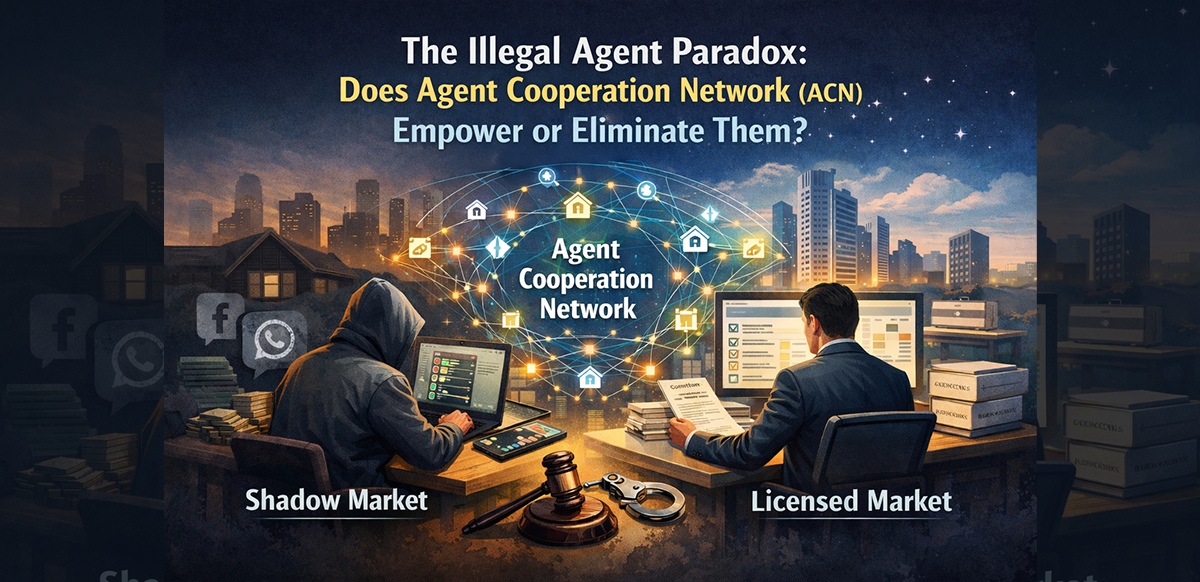
A persistent challenge in the Malaysian property market is the presence of the professional illegal agent.
These are not amateurs. They are often sophisticated, high-performing operators who deliberately opt out of registration with the Board of Valuers, Appraisers, Estate Agents and Property Managers (BOVAEP), viewing Act 242 compliance as an administrative burden with no clear competitive upside.
In a fragmented market, this decision creates an invisible advantage. They deploy professional scripts and polished media while avoiding the overhead of regulatory fees, audits, and professional indemnity insurance.
The question is unavoidable: Does a neutral Agent Cooperation Network (ACN) empower these unlicensed professionals — or does it accelerate their obsolescence?
Enforcement under Act 242 is inherently reactive and resource-constrained. The shadow market thrives in environments that are noisy, ephemeral, and difficult to reconstruct—WhatsApp messages, verbal arrangements, and deleted social posts.
The core issue is not intent. It is observable.
An Agent Cooperation Network (ACN) shifts coordination from informal chatter into structured, timestamped activity. This creates the Strategic Paradox:
If an illegal agent uses the ACN to scale, they are effectively building a persistent record of the exact evidence needed to shut them down. If they don't use it, they stay stuck in the slow, manual "Shadow Market" while licensed firms use the ACN to move at 10x the speed.
To compete on efficiency, the illegal agent must accept visibility. To preserve invisibility, they must accept stagnation. An ACN does not accuse or enforce. It simply makes scale and opacity incompatible.
Banks, law firms, and insurers do not need to integrate directly with agencies to shape outcomes. They operate under internal risk frameworks designed to minimise exposure to money laundering, negligence, and reputational damage.
From that perspective, the distinction is structural:
As coordination in the market becomes more standardised through ACNs, institutions naturally gravitate toward lower-risk interaction paths. This is not loyalty to regulation; it is economic self-preservation. In such an environment, continuing to rely on opaque, unlicensed sources becomes an increasingly fragile choice when structured alternatives exist.
Coordination at scale requires more than goodwill. It requires enforceability. Licensed professionals operate with a legal floor: documented mandates, defensible commission agreements, and formal dispute resolution mechanisms.
The illegal agent operates without that floor. As their network grows:
Growth in an informal system does not reduce friction. It amplifies it. This is not a legal argument; it is an operational one.
An ACN does not police the market, nor does it certify legality. What it does is convert a legal distinction into a hard economic boundary.
| Dimension | Professional Illegal Agent | Professional Licensed Agent |
|---|---|---|
| Trust Basis | Personal, fragile | Systemic, repeatable |
| Recourse Path | Informal / social | Institutional / legal |
| Risk Profile | Escalates with scale | Contained by structure |
| Coordination Cost | Rises non-linearly | Collapses with scale |
| Longevity | Opportunistic | Durable |
The software does not enforce this outcome. Mathematics does.
Does an ACN empower illegal agents — or eliminate them? In the short term, it improves coordination for everyone. In the long term, it functions as a selection mechanism.
Not by banning. Not by policing. But by making scale mathematically incompatible with opacity.
An ACN does not fight the illegal agent. It makes the licensed, disciplined model so much more efficient that the shadow model collapses under its own constraints. The market moves toward legality not through moral reform, but through the inevitability of superior unit economics.

Founder of ListingMine and author of Agent for Life. Building ERP for Malaysian real estate agencies since 2008 — and writing to reshape how agencies grow.
More about Marvin Foong →More articles in this topic
This article is one of the sources behind this assessment. Take it to see what you already know and what to read next.
Educational self-assessment. Not a licensing examination or professional certification.