REN freedom has hidden costs such as marketing, transport, time, failed deals, and unstable income. Agents must calculate the real cost before assuming independence is free.
Why most new agents overestimate their freedom and underestimate their real cost of independence
Ask any aspiring real estate negotiator (REN) why they joined the industry, and the answers sound familiar:
But freedom has a price tag — one that most new agents never calculate. Behind the flexible hours and commission dreams lies a hidden salary that every REN pays in the form of risk, delay, and self-financed opportunity cost.
Freedom, in real estate, is not free.
When you become a REN, you don’t earn a salary — you buy time with your own money until your deals mature.
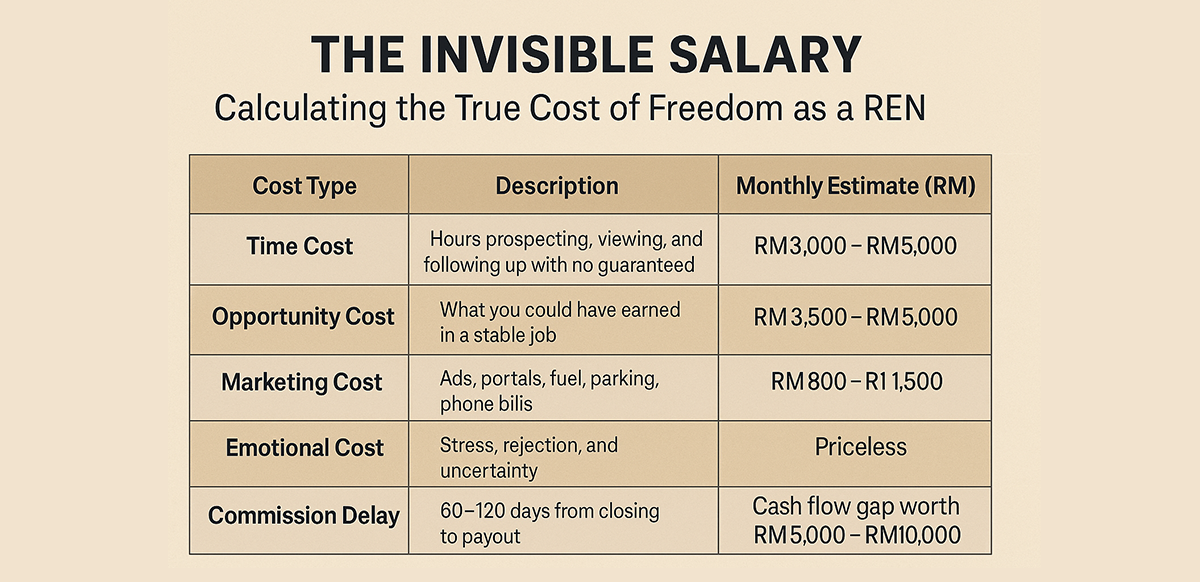
Let’s break down the invisible salary you pay in your first year:
| Cost Type | Description | Monthly Estimate (RM) |
|---|---|---|
| Time Cost | Hours prospecting, viewing, and following up with no guaranteed income | RM3,000–RM6,000 |
| Opportunity Cost | What you could have earned in a stable job | RM3,500–RM5,000 |
| Marketing Cost | Ads, portals, fuel, parking, phone bills | RM800–RM1,500 |
| Emotional Cost | Stress, rejection, and uncertainty | Priceless |
| Commission Delay | 60–120 days from closing to payout | Cash flow gap worth RM5,000–RM10,000 |
In total, you’re effectively investing RM10,000–RM15,000 per month before earning your first stable commission. That’s your invisible salary — the price you pay to own your freedom.
Most new RENs assume their capital is cash. It’s not. It’s time.
Each day spent learning, waiting for clients, or chasing prospects is an investment. But few agents calculate their hourly ROI.
If you spend 8 hours a day for 30 days (240 hours) and close one deal that nets RM6,000, your effective hourly rate is RM25/hour — before expenses.
That’s lower than many entry-level jobs. But most RENs won’t realize it because they confuse busyness with productivity.
The only way to flip that equation is to compound your skill per hour — to make every action more valuable than the last.
The difference between agents who survive and those who quit is how they define ROI.
When you invest time in financial literacy, digital marketing, and negotiation psychology, your ROI compounds because every future hour becomes more valuable.
That’s why top agents earn exponentially more within the same 24 hours — not because they work harder, but because their skill per hour has higher yield.
Freedom only becomes profitable when your skills outperform your expenses.
Every REN goes through three financial stages:
The trap is quitting before your skill compounds. The reward is crossing the invisible line — when your “salary” finally pays you instead of the other way around.
Being a REN is not an escape from employment — it’s a promotion to entrepreneurship. You’re no longer selling time for money; you’re investing time for equity in yourself.
But that equity only grows when managed like a business — with budgets, systems, and discipline.
So before you celebrate your freedom, ask yourself:
Because in real estate, freedom isn’t free — but it can become priceless if you learn how to earn it.

Founder of ListingMine and author of Agent for Life. Building ERP for Malaysian real estate agencies since 2008 — and writing to reshape how agencies grow.
More about Marvin Foong →More articles in this topic
This article is one of the sources behind this assessment. Take it to see what you already know and what to read next.
Educational self-assessment. Not a licensing examination or professional certification.