Agencies need clear rules to stop cultural drift, poor practices, and repeated small compromises. Anti-drift discipline protects long-term survival.
Every high-performing agency needs an invisible threshold—a line that, when crossed, automatically triggers discipline. In engineering, this is a kill switch: the instant power cutoff when the system detects a critical fault. In business, most agencies fail to install one.
When numbers slip, people improvise. When targets drift, everyone argues. And before long, the agency culture itself drifts—from accountability to excuses.
A Kill Switch Culture prevents this drift. It defines what stops first when performance declines—not to punish, but to preserve clarity, focus, and integrity.
Drift rarely starts with big mistakes. It begins with small, seemingly harmless permissions:
Each small compromise compounds. Slowly, the agency stops being a reliable system and becomes a collection of personal stories. When emotion replaces evidence, metrics lose meaning. Anti-drift rules exist to freeze that slide before it becomes institutional culture.
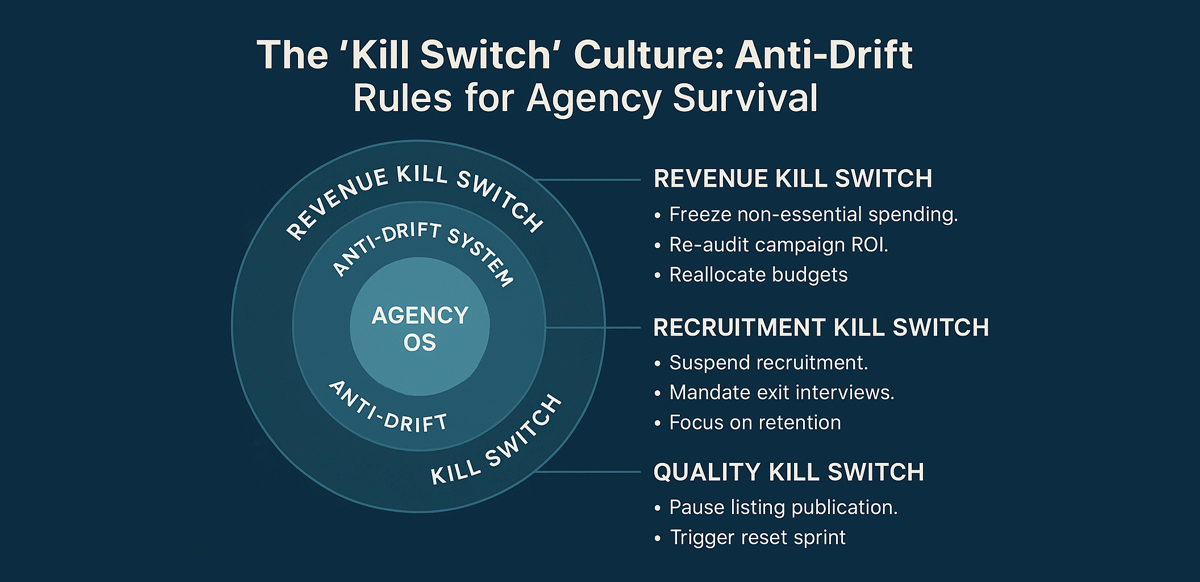
A mature agency defines three automatic "kill zones"—clear triggers that deactivate comfort, not creativity.
If the agency misses core revenue targets for two consecutive months:
Rule: You cannot spend your way out of a data problem.
If agent attrition exceeds new agent growth (net negative headcount):
Rule: Never pour water into a leaking bucket.
If co-broking conflicts, client complaints, or compliance flags exceed tolerance limits:
Rule: Speed never outranks trust or compliance.
A Kill Switch Culture isn't emotional—it’s architectural.
A modern Agency OS embeds these anti-drift rules as automated triggers:
These digital guardrails protect focus, discipline, and truth when human motivation fluctuates.
Leaders often fear automation because it feels like losing flexibility. But real flexibility isn't chaos—it’s structure that enables fast recovery.
A Kill Switch system builds certainty:
This eliminates politics and blame. It transforms "Why did you stop this?" into a collective understanding: "We all agreed this is what happens when X occurs."
Every agency wants growth, but few prepare for drift. The question isn't whether numbers will slip, but what shuts off when they do.
Those who codify their kill switches early will outlast those who manage by emotion and hope. In a world drowning in dashboards, the real KPI is control.
The true sign of control is knowing exactly when to stop.

Founder of ListingMine and author of Agent for Life. Building ERP for Malaysian real estate agencies since 2008 — and writing to reshape how agencies grow.
More about Marvin Foong →More articles in this topic
This article is one of the sources behind this assessment. Take it to see what you already know and what to read next.
Educational self-assessment. Not a licensing examination or professional certification.