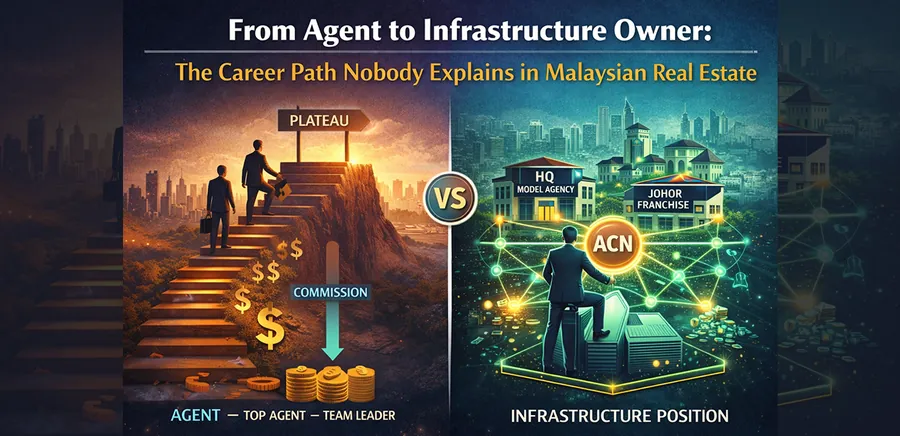
Retail agents may hit a leverage ceiling if they rely only on personal transactions. Corporate real estate can offer larger opportunities, but requires different skills and structure.
Most retail agents avoid corporate real estate for one reason: they assume it is harder than residential.
Too complex.
Too corporate.
Too difficult to break in.
Too hard to find tenants.
This belief keeps agents locked in the highest-effort, lowest-leverage segment of the industry. In reality, corporate real estate is not harder. It is more structured, more professional, and exponentially more leveraged. Once the emotional noise of retail is removed, corporate transactions often become simpler—not more complicated.
Any serious comparison must start with the right benchmark. This is not a comparison between corporate leasing and residential rental. Residential rental commissions are too small to represent a sustainable business model for senior agents. The correct comparison is:
Corporate leasing or corporate transactions versus Retail residential subsale
That is where retail agents invest their time, energy, and emotional capital. And this is where the leverage gap becomes undeniable.
Corporate lease example
50,000 sf × RM4.50 psf
Monthly rent: RM225,000
Commission (1 month): RM225,000
Retail subsale example
RM1,000,000 house
3% commission: RM30,000
One corporate lease equals 7 to 8 million-ringgit subsale transactions.
One negotiation.
One approval chain.
One closing.
Versus:
The math alone explains why retail agents burn out while corporate agents compound.
The greatest drain in retail is the amateur vendor.
Homeowners are emotional, disorganised, and often irrational.
Documents are missing.
Decisions change.
Timelines collapse.
Commercial buildings are owned by businesses.
They have:
There is no guesswork.
When a tenant is introduced:
Most commercial landlords treat agents as distribution partners, not intruders.
Occupancy is their core business.
They want deals to move.
Retail agents rely on passive prospecting:
Corporate real estate operates on active demand creation.
Tenants are not waited for. They are identified, analysed, and moved.
This is not intuition or luck. It is a systematic process.
A target building or district is analysed deliberately.
Nearby buildings are surveyed:
This information is observable through:
A tenant ecosystem is mapped before any outreach begins.
Companies do not relocate casually.
They move because of friction:
The objective is not to sell space. The objective is to remove friction from operations.
Decision-makers are approached properly:
Communication is done via:
No WhatsApp blasting.
No "PM best price".
No PDPA grey zones.
This is business-to-business problem solving.
Retail transactions usually terminate the relationship.
Corporate relationships extend it.
Renewal → commission
Expansion → commission
Relocation → commission
Clients do not disappear for ten years. They evolve—and the advisor evolves with them. Income becomes repeatable, not transactional.
When a company occupies a large space long enough, the conversation matures. Why rent forever?
Owner-occupier purchases follow:
A single corporate purchase: RM80 million building
To match that in retail:
Same transaction value. Eighty times the operational stress.
Why doesn't everyone do corporate? Because corporate filters out tourists. Retail tolerates weak fundamentals. Corporate exposes them.
It requires:
This is not a flaw. It is the moat. While thousands fight over terrace houses, a small group of professionals quietly controls corporate deals.
Retail agents perform the most labour for the least leverage.
Corporate real estate is:
It is not a harder game. It is a bigger game, played with fewer players and better rules.
Once the math is understood, the question is no longer:
"Why corporate?"
It becomes:
"Why are you still doing retail?"

Founder of ListingMine and author of Agent for Life. Building ERP for Malaysian real estate agencies since 2008 — and writing to reshape how agencies grow.
More about Marvin Foong →More articles in this topic
This article is one of the sources behind this assessment. Take it to see what you already know and what to read next.
Educational self-assessment. Not a licensing examination or professional certification.