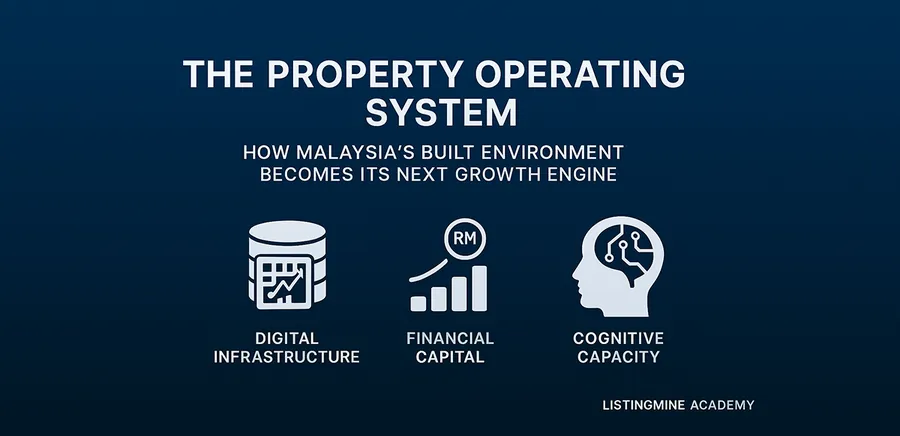
Malaysia’s property industry may shift from speculative thinking toward systems, infrastructure, data, and professional operations. The next decade rewards organized players.
The next ten years will reshape Malaysia's property landscape more than any period since independence.
This transformation won't be led by developers defending the past, or politicians chasing cycles. It will be led by system thinkers who understand one truth: property is no longer an asset — it's an operating system.
For decades, property was treated as a shortcut to riches — a speculation game disguised as investment. The next decade will see it return to its true essence: the physical, cognitive, and economic infrastructure of our society.
Malaysia's last property boom was built on "exam-thinking". The rules were simple and memorized: "buy early," "land never loses value," "location is everything."
That era is over. The exam-thinkers are now prisoners of their own playbook, trapped by the very rules that once gave them confidence.
In the decade ahead, success will not come from what you own, but what you see. The new battleground is not on a balance sheet; it is cognitive. Victory will be defined by "system literacy"—the ability to see how policy, urban design, and technology interact, and to build anti-fragile architectures that feed on uncertainty.
Capital is no longer the main advantage. The cognitive gap is.
In the property market of the 2030s, IQ will matter less than AQ — adaptability quotient.
"The next generation of property leaders won't hunt for discounts—they'll architect the systems that create them."
Property will stop driving the economy — and start powering the new one. As Malaysia shifts from a resource-driven to an innovation-driven economy, capital will hunt for talent, and land is merely the territory where it lives.
The old questions—"How many units?" "What's the psf?"—are obsolete. The new questions are:
Developers who prioritize livability, digital infrastructure, and integrated services (healthcare, mobility, logistics) will lead. Those who just sell square footage will be left holding inventory.
"Location is what you buy. An ecosystem is what you design."
Technology is the weapon of the new architect. It's the tool of asymmetric warfare.
Technology is the great equalizer. It lets small, intelligent teams orchestrate assets with a precision the old empires of capital can't match.
"The most valuable square foot of the future isn't concrete—it's data."
The physics of wealth creation has inverted. The old way was to hold assets and wait. The new way is to orchestrate assets and act.
The new playbook is clear:
The old guard was given a map. The new architect draws the map.
And soon, only those who draw maps will own them.
This shift demands a new kind of professional. The "salesman" is obsolete. The "iron rice bowl" is rusting to dust. The "operator" or "consultant" is the future.
The old agent sold a product.
The new operator sells systemic insight—how a building's data infrastructure lowers costs, how its mobility access creates value, or how its "smart aging" features serve the silver economy.
The property professional of tomorrow is part analyst, part technologist, part economist — a hybrid operator who translates data into design.
In the new economy, your value is not your network; it's your data literacy and your velocity for learning.
"In property, your personal brand will soon be measured by your data literacy—not your car brand."
Those who master data, context, and design will not just sell property — they'll shape how Malaysia lives.
The evolution of Malaysia's property market is the story of its economic maturity.
In the 2010s, property was the dream of the middle class.
In the 2020s, it became the burden of oversupply.
In the 2030s, it will become the living infrastructure of our new economy.
The winners will not be those who simply hold assets. The winners will be the architects who weave these assets into intelligent, living systems: connecting urban planning to human behavior, AI to affordability, and data to decision-making.
Malaysia's next property cycle won't be fueled by hype, but by cognition, structure, and design.
Those who evolve with these forces will build the future. Those who cling to the old playbook will not just be wrong; they will be irrelevant.
"The age of flipping is over.
The age of architecture — and architects of systems — has begun."
The question is no longer what to buy — it's how to build the cognitive infrastructure that lets you see what others can't.

Founder of ListingMine and author of Agent for Life. Building ERP for Malaysian real estate agencies since 2008 — and writing to reshape how agencies grow.
More about Marvin Foong →More articles in this topic