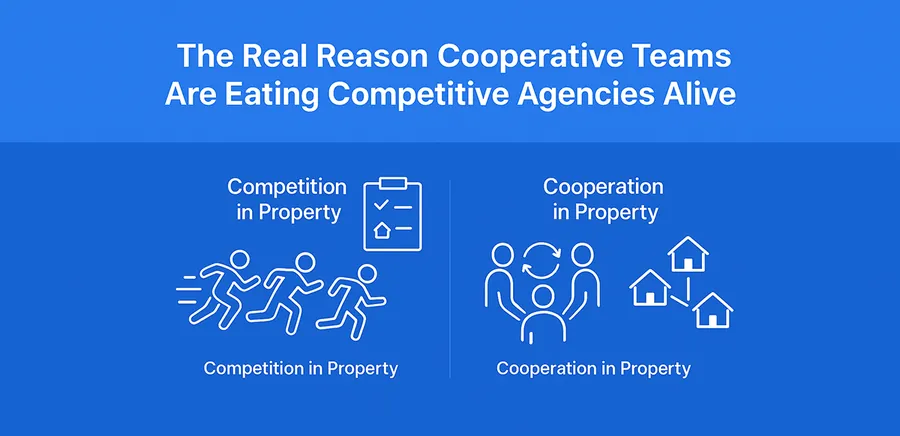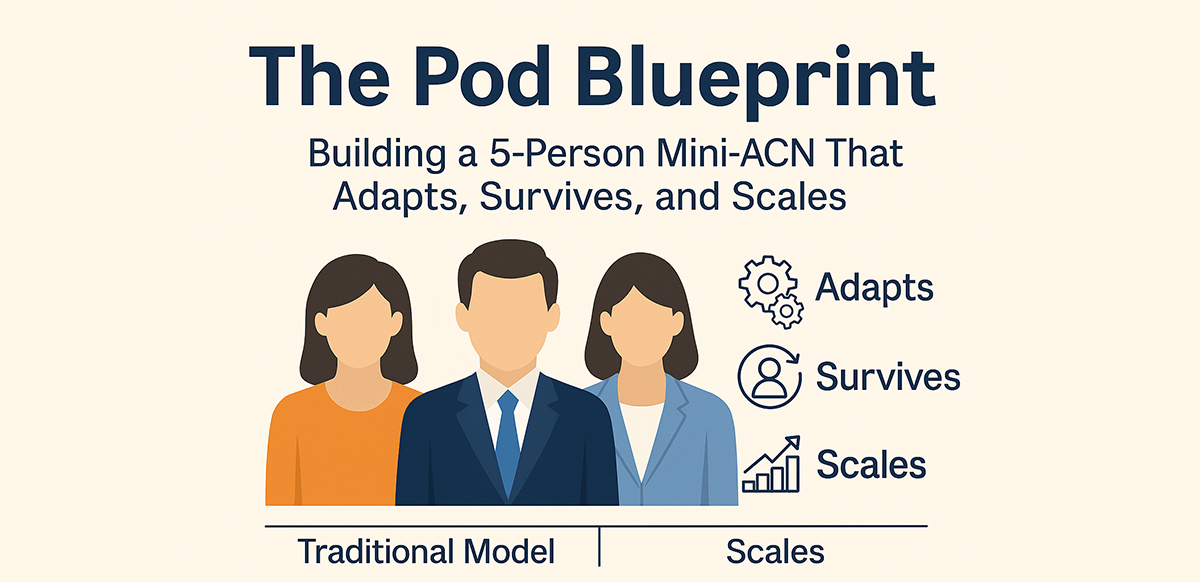
A small pod can divide property work into complementary roles instead of expecting one agent to do everything. Mini-ACN teams make cooperation practical at small scale.
Most property agents don’t fail because they lack effort. They fail because solo economics are hostile. Irregular income. Rising ad costs. Emotional isolation. No margin for error.
The pod model exists to solve one thing clearly: It turns individual survival into shared architecture. A pod is not a “team.” It is the smallest executable unit of an Agent Cooperation Network (ACN). There is no perfect pod. There is only a pod that fits its people and its market.
A pod is not:
A pod is:
Think of a pod as a micro-business, not a hierarchy.
Most effective pods sit between 3 and 6 people. Not because 5 is magical — but because:
The goal isn’t symmetry. The goal is coverage.
The pod fund is not mandatory and not always equal. Its purpose is simple: Convert individual risk into shared infrastructure.
Pods already operating successfully in Malaysia use very different funding structures — and all work.
Structure
Commission Logic (Net Commission Split)
Total: 100% of Net Commission
Nothing is hidden. Nothing is discretionary.
Outcome
All four juniors closed their first deal within 5 months
Zero dropout in 18 months
This pod works because cash, inventory, and execution are all recognised as real contributions — and rewarded precisely.
Pods outperform traditional teams because roles replace rank. Common roles that emerge:
Not every pod has the same skills. And that’s exactly why rigid rules fail. The only mistake is forcing everyone to do everything badly.
This pod demonstrates a principle most agencies still resist: Not all value comes from cash.
Structure
Her contribution: Audience attention.
Others’ contribution: Cash funding, listings, viewings, closing.
Result: Income is allocated by role and output, not bank balance.
Outcome
2024 total GCV ≈ RM42 million
Only 5 people
Every member earned > RM350,000
This is not generosity. It is equity through contribution, not payment.
Most pods fail not because leads are bad — but because rules are vague. Before the first lead arrives, pods decide:
The exact rule doesn’t matter. What matters is clarity before emotion. Uncertainty destroys pods faster than bad markets.
Structure
Commission Logic
Outcome
Average closing cycle reduced from 11 months → 4.5 months
This pod wins through specialisation + role clarity, not scale.
There is no “correct” split.
Pods move between:
As:
The only rule that survives long-term: Commission follows contribution.
Not titles. Not seniority. Not ego.
Pods don’t just reduce cost.
They eliminate three silent killers:
Inside a pod, agents know:
That psychological safety keeps people alive long enough to win.
In the past, pods tried to run on:
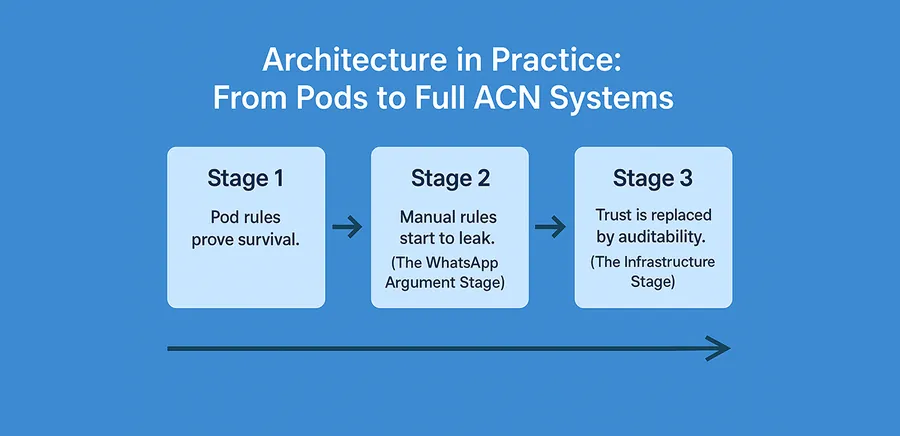
This fails for one reason: Spreadsheets rely on trust. Systems rely on visibility.
Every pod eventually hits the same argument:
“Did you really rotate that lead? Or did you keep it because it looked good?”
Once that question appears, trust decays — even among friends. A proper system replaces trust with audit logs:
When the data is visible, the argument never happens. Politics disappear. Emotion disappears. Only contribution remains.
Pods don’t work because of a perfect formula. They work because they stop pretending real estate is a solo sport. A pod is simply the smallest unit where:
There is no “best pod.” There are only pods that adapt — and solo agents who burn out pretending they don’t need one.

Founder of ListingMine and author of Agent for Life. Building ERP for Malaysian real estate agencies since 2008 — and writing to reshape how agencies grow.
More about Marvin Foong →More articles in this topic
This article is one of the sources behind this assessment. Take it to see what you already know and what to read next.
Educational self-assessment. Not a licensing examination or professional certification.