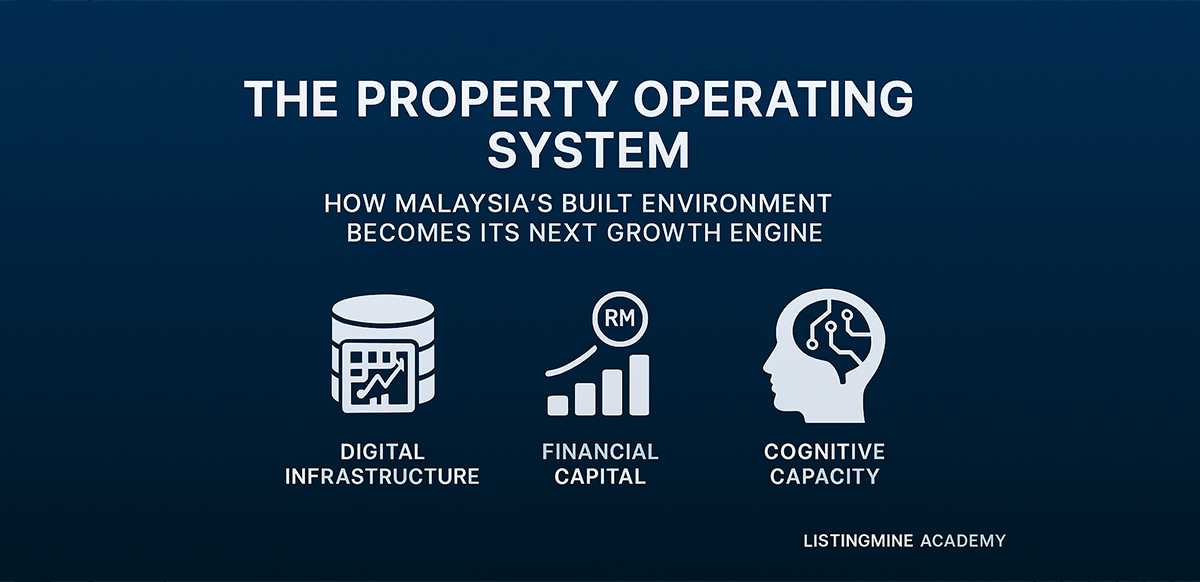
Malaysia’s built environment can become a growth engine when property data, operations, agency systems, and development decisions become more coordinated. A property operating system connects these layers.
Authored by: ListingMine Academy
Lead Researcher: Marvin Foong
Date: November 2025
For half a century, Malaysia’s property market has been driven by construction — buildings as outputs, transactions as milestones, and speculation as strategy. But the foundations of growth have shifted. The new economy runs not on concrete, but on connectivity, cognition, and compliance — and the property industry is quietly becoming the operating system that binds them all. Every listing, every lease, every commission, every audit — these are now data events. Each interaction creates digital infrastructure, forming the base layer of Malaysia’s next growth engine: The Property Operating System (Property OS).
Traditional development created space. The next generation of property creates systems — systems that connect financial data, regulatory records, and human behavior into one living network. In economic terms, Malaysia’s built environment is no longer a passive asset class; it’s becoming an active data ecosystem. Three structural forces are driving this transition:
These forces are transforming property from a lagging indicator of economic growth into its core enabler. “In the next decade, the nation’s physical infrastructure and digital infrastructure will merge — and property will be the convergence point.”
An operating system (OS) doesn’t build hardware — it synchronizes it. Likewise, the Property OS doesn’t replace developers, agencies, or agents; it connects them through verified data, standardized workflows, and shared governance. At its core, the Property OS runs on five interdependent layers:
| Layer | Function | Example System Element |
|---|---|---|
| Data Layer | Verified inventory, transaction logs, digital CP58 issuance | National Property Ledger |
| Workflow Layer | Role-based ERP, ACN cooperation, commission automation | ListingMine ERP |
| Compliance Layer | PDPA / AMLA / BOVAEP audit trails | Timestamped proof systems |
| Finance Layer | Fast-commission ecosystems, receivable tokenization | RCPS yield pool |
| Interface Layer | Consumer portals, analytics dashboards, AI agents | PropertySifu, Academy dashboards |
These five layers together convert fragmented market behavior into a coordinated national platform. “The property market doesn’t need a portal — it needs an operating system.”
The Property OS converts inefficiency into growth. By digitizing and standardizing workflows, it releases three forms of economic energy previously trapped in fragmentation.
We estimate that fragmentation and manual processes currently lock away 15–20 percent of the industry’s potential economic value in dispute resolution, search costs, and compliance overhead. By systemizing the market, that trapped energy is released — transforming friction into productivity. Together, these forces create a multiplier effect — turning a static RM 6 billion commission economy into a dynamic, data-driven ecosystem.
Historically, Malaysia’s GDP has been fueled by manufacturing, commodities, and real-estate construction. But as those sectors plateau, the systemization of property can become the next major productivity wave. Consider the multiplier:
Once connected, these micro-events form a macro-network — the digital nervous system of Malaysia’s economy. In this architecture, property is not just a beneficiary of growth — it becomes the engine that drives it.
The transition to a Property OS cannot be built by policy alone. It requires a neutral, interoperable system that agents trust, agencies can scale with, and regulators can audit. ListingMine’s architecture was designed for precisely this role:
Each component feeds the others — forming the foundation of Malaysia’s distributed Property Operating System. “What Beike achieved in China’s real-estate ecosystem, ListingMine is architecting as a uniquely Malaysian model — leveraging one-tenth the capital for a system designed with ten times the agility for Southeast Asia’s diverse markets.”
No system evolves faster than the people who run it. Malaysia’s next competitive edge lies in cognitive infrastructure — the collective system literacy of its real-estate professionals. Strategic Priorities
This cognitive infrastructure directly fuels the Financial Capital unlocked in Section 3, transforming skilled professionals into high-value system operators. When agents, agencies, and regulators think in systems, not silos, innovation and compliance align naturally. “Digital transformation is not just about new tools — it’s about new cognition.”
The Property OS makes governance proactive instead of punitive. Because every workflow is auditable, trust becomes infrastructure — not bureaucracy. Outcomes
The system creates a self-reinforcing loop: Transparency → Trust → Investment → Growth.
By 2035, property will evolve from a sector into a national platform — synchronizing land, data, and capital. Agents become verified operators. Developers become ecosystem architects. Government becomes the governance layer, not the bottleneck. When every transaction, workflow, and incentive is digitized, property stops being a mirror of the economy and starts being its engine. “Property is not Malaysia’s backdrop — it is Malaysia’s blueprint.”
Malaysia’s next decade of growth will not be driven by resource extraction or speculative cycles. It will be driven by systemization — by turning property from a transaction chain into a cognitive, financial, and technological operating system. The question is no longer whether property will become digital infrastructure. It’s which coalition of visionary institutions, developers, and agencies will step forward to build its architecture — and whether they’ll recognize that the blueprint already exists.
Institutional Attribution:
© 2025 ListingMine Academy • Research Division • All Rights Reserved

Founder of ListingMine and author of Agent for Life. Building ERP for Malaysian real estate agencies since 2008 — and writing to reshape how agencies grow.
More about Marvin Foong →More articles in this topic