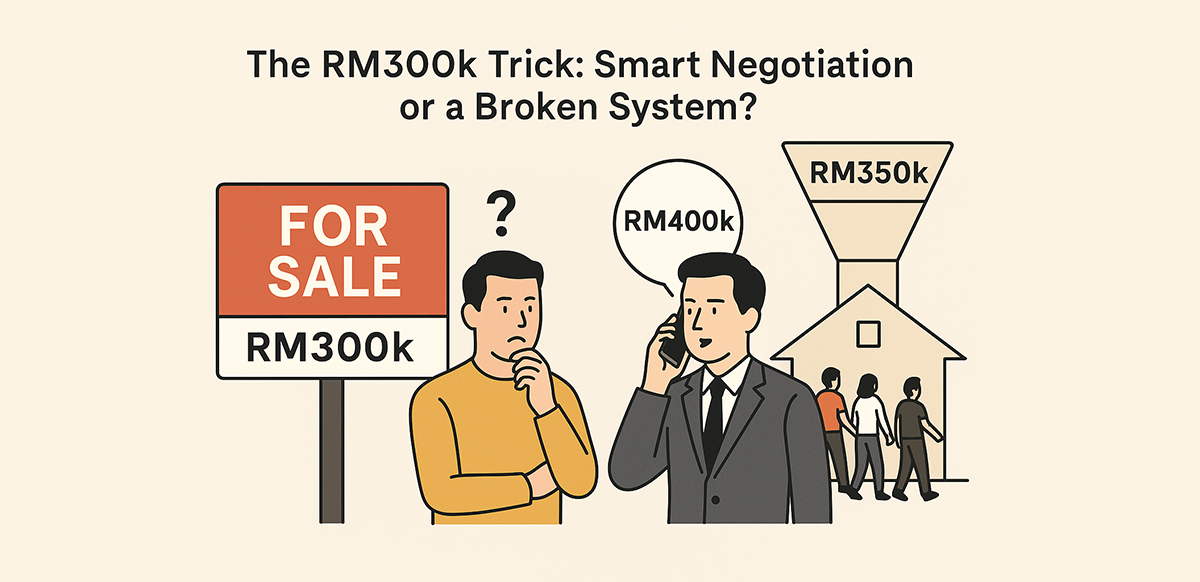
Big price negotiation may look smart, but it can also reveal distorted pricing or weak market structure. Agents need to understand whether the discount reflects skill or system failure.
Below is a real example of how some top-performing agents in Malaysia operate.
It works. It closes deals. And it raises uncomfortable questions about professionalism, ethics, and where the industry is headed.
A homeowner wants to sell his house for RM400,000. That is the market price.
Every similar unit on the property portal is listed at RM400k. Ten pages of listings. Zero differentiation.
The agent knows one thing very clearly: If he lists at RM400k, he will not receive a single call.
Instead of competing in a sea of RM400k listings, the agent publishes the unit at RM300,000.
Immediately, the phone explodes. More than 20 buyers call in a single afternoon.
To each caller, the agent replies with a practiced line:
"Sorry, that specific unit just got sold. But I have your contact now—I'll call you immediately if another deal like this drops."
He doesn't lose these callers. He collects them.
With a list of 20 hungry buyers, the agent contacts the owner. He says:
"I have a keen offer at RM300k. Are you willing to accept?"
The owner is furious. He scolds the agent for bringing such a lowball offer. This is where most agents collapse emotionally. But the experienced ones don't. They use the anger.
The agent calmly replies:
"The buyer is ready to write a cheque right now. Yes or no—what is your absolute lowest price to let this go today?"
The owner snaps back:
"RM370k. That's my bottom. Don't call me with anything less."
The agent waits. Two days later, the same conversation happens again. The "lowest price" shifts: RM370k → RM360k → RM350k.
Once the seller cracks to RM350k, the agent calls back the 20 buyers he collected earlier. He tells them:
"This is the best-priced unit in the entire area. Everyone else is asking RM400k. I've secured this one for RM350k. Viewing is today at 2 PM. First come, first served."
To the buyers, this looks like a steal. They show up together. FOMO (Fear of Missing Out) kicks in. The deal closes.
From the agent's perspective:
The agent convinces himself: "I helped both sides. I bridged the gap. I did my job professionally."
But did he?
This behaviour does not exist because agents are unethical by nature. It exists because the system rewards it.
Agents are rewarded for attention hacking, not transparency. If you tell the truth (RM400k), you get zero calls. If you lie (RM300k), you get a commission. The market incentives are broken.
This exact scenario explains why systems like Beike's ACN exist. A Verified Listing system would require:
An ACN-style structure would:
The goal is not to weaken agents—it is to stop performance from depending on misrepresentation.
The agent in this story is not stupid, lazy, or unskilled. He is simply operating in a system where attention is scarce and governance is weak. So manipulation becomes a survival strategy.
The question is no longer: "Does this work?" It clearly does.
The real question is: "Should the industry continue to rely on tricks—or finally build systems that make professionalism scalable?"
That decision will define the next decade of real estate.

Founder of ListingMine and author of Agent for Life. Building ERP for Malaysian real estate agencies since 2008 — and writing to reshape how agencies grow.
More about Marvin Foong →More articles in this topic
This article is one of the sources behind this assessment. Take it to see what you already know and what to read next.
Educational self-assessment. Not a licensing examination or professional certification.