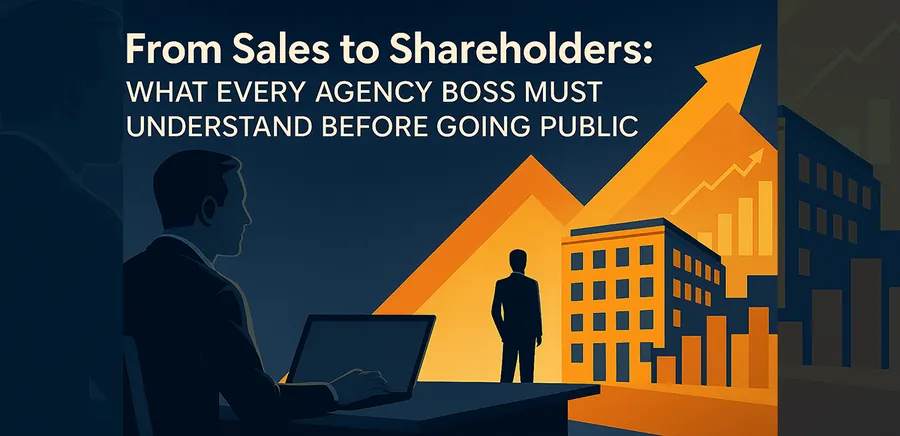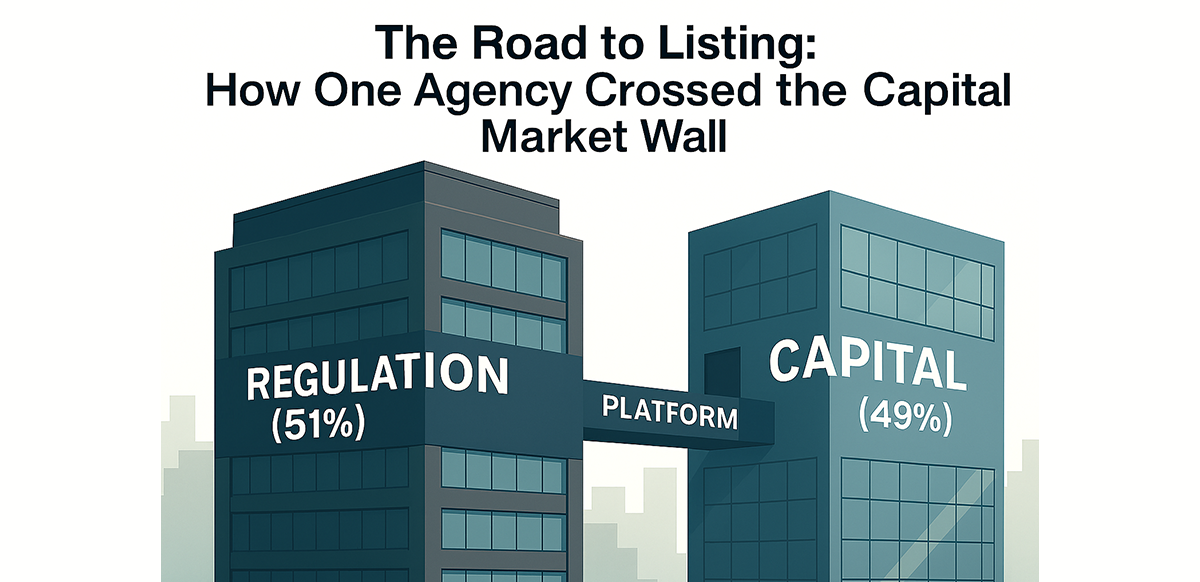
Going public requires more than sales volume; agencies need governance, profit visibility, systems, and investor confidence. Capital markets reward businesses that are measurable and scalable.
ListingMine Academy | Real Estate System Design
For years, every agency boss has dreamt of being the first to get listed.
To finally move from recruiting agents to attracting investors.
To prove that Malaysia’s agency model can scale beyond cashflow — into capital.
But there’s one giant wall in front of everyone:
The 51% Rule.
By law, 51% of any licensed real estate agency must be owned by registered estate agents (REAs).
That single rule has blocked every listing plan before it even starts.
It’s why all the “reverse takeover” dreams collapsed halfway.
You can’t legally inject a licensed entity into a public company — not without breaking the Act.
Yet one agency actually found a way.
The agency didn’t list itself.
Instead, it built a second company — a platform arm.
The licensed agency remained 51% REA-owned, handling commissions, recruitment, and compliance.
The platform company ran all the scalable assets — developer marketing contracts, training systems, CRM technology, ERP data, and revenue-sharing projects.
This second company was clean, auditable, and free from regulatory constraints.
It was the perfect “engine” that investors could safely acquire.
A Bursa-listed developer noticed the model.
Instead of buying the agency (which it legally couldn’t), it acquired a majority stake in the platform company.
Instantly, the ecosystem went public — not the licence, but the infrastructure that powers the licence.
The deal included a multi-year profit guarantee — showing that this was not a speculative PropTech idea, but a real, cash-producing operation built on verified transactions.
Through this move:
Every failed listing attempt before this shared the same mistake — they tried to merge the licence and the capital.
It can’t be done.
This model separated compliance from scalability.
The licensed entity protects the profession.
The platform entity attracts investors.
Both are linked through contracts, not ownership.
That separation created the first legal, repeatable blueprint for agencies that want to go public.
Even if tomorrow the 51 % cap disappeared and agencies could list freely, most would still struggle to attract investors.
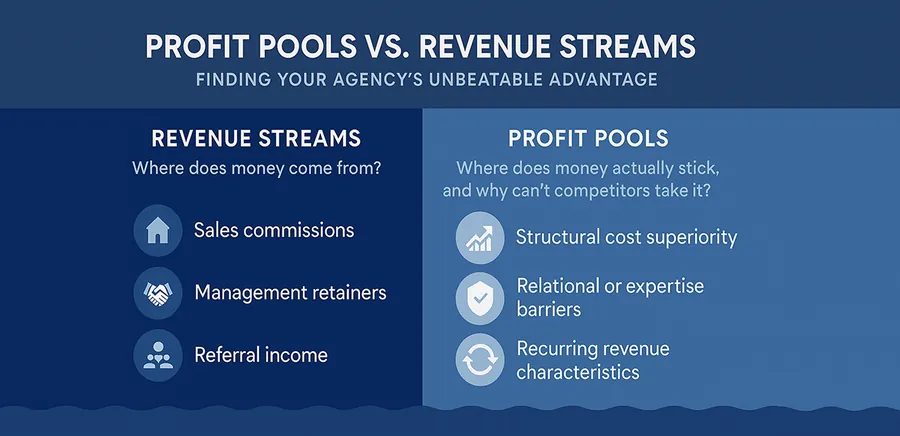
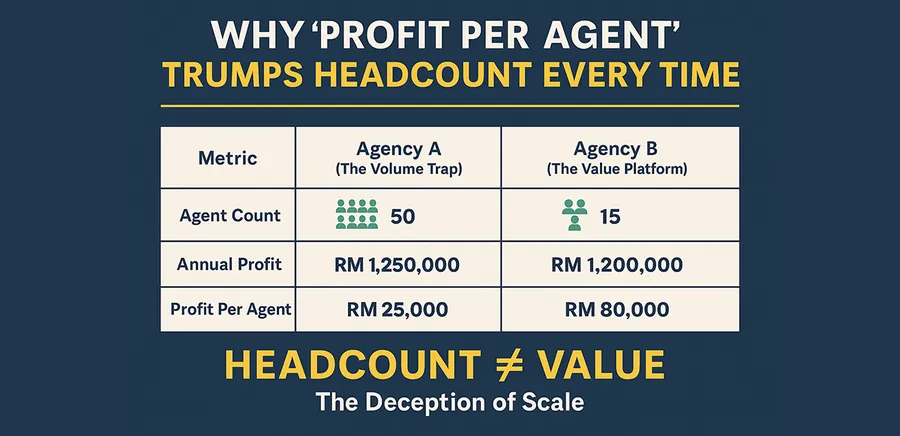
That’s because pure agency businesses don’t command high valuation multiples — their earnings are volatile, leader-dependent, and hard to scale.
In today’s market, a property-agency firm’s price-to-earnings ratio (P/E) rarely exceeds 3× — sometimes less. Investors discount them because commissions fluctuate with sentiment and leadership turnover.
By contrast, a platform-driven structure — with contracts, data, and system revenues — can command multiples of 5 to 10× or more because it represents infrastructure, not manpower.
That’s why separating the licence from the platform isn’t just a legal workaround — it’s a financial strategy. You’re converting a human-based income model into a product-based enterprise that capital markets can value properly.
If you’re building an agency today, don’t just think “more agents.”
Think “dual structure.”
| Layer | Function | Who Can Own It |
|---|---|---|
| Agency (Licensed) | Commission handling, compliance, agent management | 51% REAs |
| Platform (Business) | ERP, data, developer marketing, training, tech IP | Any investor |
With this setup, you can raise funds, partner with listed companies, or even spin off your platform for its own IPO — while keeping your licence fully compliant.
This model quietly proved something powerful:
Malaysia’s property agency industry isn’t small — it’s just structurally locked.
Once the rails are built — systems, audit trails, and compliant separation — agencies can finally attract institutional capital, create shareholder value, and grow beyond recruitment-driven cashflow.
It’s the same formula that ListingMine is now standardizing across ERPs — turning fragmented agency operations into scalable, auditable, federated networks.
The path to listing isn’t about finding an investor — it’s about building a structure they can legally enter.
One agency already showed it can be done.
The next one could be yours — if you build it right from the start.

Founder of ListingMine and author of Agent for Life. Building ERP for Malaysian real estate agencies since 2008 — and writing to reshape how agencies grow.
More about Marvin Foong →More articles in this topic
This article is one of the sources behind this assessment. Take it to see what you already know and what to read next.
Educational self-assessment. Not a licensing examination or professional certification.