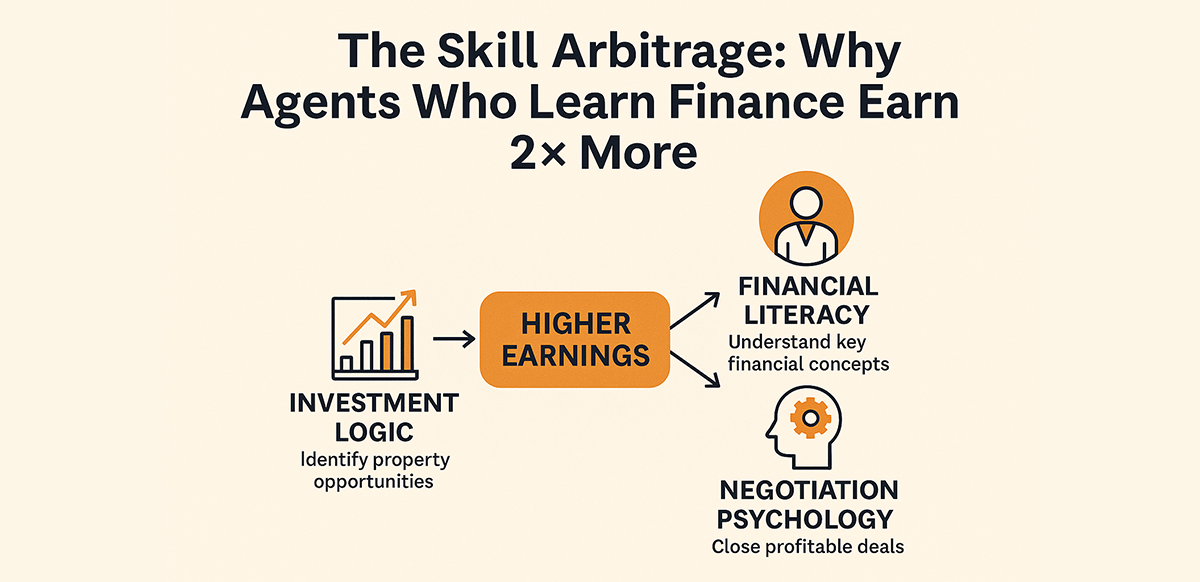
Agents who understand finance can advise buyers better, qualify clients earlier, and handle investment conversations with more authority. Financial skill creates income leverage.
How financial literacy, investment logic, and negotiation psychology converge to create top earners
Most real estate agents are trained to sell. Few are trained to structure. They can describe layouts, amenities, and prices — but when the conversation shifts to yield, leverage, or tax strategy, silence follows.
That silence is expensive.
In every property transaction, the financially literate agent operates on a higher plane. They’re not just selling a home — they’re designing a financial outcome. While others compete on listings and charm, they win on logic.
This is skill arbitrage — when superior understanding of money multiplies the same effort into double the income.
Real estate is not just a physical asset; it’s a financial instrument with cash flow, leverage, and risk layers.
Agents who master finance see through multiple lenses at once:
To clients, these agents stop being salespeople. They become advisors. And advisors earn loyalty, not just commissions.
Clients don’t trust agents because of what they say — they trust them because of how they think. Financially trained agents ask smarter questions:
These aren’t sales questions. They’re fiduciary questions. And they change the client’s perception instantly.
Every transaction becomes a consultation. Every consultation becomes a relationship. That’s why these agents earn 2× more — not from luck, but from layered value.
When an agent learns finance, every listing transforms into a case study:
This level of conversation filters out low-value clients and attracts serious ones — investors, developers, and repeat buyers. They stop chasing leads; leads start chasing them.
That’s the invisible compounding power of skill arbitrage: better clients, higher ticket sizes, and referral velocity that compounds over time.
Finance-trained agents don’t negotiate emotionally. They negotiate structurally. They reframe every price objection in terms of return, not emotion.
Example:
“If this property’s rental yield holds, you’re essentially getting a 5% secured return on leverage. Can you show me any FD or bond giving that?”
That shift turns resistance into curiosity. The buyer feels logical, not pressured. The deal closes itself.
The agent of the future is not just a communicator — they’re a financial interpreter. They translate market noise into structured decision-making.
Learning finance is no longer optional. It’s the difference between selling properties and designing outcomes.
The best agents don’t chase commissions. They manage capital — starting with their client’s, and eventually their own.
Skill arbitrage is the new commission structure. The more you understand money, the more the market pays you for the same effort.
Agents who learn finance don’t just sell faster — they build empires, one spreadsheet at a time.

Founder of ListingMine and author of Agent for Life. Building ERP for Malaysian real estate agencies since 2008 — and writing to reshape how agencies grow.
More about Marvin Foong →More articles in this topic