Competence is not enough when buyers face fear, uncertainty, and major financial risk. Agents need a trust stack built from proof, empathy, clarity, consistency, and protection.
In low-risk purchases, competence is enough. If you are buying a phone cable or choosing a café, you only need to know one thing: Can this work? Price and convenience do the rest.
But property is not a low-risk purchase. It is a high-anxiety decision—financially, legally, and emotionally. In these moments, competence alone does not close the deal. In fact, leading with competence often causes the deal to fail.
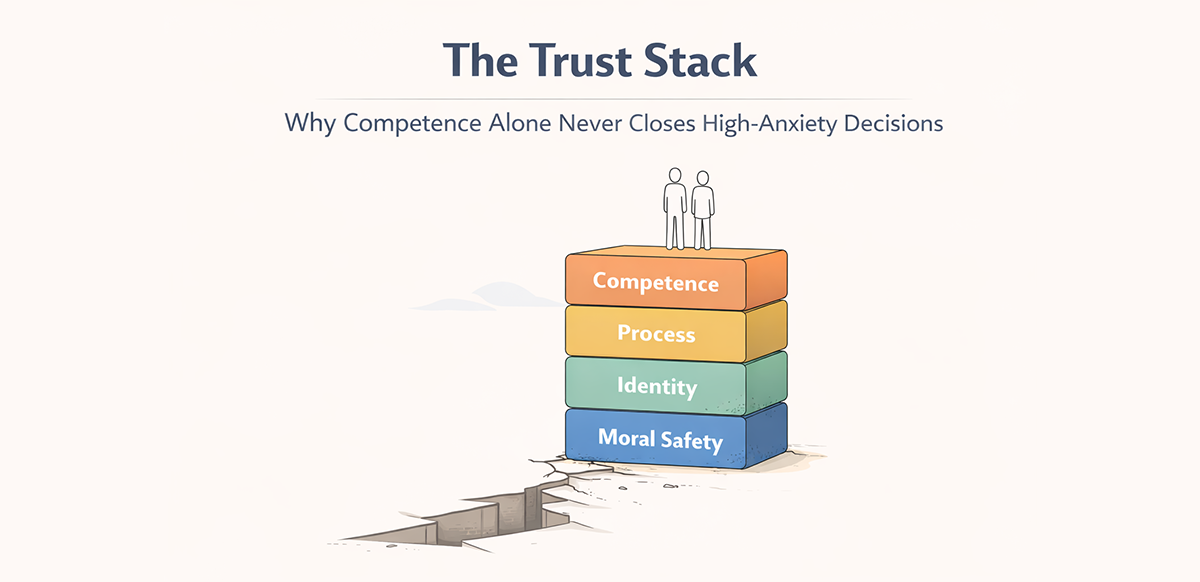
What actually closes the decision is The Trust Stack.
Many agents are genuinely competent. They know the law, the paperwork, and the market history. Yet they constantly hear: “Let me think about it.”
This isn't because the buyer doubts their intelligence. It’s because the buyer’s fear system is still active. When fear is active, the brain does not ask, "Is this person capable?" It asks, “Is this person safe?”
Competence answers the wrong question, too late.
Trust is not a single judgment; it is a stack that must be built in order. If you start at the wrong layer, the entire structure collapses.
Layer 1: Moral Safety (“Will you exploit me?”)
This is the foundation. Before logic or facts, the buyer’s subconscious scans for danger: hidden incentives, pressure tactics, or selective disclosure.
The Shortcut: Observed kindness, honesty under no incentive, and the disclosure of flaws compress trust instantly.
The Rule: Without moral safety, competence feels dangerous.
Layer 2: Identity Alignment (“Are you on my side?”)
Once safe, the buyer looks for shared values and compatible risk tolerance. They need to feel you understand them existentially, not just intellectually.
The Rule: An agent can be competent but misaligned—and therefore rejected.
Layer 3: Process Reliability (“Is there a path if things break?”)
Only now does the buyer care about checklists, timelines, and verification steps. Process tells the buyer there is a path forward even if emotions run high.
The Rule: Process without safety feels like a weapon; process without identity feels like bureaucracy.
Layer 4: Competence (“Can you execute?”)
Competence matters, but it is last, not first. When it appears too early, it triggers skepticism:
"Why are you trying so hard to prove how smart you are? What are you hiding?"
Most agents are trained to lead with Layer 4: credentials, awards, and transaction counts. But the buyer is still stuck at Layer 1, wondering if they are about to be cheated.
This mismatch is why:
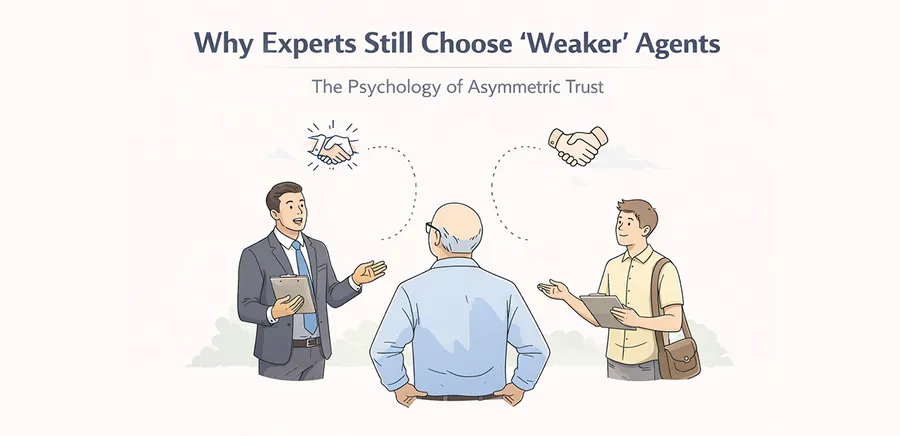
High-Net-Worth (HNW) buyers already understand the math and the law. What they fear is not your ignorance; they fear your intent.
They reverse the usual logic: Competence is assumed; Character is tested.
They often choose slower, less polished agents because:
“I can fix a mistake. I cannot fix a betrayal.”
When the layers are built in order, decision speed increases dramatically. This is Trust Compression. The buyer stops re-checking and shopping around.
They don't just feel "convinced"—they feel relieved.
Trust is not built by stacking facts; it is built by sequencing signals.
Stop asking how to prove you are smart. Start asking how to signal you are safe.

Founder of ListingMine and author of Agent for Life. Building ERP for Malaysian real estate agencies since 2008 — and writing to reshape how agencies grow.
More about Marvin Foong →More articles in this topic
This article is one of the sources behind this assessment. Take it to see what you already know and what to read next.
Educational self-assessment. Not a licensing examination or professional certification.