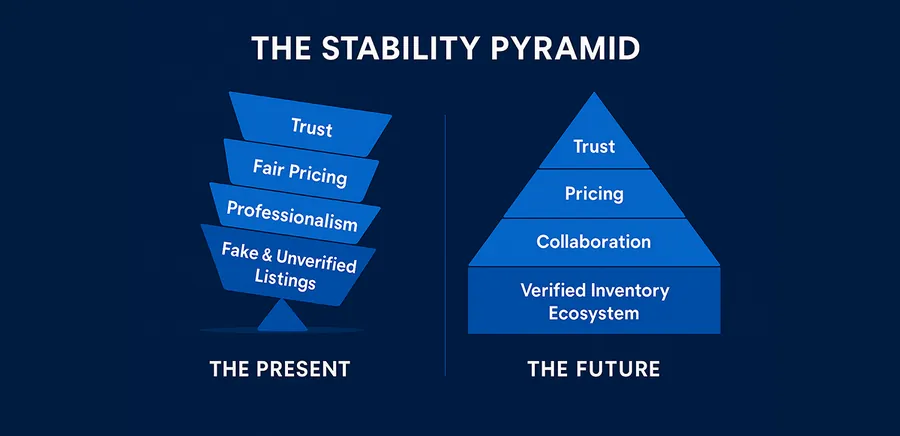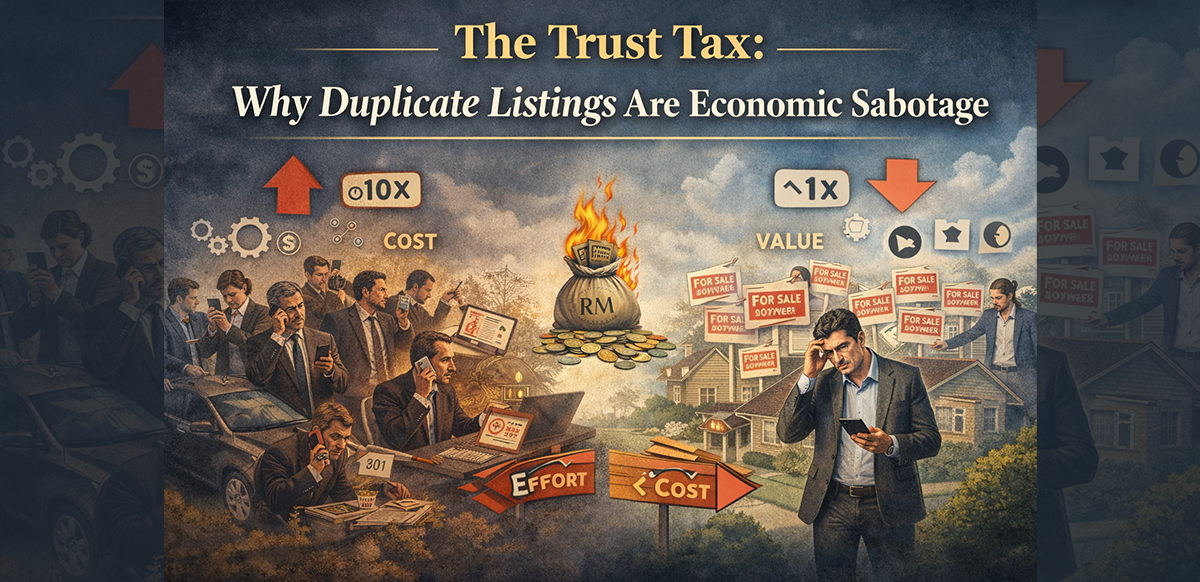
Duplicate listings waste buyer attention, distort market signals, and increase distrust. Better inventory governance reduces the hidden trust tax.
At first glance, ten agents competing for the same listing looks like "healthy competition." In reality, it is a massive, invisible tax imposed on the entire property market.
When agents do not trust each other's listings, the system forces total duplication of effort. This inefficiency is not cosmetic. It is structural. And it quietly burns millions of Ringgit in time, energy, and capital every year.
Assume one seller wants to dispose of a property.
In a low-trust environment, ten agents independently attempt to secure that same listing. Because there is no shared source of truth, each agent must repeat the exact same work:
None of this work creates incremental value. From a systems perspective, the industry expends 1,000 units of effort to generate 100 units of output. The remaining 900 units are pure waste.
This is not competition. It is redundancy.
The inefficiency does not stop with agents. It is transferred directly to the seller. In a fragmented market, sellers are forced to perform unpaid administrative labor to compensate for the industry's lack of trust infrastructure.
They must:
What appears to be "agent choice" is, in reality, cognitive overload. Over time, sellers disengage. Cooperation quality drops. Trust erodes further. The system degrades itself.
Trust is often framed as a moral or cultural issue. That framing is misleading. In market design, trust is cost engineering.
| Component | Under Distrust (Current) | Under Trust (Architected) |
|---|---|---|
| Verification | Repeated by 10 agents | Performed once |
| Content | Multiple low-fidelity sets | One high-fidelity asset |
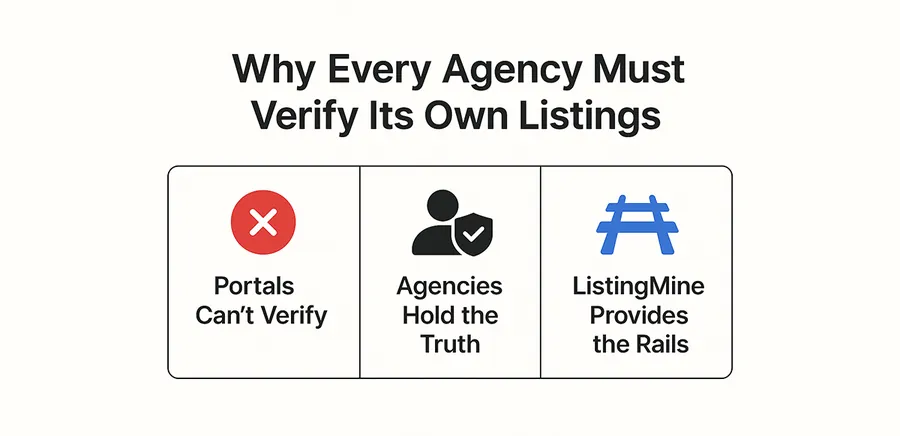
| Information | Fragmented and inconsistent | Single source of truth |
| Cost Structure | High acquisition cost | Low distribution cost |
| Speed | Slow, friction-heavy | Fast, pre-verified |
Distrust forces every agent to rebuild the foundation from scratch. Trust allows the foundation to be reused. The difference is not attitude. It is architecture.
The Malaysian property market does not suffer from lazy agents. It suffers from structural leakage. Without trusted listing infrastructure:
This is why many agents work 12-hour days yet fail to scale. Their energy is consumed paying the Trust Tax, leaving little capacity for high-value advisory work.
The real question is not: "Why should agents trust each other?"
The real question is: "Why is the system designed so that distrust is the only rational choice?"
A functioning market must move from competitive redundancy to collaborative distribution. When the system provides a verified source of truth:
The Trust Tax is abolished. Not through goodwill, but through design. That is how markets scale.

Founder of ListingMine and author of Agent for Life. Building ERP for Malaysian real estate agencies since 2008 — and writing to reshape how agencies grow.
More about Marvin Foong →More articles in this topic
This article is one of the sources behind this assessment. Take it to see what you already know and what to read next.
Educational self-assessment. Not a licensing examination or professional certification.