Malaysian agencies use different training methods, from classroom learning to field coaching and team-based support. Training only works when it connects to real agent activation and daily execution.
A Structural Comparison of Compliance, Capability, Cost, and Long-Term ROI
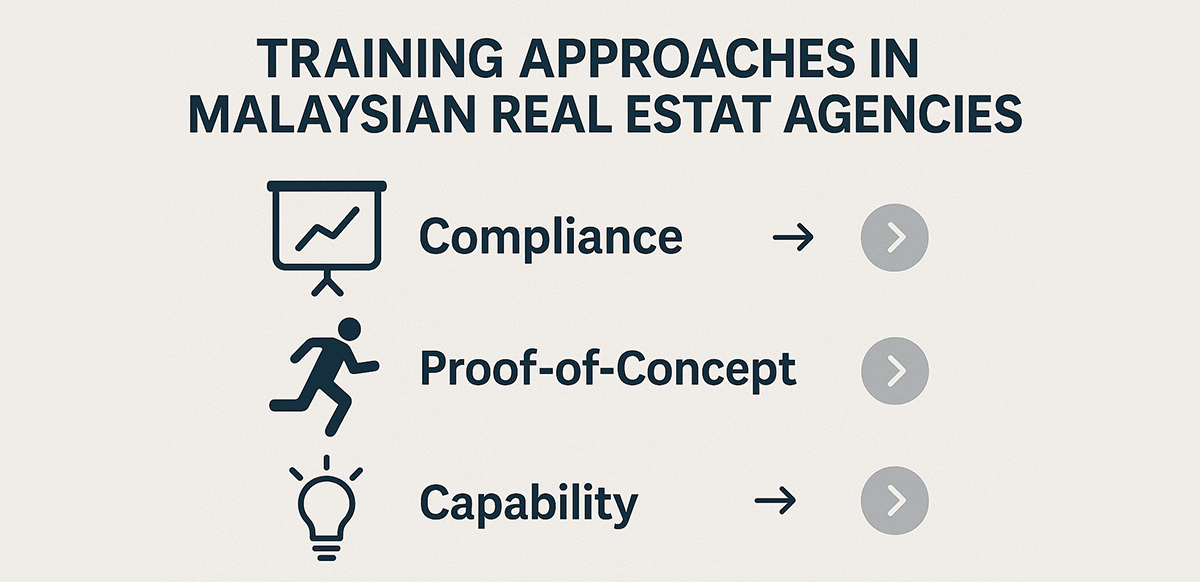
The Malaysian real estate industry has no unified training standard. As a result, agencies adopt wildly different philosophies shaped by: compliance requirements, recruitment costs, fear of churn, short-term economics, and long-term capability goals.
Broadly, these fall into three strategic models:
To evaluate them properly, we analyse them along two dimensions: Compliance vs. Capability and Cost vs. Investment.
"Send them to the NCC course, give them a REN tag, and hope they perform." (The regulatory minimum / the 'Send & Hope' model)
| Metric | Detail |
|---|---|
| Focus | Legal compliance and fast onboarding. The NCC is a 2-day course on The Act & Rules. |
| Why Used | Cheapest and simplest method; rapid recruitment; minimal internal training. |
| Pros | Fastest entry into the market; lowest direct cost per recruit; legally compliant from day one. |
| Cons | NCC only covers compliance, not sales capability; agents are unskilled; extremely high failure and churn; inconsistent client service. |
| Cost | Lowest. RM1k–2k per agent (NCC fee and initial application). |
| Outcome | High volume of agents with low capability. Prioritises compliance, not competence. |
| Strategic Verdict | Suitable only for high-churn, low-expectation firms. |
"No REN tag until you prove yourself. If you can close, we will invest in you." (The cost-saving, sink-or-swim model)
| Metric | Detail |
|---|---|
| Focus | Zero cost until the agent proves they can perform. Filters for grit and persistence. |
| Why Used | Avoids wasting money on agents who quit quickly; reduces the cost of issuing REN tags. |
| Pros | Extremely low initial cost; strong filter for natural sales ability; those who survive often become hard-driving performers. |
| Cons | Highly Illegal: Agents prospecting without a valid REN tag violates Section 30 of the Act. Exposes the firm to BOVAEP fines up to RM300,000 or jail time. Agents develop bad habits due to lack of guidance. |
| Cost | Near zero until agent closes a deal. |
| Outcome | Some survivors perform well. Most fail. Legal risk is catastrophically high. |
| Strategic Verdict | Economically attractive but structurally dangerous. Legality and professionalism cannot be compromised for scale. |
"Mandatory 4–5 day in-house bootcamp + internal exam. Only those who pass will receive REN sponsorship." (The Immersive Academy model)
| Metric | Detail |
|---|---|
| Focus | Building competency, consistency, culture, and long-term agent quality. Training is an investment. |
| Why Used | Desire for predictable output, professional brand, and developing leaders from within. |
| Pros | Highest-quality agents from day one; faster Time-to-First Closing (3–6 months); strong cultural alignment; reduced operational errors & compliance risk; significantly higher retention (70–90%). |
| Cons | High upfront training cost; slower recruitment volume; requires experienced trainers and curriculum development. |
| Cost | Highest upfront (RM4k–12k per agent including trainer time and materials). |
| Outcome | Lower volume but high quality, long-term retention, and predictable production. |
| Strategic Verdict | Superior for agencies that want long-term stability, professionalism, and strong market reputation. |
| Metric | Compliance-Only (NCC) | Proof-of-Concept (No REN) | Capability-First (In-House Bootcamp) |
|---|---|---|---|
| Upfront Cost | Very Low | Almost Zero | High |
| Compliance Risk | Low | Very High | Very Low |
| Agent Skill Level | Very Low | Inconsistent | High |
| Time to First Close | Slow (9–18 months) | Variable | Fast (3–6 months) |
| 12-Month Retention | 15–25% | 50–70% | 70–90% |
| Brand Consistency | Poor | Unpredictable | Excellent |
| Scalability | Easy to recruit | Hard to scale legally | Easy to scale performance |
| Long-Term ROI | Poor | Risky | Excellent |
The Capability-First Model is the only model aligned with long-term agency growth, professionalism, and brand protection.
It wins because it:
Training is not a cost. Training is a capital allocation decision that determines: the agency's reputation, the agency's leadership pipeline, the agency's culture, the agency's long-term revenue stability, and the principal's freedom to scale.
The Capability-First Model is not just better — it is necessary for any agency that intends to become a professional institution rather than a churn-heavy contractor hub. Agencies that lead the market in 2025–2030 will be the ones that treat training as their core competitive advantage.

Founder of ListingMine and author of Agent for Life. Building ERP for Malaysian real estate agencies since 2008 — and writing to reshape how agencies grow.
More about Marvin Foong →More articles in this topic
This article is one of the sources behind these assessments. Take one to see what you already know and what to read next.
Educational self-assessment. Not a licensing examination or professional certification.