Agencies are not always forced to be transparent, but transparency builds trust with agents, clients, and partners. Clear numbers and rules can become a market advantage.
A neutral analysis of how different commission models shape trust, cooperation, and long-term stability in agencies.
In the Malaysian property industry, there is a recurring question: Should agencies be transparent about commissions and project margins — or is it perfectly acceptable to keep everything confidential?
The honest answer:
Both approaches can work.
Both have strengths.
Both have costs.
This article does not argue that transparency is “better” or that secrecy is “wrong.” Instead, it explains the strategic trade-offs — so agency leaders can choose the model that best fits their structure.
There are many legitimate reasons an agency may choose a non-transparent model:
Transparency is not a moral obligation — it is a strategic design choice. Some highly successful Asian agencies run on near-total confidentiality. It works because their branding is strong, their developer supply is stable, and their leaders carry long-term credibility. This model is not “wrong.” It's simply one way to run an agency.
Confidential systems come with hidden operational costs. When commission details are not shared, leaders must actively maintain trust through other mechanisms:
This is the “Trust Tax.” Non-transparency isn't free — it increases the management overhead required to keep agents confident and loyal. Some agencies excel at paying this trust tax. Others struggle because once suspicion enters the system, it compounds quickly.
Ten years ago, agencies could reasonably expect commission structures to remain internal. Today, secrecy is almost impossible because:
Agents are not dumb — they eventually find out the true commission. Not because they are malicious, but because the industry is interconnected.
This is why some agencies adopt controlled transparency: Better agents hear the truth from you — not from someone else. It reduces risk, prevents unnecessary drama, and protects the agency's internal credibility.
Many principals fear: “If I reveal the commission, agents will demand more.” In reality, what agents value most is predictability, not necessarily the highest payout.
Agents can accept 40%, 50%, 60%, or 70% — as long as the structure is clear:
When agents understand the system, they stop guessing. When guessing stops, suspicion stops.
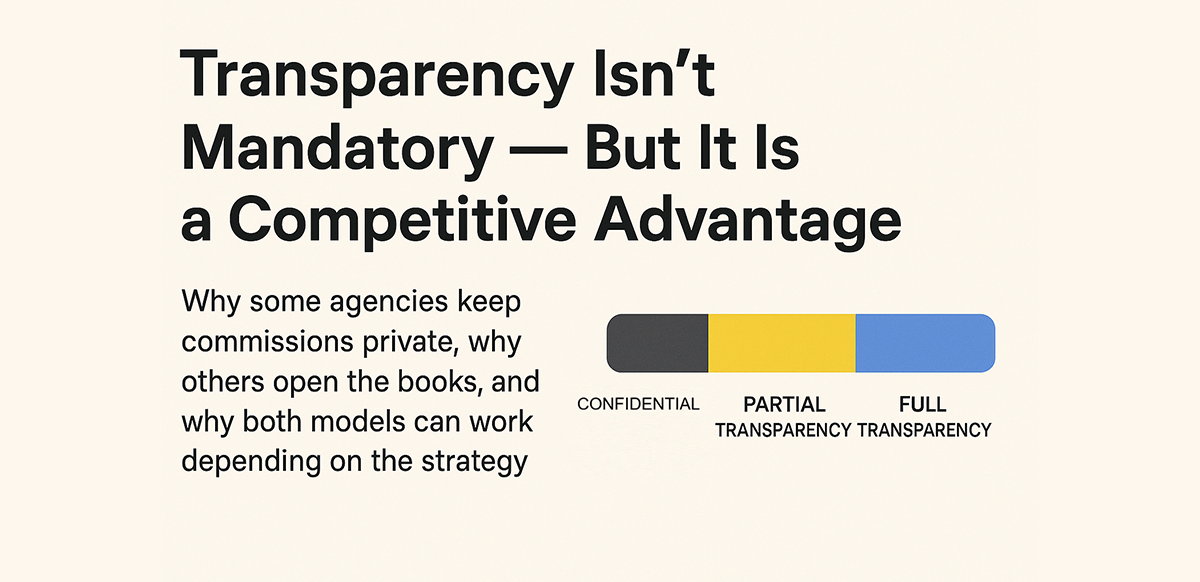
Transparency is not “all or nothing.” Most agencies sit somewhere in the middle.
FULL OPAQUENESS (Traditional Model): Agents only know their own payout. Project margins are confidential.
ROLE-BASED / TIER-BASED TRANSPARENCY: Agents know their percentage and progression path. Project margin is invisible.
PROJECT-LEVEL TRANSPARENCY: Agents know the project commission and the agency retained amount.
FULL LEDGER TRANSPARENCY (ACN Style): Every role, split, and entitlement is visible. Often used in high-cooperation environments.
None of these models are “right” or “wrong.” Each model supports a different agency identity.
ACN (Agent Cooperation Network) separates the transaction into specialized roles: Connector, Closer, Processor. Each role earns differently. Each role depends on the others.
In such environments, transparency prevents:
This is why ACN-aligned agencies naturally gravitate toward transparency — because cooperation thrives when everyone understands the rules.
Many principals privately worry: “If I show the numbers, they'll question my share.” But this fear usually signals something deeper:
Transparency forces a leader to answer the real question: “Why should agents stay?” If the agency can answer this strongly (branding, leads, support, systems), transparency becomes a strength. If the agency cannot, transparency becomes a threat. This is not judgment. It is a strategic diagnosis.
Agencies that choose non-transparency still retain agents through:
Trust has many sources. Transparency is only one of them. The key question is: Does your current model create enough trust for your scale?
Transparency is not mandatory. Confidentiality is not wrong. Each model carries strengths and trade-offs.
Transparency reduces suspicion but forces clarity on value.
Non-transparency protects flexibility but increases the Trust Tax.
Digital transparency makes secrecy harder to maintain.
ACN models gain the most from structured clarity.
But one principle applies to all agencies: Whatever model you choose, it must be strong enough that agents never feel the need to look elsewhere for the truth.
When clarity — full or partial — comes from leadership, trust grows. When clarity comes from rumours or screenshots, trust erodes.
Choose your model consciously. Build trust intentionally. Operate consistently. That is the real foundation of agency stability.

Founder of ListingMine and author of Agent for Life. Building ERP for Malaysian real estate agencies since 2008 — and writing to reshape how agencies grow.
More about Marvin Foong →More articles in this topic
This article is one of the sources behind this assessment. Take it to see what you already know and what to read next.
Educational self-assessment. Not a licensing examination or professional certification.